
Passive real estate investing in Africa has emerged as a compelling strategy for investors seeking exposure to high-growth markets without the operational complexity of property management. Rather than overseeing construction, tenants, or maintenance, investors commit capital to professionally managed real estate ventures and participate in returns generated from rental income and long-term appreciation.
Africa’s relevance in global investment discussions has grown significantly over the past decade. Accelerated urbanization, demographic expansion, infrastructure development, and improving regulatory frameworks are reshaping property markets across the continent. For long-term investors, these structural shifts present an opportunity to participate early in markets that are still relatively undercapitalized compared to mature regions.
This article presents ten structured reasons why passive African real estate investing deserves serious consideration. While the narrative and examples are entirely fresh, the core framework highlights market access, economic momentum, diversification, technology, sustainability, and long-term wealth creation as central pillars of the strategy.
1. Entry Into Underserved Yet High-Potential Property Markets
Passive investing provides a practical gateway into African real estate markets that would otherwise be difficult to access independently. Many cities across the continent are experiencing strong demand for residential, retail, logistics, and hospitality assets, yet local capital supply remains constrained.
Investment vehicles such as listed property trusts, private funds, and structured co-investment vehicles allow individuals to participate in income-generating assets without direct ownership. These models lower capital requirements, reduce administrative burden, and open access to professionally curated opportunities.
Digital investment platforms based in Africa now play a critical role in connecting international capital with local developments. By offering standardized documentation, project disclosures, and centralized reporting, these platforms simplify cross-border participation and remove many historical barriers associated with investing on the continent.

2. Strong Economic Expansion Supporting Real Estate Demand
Several African economies continue to record growth rates that exceed global averages. Cities such as Abidjan, Nairobi, Dakar, and Addis Ababa are benefiting from rising household incomes, expanding service sectors, and increasing domestic consumption.
This economic momentum directly translates into demand for property. Growing middle-income populations require housing, offices, retail centers, healthcare facilities, and entertainment infrastructure. Passive investors benefit by aligning their capital with these long-term demand drivers rather than short-term market cycles.
As industrialization and digital services expand, commercial real estate tied to logistics, data infrastructure, and business services is also gaining prominence. These sectors provide additional avenues for income stability within diversified portfolios.
3. Rapid Urbanization Creating Structural Housing Shortages
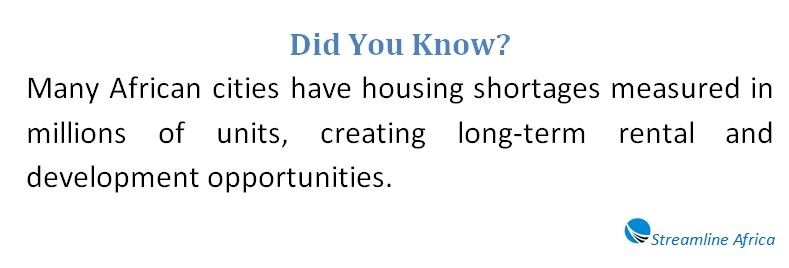
Africa remains the fastest urbanizing region globally. Millions of people migrate to cities each year in search of employment and improved living standards. This demographic shift has created a persistent gap between housing supply and demand.
Passive investors can gain exposure to residential developments designed for urban professionals, mixed-income communities, and rental-focused housing models. These projects often demonstrate resilient occupancy levels due to the underlying demographic pressure.
Urban expansion also drives demand for supporting infrastructure, including shopping centers, schools, healthcare facilities, and transport-linked developments. By investing passively, individuals participate in the broader urban growth story without managing individual properties.
4. Broad Range of Property Sectors Available to Investors
African real estate is not a single-asset story. Investors can allocate capital across multiple segments depending on risk tolerance and income objectives.
Residential developments remain foundational, particularly in growing cities with constrained housing supply. Hospitality assets such as serviced apartments and resort-linked properties benefit from increasing intra-African travel and international tourism. Commercial properties, including offices and retail hubs, support expanding business ecosystems, while industrial and logistics facilities are gaining relevance alongside e-commerce growth.
Passive structures allow investors to gain exposure to several of these sectors simultaneously, reducing reliance on any single revenue stream.
5. Technology Improving Transparency and Investment Efficiency
Technology has fundamentally altered how real estate investments are sourced, evaluated, and managed in Africa. Digital platforms now provide investors with access to project data, financial models, progress updates, and performance reporting in real time.
Virtual property tours, remote document execution, and centralized investor dashboards reduce geographic limitations and enhance decision-making efficiency. For passive investors, this level of visibility significantly improves confidence and accountability.
Emerging applications of distributed ledger technology are also improving title verification, transaction security, and auditability. These advancements address historical concerns around opacity and governance in certain markets.
6. Lower Cost Structures Compared With Active Investment Models
Passive real estate strategies generally carry lower operational costs than hands-on property ownership. Investors avoid expenses related to tenant management, repairs, staffing, and compliance, while benefiting from economies of scale achieved by professional operators.
Fee structures in pooled investment vehicles are typically predictable and disclosed upfront. Over time, these cost efficiencies can materially improve net returns, particularly when combined with long holding periods and compounding income streams.
Tax efficiency also plays a role. Long-term property holdings often benefit from favorable capital treatment, and certain jurisdictions offer incentives for real estate development aligned with national growth priorities.
7. Portfolio Diversification Across Countries and Asset Classes
One of the most compelling benefits of passive African real estate investing is diversification. By spreading capital across multiple countries, cities, and property types, investors reduce exposure to localized risks.
Economic cycles, regulatory changes, and currency movements vary widely across the continent. A diversified portfolio that includes assets in East, West, North, and Southern Africa can balance these dynamics while capturing growth from multiple regions.
Passive structures make such diversification achievable even for investors with moderate capital allocations, as pooled vehicles naturally distribute exposure across assets.
8. Access to Local Expertise and Market Intelligence
Successful real estate investing in Africa requires local knowledge. Market dynamics, land tenure systems, planning regulations, and consumer preferences vary significantly from one location to another.
Professional investment managers and development partners bring on-the-ground expertise that individual investors typically lack. Their insights into pricing, demand trends, regulatory compliance, and risk mitigation are critical to long-term performance.
Passive investors benefit from this expertise without needing to build local networks themselves. Structured reporting and professional oversight ensure that decisions are guided by data rather than speculation.
9. Rising Emphasis on Sustainable and Impact-Oriented Developments
Sustainability has become a defining theme in African real estate. Developers are increasingly integrating energy-efficient design, renewable power solutions, water conservation systems, and environmentally responsible materials into new projects.
Beyond environmental considerations, many developments address social priorities such as affordable housing, job creation, and community infrastructure. These projects often attract institutional capital and benefit from government support, enhancing their long-term viability.
For passive investors, sustainability-focused assets offer a combination of financial return and measurable social impact, aligning investment objectives with broader development goals.
10. Real Estate Syndication Enabling Participation in Larger Projects
Real estate syndication has gained traction across Africa as a mechanism for funding sizable developments. Through syndication, multiple investors pool capital under a single structure managed by an experienced sponsor.
This model allows individuals to participate in projects such as mixed-use complexes, business parks, or large-scale residential estates that would be inaccessible independently. Risk is shared among participants, while professional management oversees execution.
Syndication aligns interests through clearly defined roles, return structures, and exit strategies, making it an effective vehicle for passive participation in high-value assets.
Passive Investing as a Long-Term Wealth Strategy
Passive African real estate investing is particularly well-suited to long-term wealth accumulation. Rental income provides recurring cash flow, while population growth, urban expansion, and economic development support capital appreciation over time.
As global investors increasingly recognize Africa’s role in future economic growth, early exposure to property markets may offer significant upside. Including African real estate within a diversified global portfolio can enhance overall risk-adjusted returns.
The strategy emphasizes patience, professional management, and alignment with structural trends rather than short-term speculation.
Conclusion
Passive real estate investing across Africa represents a strategic opportunity for investors seeking growth, diversification, and long-term value creation. The continent’s expanding cities, improving infrastructure, technological adoption, and sustainability initiatives collectively support a favorable investment environment.
By leveraging passive structures, investors can participate in this growth while minimizing operational complexity and geographic barriers. As perceptions shift and capital flows increase, Africa is increasingly viewed not as a peripheral market, but as a core component of future-oriented investment strategies.
Positioning capital today allows investors to participate in a transformation that is still unfolding—one defined by urban growth, demographic momentum, and an expanding role in the global economy.
Frequently Asked Questions about Investment in Africa
Why Is Africa Considered Attractive for Long-Term Real Estate Investment?
Africa’s rapid urbanization, young population, expanding middle class, and infrastructure development are creating sustained demand for housing, commercial spaces, and logistics facilities, supporting long-term property value growth.
How Can Foreign Investors Access African Real Estate Passively?
Foreign investors typically participate through structured vehicles such as property funds, REIT-like structures, syndications, or digital investment platforms that manage compliance, due diligence, and reporting.
What Types of Properties Are Common in Passive African Portfolios?
Portfolios often include residential housing, mixed-use developments, hospitality assets, logistics warehouses, and office or retail spaces in growing urban centers.
How Does Passive Investing Reduce Risk Compared to Direct Ownership?
Risk is reduced through diversification across locations and asset types, professional management, shared capital exposure, and reduced operational responsibilities for individual investors.

What Role Does Technology Play in These Investments?
Technology improves transparency and efficiency by enabling digital onboarding, virtual property reviews, real-time reporting, secure transactions, and easier cross-border participation.
Are Sustainable Real Estate Projects Financially Viable in Africa?
Yes. Sustainable developments often lower operating costs, attract institutional capital, benefit from policy incentives, and maintain strong demand, supporting both financial returns and social impact.
How Do Real Estate Syndicates Benefit Individual Investors?
Syndicates allow individuals to pool capital to access larger, higher-quality projects while sharing risk and benefiting from experienced sponsors who manage execution and strategy.
Is Passive African Real Estate Suitable for Wealth Building Over Time?
It is well-suited for long-term investors seeking steady income, portfolio diversification, and exposure to emerging-market growth driven by demographic and economic trends.