
Introduction to the Concept
The quantity theory of money is one of the most widely discussed ideas in economics. At its core, it links the amount of money circulating in an economy to the overall level of prices. The theory suggests that when more money is available, prices generally rise, and when money is scarce, prices tend to fall. Although it sounds simple, this concept has been debated for centuries, influencing schools of thought from classical economists to modern monetary theorists.

The Fisher Equation Explained
American economist Irving Fisher popularized the formula that embodies the theory:
MV = PT
- M represents the money supply.
- V is the velocity of money, or how often a unit of money is spent in a given period.
- P is the average price level.
- T stands for the number of transactions in the economy.
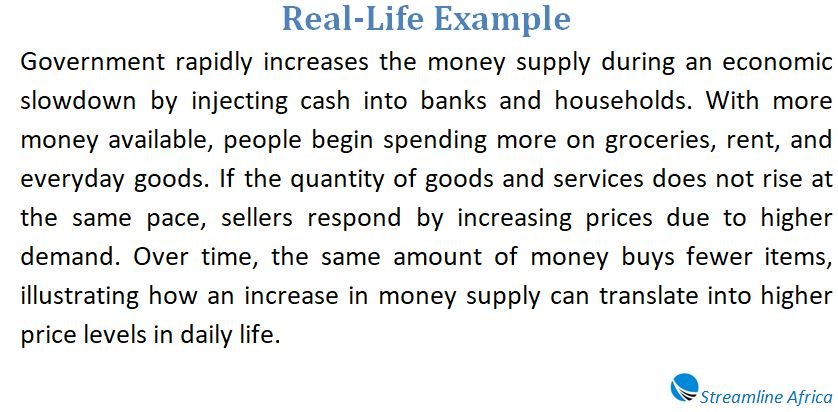
The relationship implies that if money supply (M) grows, and velocity (V) plus transactions (T) remain constant, then prices (P) must rise. For example, if a central bank were to double the money supply, the theory predicts that average prices would roughly double as well.
Why Economists Debate the Theory
While elegant in form, the Fisher model relies on assumptions that are rarely true in practice. It assumes that the velocity of money is stable and that the number of transactions does not shift significantly. In real economies, however, consumer confidence, interest rates, and technological changes often alter both velocity and output. This has led to sharp disagreements among economists about how directly money supply impacts inflation.
Monetarist Perspectives
Monetarists, a school of thought closely tied to Milton Friedman and the Chicago School, support the theory but allow for flexibility in velocity. They argue that while V may fluctuate, it usually does so in a predictable way that can be managed by policymakers. Monetarists generally recommend a steady, controlled increase in the money supply to maintain price stability. They also believe that in the long run, money supply does not affect real economic growth—it only affects price levels.
Keynesian Critiques
Keynesian economists view the theory as too simplistic. John Maynard Keynes emphasized the importance of interest rates and liquidity preference, arguing that money supply does not always translate directly into higher prices. In times of uncertainty, for instance, people may prefer to hold onto cash rather than spend it, reducing velocity. Keynesians also stress that price adjustments happen unevenly across different markets, meaning inflation does not spread in a uniform way.
The Austrian and Wicksellian Views
Economists like Knut Wicksell and the Austrian school, including Ludwig von Mises and Joseph Schumpeter, accepted that more money often results in higher prices but criticized the idea of uniformity. They argued that when banks expand credit, the new money distorts prices in certain sectors more than others, particularly in capital goods. This uneven impact, they suggested, can trigger cycles of boom and bust. Their focus was less on a neat formula and more on how money affects economic dynamics and wealth distribution.
Simplifying the Theory
For those new to economics, the quantity theory can be summarized simply: more money in circulation usually leads to higher prices because there are more dollars chasing the same number of goods. Conversely, a shrinking money supply can pull prices downward. While this simplification captures the essence, it glosses over the complex variables that shape real economies.
Key Assumptions of the Model
The theory relies on several critical assumptions:
- Economic output is determined by production factors like labor and capital, not by money supply.
- Money supply influences prices but is not influenced by them.
- Velocity of money remains relatively constant.
These assumptions provide a clean framework but rarely hold steady in practice. Consumer behavior, credit markets, and global events frequently shift velocity and output in unpredictable ways.

Limitations in Practice
One of the major criticisms of the theory is its reliance on a stable velocity of money. In modern economies, V can change rapidly with shifts in payment technology, financial innovation, or public sentiment. Another weakness arises during liquidity traps—periods when interest rates are near zero, and people hoard money rather than spend it. In such cases, increasing the money supply may fail to stimulate inflation or economic activity, making the theory less reliable as a guide for policy.
The Lemons in Application
Real-world scenarios show that the relationship between money supply and prices is not always direct. For instance, after the 2008 financial crisis, central banks increased money supply dramatically, but inflation stayed subdued for years. This happened because people and businesses were cautious, keeping velocity low. Such cases highlight why relying solely on the quantity theory can be misleading.
Why It Still Matters
Despite its limitations, the theory remains important because it provides a foundation for understanding the role of money in the economy. Policymakers often use it as a starting point for thinking about inflation, monetary policy, and long-term economic growth. Investors, too, can benefit from grasping its logic, as changes in money supply can signal shifts in inflation and purchasing power.
Conclusion
The quantity theory of money is a cornerstone of economic thought, explaining how money supply can shape price levels through the Fisher equation. While monetarists support its principles with some modifications, Keynesians and Austrian economists highlight its oversimplification and limitations. Real economies are more complex than a single formula suggests, but the theory offers a valuable lens for analyzing the relationship between money, prices, and economic behavior.