
Why Economists Look Beyond GDP
For decades, gross domestic product (GDP) has been the gold standard for measuring a nation’s economic performance. It captures the total value of goods and services produced within a country, offering a snapshot of output and growth. Yet, GDP has long faced criticism for leaving out crucial aspects of well-being. It does not account for pollution, income inequality, unpaid work, or the depletion of natural resources.
This gap has led economists, policymakers, and environmental advocates to look for more inclusive measures. One of the most notable alternatives is the Genuine Progress Indicator (GPI). Unlike GDP, GPI considers both the benefits and the costs of economic activity, providing a more balanced picture of whether growth actually improves people’s quality of life.
What the Genuine Progress Indicator Measures
At its core, GPI asks a simple but profound question: does economic growth translate into genuine improvements in well-being? To answer this, GPI goes beyond financial transactions and considers factors such as environmental health, crime rates, unpaid household labor, and income distribution.
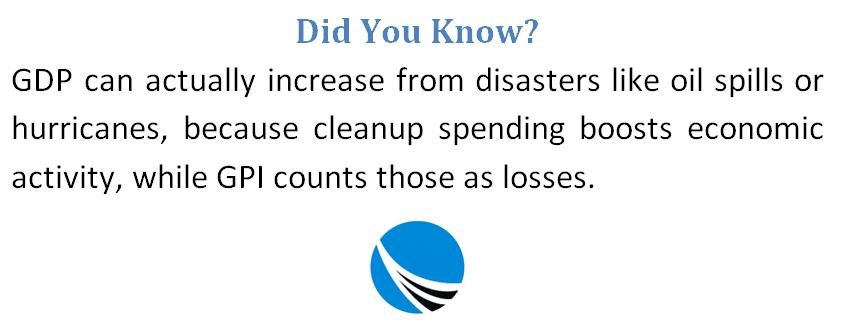
For example, while GDP counts money spent on cleaning up an oil spill as economic activity, GPI subtracts the environmental damage from the equation. Similarly, GDP ignores the value of unpaid work like caregiving or volunteerism, but GPI assigns a value to these contributions because they strengthen communities.
The Historical Roots of GPI
The story of GPI begins with the creation of GDP itself. In the 1930s, economist Simon Kuznets introduced national income accounting to help U.S. policymakers understand the economy during the Great Depression. While his system evolved into GDP, Kuznets himself warned that the measure was never designed to reflect national welfare.
Fast forward to 1995, when researchers Clifford Cobb, Ted Halstead, and Jonathan Rowe developed the Genuine Progress Indicator. Their goal was to design a metric that not only measured economic output but also reflected environmental sustainability and social equity. Since then, GPI has been refined through summits, pilot projects, and new versions such as GPI 2.0, which updates indicators to reflect modern challenges.
How GPI Is Calculated
The formula for GPI is more complex than GDP because it integrates a wider range of factors:
GPI = Adjusted Personal Consumption + Capital Growth + Social Contributions – Defensive Costs – Social Declines – Environmental Damage – Natural Capital Loss
Each element plays a role in capturing the balance between benefits and costs:
- Adjusted personal consumption reflects household spending but corrects for income inequality.
- Capital growth includes investments in long-term assets.
- Social contributions capture unpaid work such as volunteering and caregiving.
- Defensive costs include money spent to offset harms, like medical bills from pollution.
- Social declines account for issues such as crime or family breakdown.
- Environmental damage measures costs from pollution and climate change.
- Natural capital loss considers the depletion of resources like forests and fisheries.
Because these values involve judgment calls—such as placing a dollar figure on leisure time or clean air—GPI calculations can vary depending on methodology.
Valuing Non-Market Activities
One of the most innovative aspects of GPI is its inclusion of non-market activities. Traditional economics often ignores work that doesn’t involve money, yet society relies heavily on it. For example, a parent staying home to raise children provides immense social value, though GDP records nothing.
Economists use several techniques to assign value to such activities. Surveys can capture how much people would be willing to pay for services like clean air or extra leisure time. Shadow pricing assigns economic worth based on related market costs, such as estimating the value of a wetland by the expense of building flood defenses if it were destroyed. These approaches are not perfect, but they attempt to measure contributions that GDP completely overlooks.
Comparing GPI and GDP
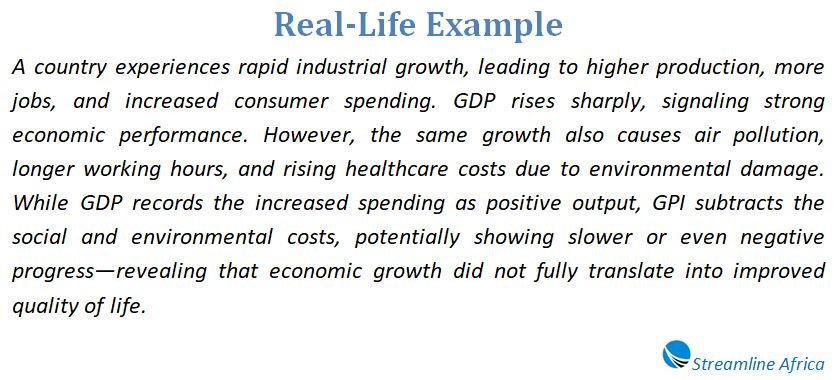
The contrast between GDP and GPI is striking. GDP treats all economic activity as positive—even money spent on cleaning up disasters. By contrast, GPI deducts the costs of damage, asking whether growth is sustainable or merely masking hidden losses.
Consider pollution: GDP rises twice, once when factories produce goods and again when money is spent cleaning up the mess. GPI, however, subtracts the environmental and health costs, showing that what looked like growth might actually reduce long-term well-being.
The relationship between GDP and GPI resembles the difference between gross and net profit in business. While gross profit highlights total income, net profit subtracts expenses to reveal true financial health. Similarly, GPI reveals whether growth is leaving people better off after accounting for costs.
The Strengths and Weaknesses of GPI
Supporters argue that GPI provides a more holistic picture of progress. It acknowledges the value of social bonds, education, and a healthy environment, while exposing the hidden costs of crime, inequality, and environmental decline. Because it rolls these into a single figure, it allows policymakers to track well-being over time.
On the downside, critics point out the challenges of subjectivity. Assigning dollar values to non-market goods involves assumptions that may vary between researchers or countries. This makes cross-national comparisons difficult. Additionally, GPI’s broad definition leaves room for inconsistent calculations, which limits its adoption as a global standard.
Real-World Use of GPI
Despite its challenges, GPI has found practical application. The state of Maryland in the United States pioneered the use of a state-level Genuine Progress Indicator as part of its Quality of Life Initiative. This effort brought together policymakers, academics, businesses, and non-profits to track indicators such as environmental sustainability, household budgets, and volunteer work.
Between 2012 and 2019, Maryland’s GPI declined by more than $14 billion. Rising defensive expenditures, such as medical costs, offset gains in other areas. However, the data also revealed positive trends: residents enjoyed more leisure time and an increase in unpaid labor that contributed to community welfare. By using GPI, Maryland could pinpoint areas of concern while recognizing strengths often invisible in GDP numbers.

Why GPI Matters Today
The modern global economy faces challenges that GDP alone cannot capture—climate change, inequality, resource depletion, and social fragmentation. Relying solely on GDP risks creating a misleading picture of prosperity, where short-term growth overshadows long-term harm.
GPI addresses this by balancing growth against its costs, giving policymakers and citizens a clearer sense of sustainability. For instance, a booming economy that destroys forests or pollutes rivers may look strong on paper, but GPI exposes the hidden liabilities.
As societies grapple with issues like carbon emissions and social inequality, GPI provides a framework for measuring progress in ways that matter most: human well-being and ecological balance.
GPI vs. GDP in Simple Terms
To put it simply, GDP asks, “How much did we produce?” while GPI asks, “Did our production make life better?” GDP counts output, while GPI weighs benefits against costs to reveal whether growth is genuine progress.
Key Takeaways for Policymakers and Citizens
The debate between GDP and GPI reflects a larger question about what societies value. If the goal is simply to increase output, GDP suffices. But if the goal is to enhance quality of life without sacrificing the environment or social cohesion, then GPI provides a more meaningful measure.
While GPI is unlikely to replace GDP entirely, it offers an important complementary tool. By recognizing unpaid work, environmental costs, and social contributions, it broadens the definition of progress beyond dollars and cents.
Final Thoughts
The Genuine Progress Indicator stands as a reminder that not all growth is good growth. By integrating social, environmental, and economic dimensions, it provides a more realistic view of prosperity. Although challenges remain in standardizing its calculation, GPI pushes the conversation forward—encouraging governments, businesses, and individuals to rethink what progress truly means.
In an age where climate change, inequality, and social well-being dominate headlines, relying solely on GDP feels outdated. GPI, despite its imperfections, points toward a future where measuring success is not just about producing more but about living better.
Frequently Asked Questions
Why was GPI created?
It was introduced in 1995 by Clifford Cobb, Ted Halstead, and Jonathan Rowe to address the shortcomings of GDP in capturing true national welfare.
How does GPI differ from GDP?
GDP treats all economic activity as positive, even pollution cleanup, while GPI subtracts social and environmental damages to give a clearer welfare measure.
What are the main components of GPI?
GPI uses 26 indicators across social, environmental, and economic categories, including pollution, crime, volunteer work, and income distribution.
How is GPI calculated?
Its formula adjusts personal consumption, adds welfare contributions, and subtracts defensive spending, social costs, environmental damages, and natural resource depletion.
What are the strengths of GPI?
It captures hidden costs and unpaid benefits, such as housework and volunteerism, giving a more holistic view of progress than GDP.
What are the criticisms of GPI?
Its biggest challenge is subjectivity—different analysts may assign different values to non-market activities, making comparisons inconsistent.
Can GPI replace GDP as the standard economic measure?
While it gives deeper insight into sustainability and well-being, its subjectivity means it’s more useful as a complement rather than a replacement for GDP.
Are there real-world examples of GPI in use?
Yes, Maryland in the U.S. adopted GPI to track quality of life, using indicators like leisure time, unpaid labor, and environmental health.