
Every company wants to know how effectively it is turning sales into actual profit. That’s where Return on Sales (ROS) becomes useful. This metric evaluates operational efficiency by showing the percentage of sales that remains as operating profit after covering costs. A higher ROS reflects greater efficiency, while a declining ratio might suggest financial challenges or inefficiencies within the business.
Investors, creditors, and managers often use ROS to get a clear picture of how well a company is running its operations, and because it focuses on core profits rather than bottom-line figures distorted by taxes or interest, it offers a cleaner view of efficiency.

Defining Return on Sales
Return on Sales is a ratio that compares operating profit to net sales. In simple terms, it answers the question: “For every dollar earned in sales, how much is left as profit after operating expenses?”
The formula can be written as:
ROS = Operating Profit ÷ Net Sales
Operating profit, often referred to as earnings before interest and taxes (EBIT), excludes items like financing costs and tax obligations. Net sales, on the other hand, represent revenue after accounting for discounts, allowances, or returns.
This makes ROS particularly valuable because it focuses on what the company can control—its operations—rather than external factors.
How to Calculate Return on Sales
Calculating ROS is straightforward, but accuracy depends on correctly identifying the components:
- Find net sales – Look at the income statement for either net sales or total revenue minus any returns and allowances.
- Identify operating profit (EBIT) – This is profit after deducting operating costs such as wages, rent, utilities, and cost of goods sold, but before subtracting taxes and interest.
- Apply the formula – Divide EBIT by net sales.
For example, if a company reports $200,000 in net sales and $30,000 in operating profit, the ROS would be 15% ($30,000 ÷ $200,000). This means the firm keeps 15 cents of profit from every dollar of sales.
What Return on Sales Reveals
Return on Sales is more than just a number—it provides insights into management effectiveness, cost control, and overall profitability.
- Efficiency check – A higher ROS suggests management is keeping costs under control and generating stronger profits from sales.
- Trend analysis – Comparing ROS over multiple years shows whether the company is improving or losing efficiency.
- Peer comparison – ROS allows investors to compare similar businesses within the same industry to see which firms are stronger operationally.
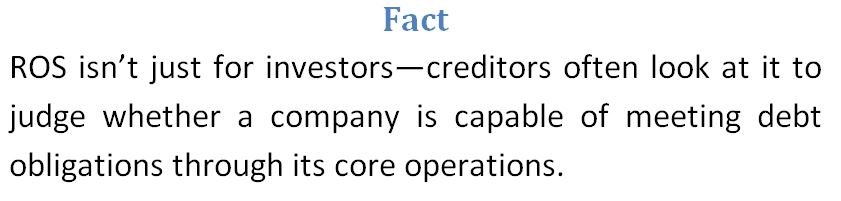
- Decision-making tool – Creditors and debt holders use ROS to assess whether a company generates enough profit to meet obligations, while investors consider it for dividend or reinvestment potential.
Practical Look
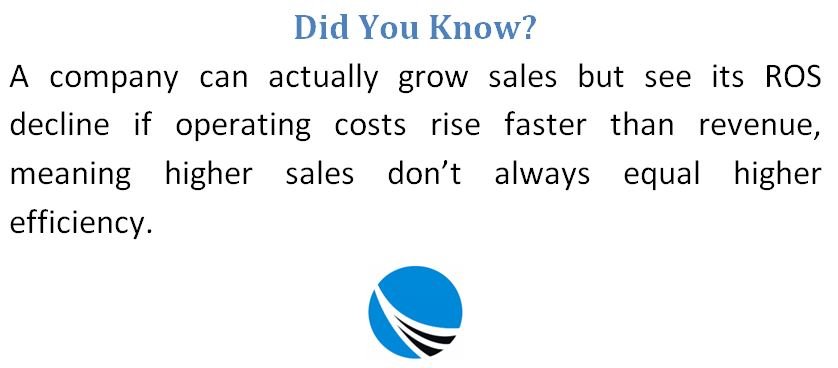
A restaurant generates $10,000 in monthly sales and records $2,000 in operating profit after covering food costs, staff wages, rent, and utilities. Its Return on Sales (ROS) is 20%, meaning it keeps 20 cents as operating profit for every dollar of sales. If sales rise to $15,000 but operating profit remains $2,000 due to higher costs, ROS drops to about 13%, signaling declining operational efficiency despite revenue growth.
ROS Across Different Industries
Not all industries operate under the same cost structures. For this reason, ROS is best used to compare companies within the same sector.
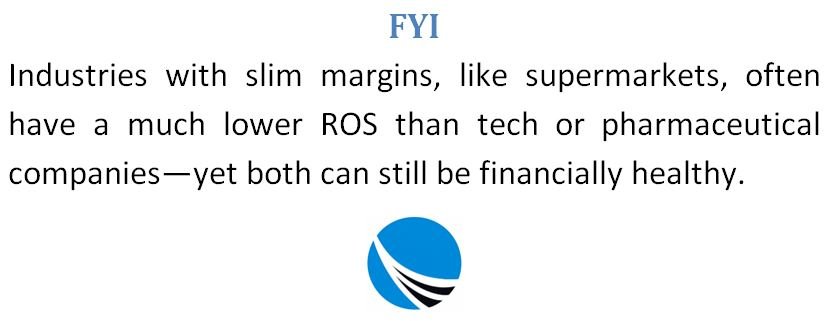
- Retail and grocery chains usually operate on razor-thin margins, so their ROS may be low.
- Technology firms often have higher margins due to innovation and intellectual property, resulting in higher ROS values.
- Manufacturing companies may sit in between, depending on their cost management and scale.
This variation means ROS should never be used in isolation to compare two businesses from unrelated sectors.
Example of Return on Sales in Action
Imagine two companies:
- Company A makes $100,000 in sales but incurs $90,000 in costs, leaving $10,000 in operating profit. Its ROS is 10%.
- Company B earns $50,000 in sales but only spends $30,000, resulting in $20,000 in operating profit. Its ROS is 40%.
Despite Company A generating higher revenue, Company B is clearly more efficient because it converts a much larger portion of sales into profit. This highlights why ROS is useful—it reveals efficiency beyond just top-line revenue.
ROS vs. Operating Margin
People often use Return on Sales and Operating Margin interchangeably because both measure profitability relative to sales. However, there is a subtle difference.
- Operating margin is typically calculated as operating income divided by net sales.
- Return on Sales uses EBIT as the numerator and net sales as the denominator.
While the difference may appear small, EBIT offers a clearer view of profitability because it consistently excludes taxes and financing, making cross-company comparisons more reliable.
Limitations of Return on Sales
Like all financial ratios, ROS has limitations that analysts must keep in mind.
- Industry variations – Comparing ROS between sectors can be misleading. A 5% ROS in retail might be excellent, while the same figure in software could indicate weakness.
- Historical focus – ROS looks backward, summarizing past performance without necessarily predicting the future.
- Non-cash expenses – It doesn’t account for depreciation or capital expenditures, which can significantly affect long-term sustainability.
- EBIT vs EBITDA – Some analysts prefer using EBITDA (earnings before interest, taxes, depreciation, and amortization) for comparisons across capital-intensive industries, since depreciation can distort profitability.
Using ROS for Strategic Insights
Despite its limitations, ROS remains a valuable tool for strategy and decision-making. Companies can use it to:
- Identify cost inefficiencies – A declining ROS may highlight rising costs or inefficiencies in production.
- Support growth strategies – Tracking ROS helps ensure that expansion into new markets or product lines doesn’t reduce overall efficiency.
- Strengthen investor confidence – A healthy ROS reassures investors that management is running operations efficiently and profitably.
- Benchmark performance – Comparing ROS with competitors provides a real-world gauge of industry standing.
ROS in Trend Analysis
One of the best uses of ROS is to examine changes over time. For example, if a company’s ROS increased from 8% to 12% in three years, it suggests improved cost control, higher sales efficiency, or both. Conversely, a declining ROS may signal competitive pressures, rising input costs, or poor management decisions.
This makes ROS not just a static figure but a dynamic tool for tracking progress and spotting red flags early.
Investors’ Perspective on ROS
For investors, ROS is a way of cutting through the noise. While sales growth may look impressive, it means little if the company isn’t converting those sales into profit. A strong ROS indicates that a business model is sustainable and scalable.
Additionally, investors often pair ROS with other metrics—such as return on equity (ROE) or free cash flow—to form a fuller picture of financial health. Used together, these ratios give insights into whether a company is simply selling more or actually building long-term profitability.
ROS vs EBITDA: A Broader Comparison
Analysts sometimes turn to EBITDA for a more standardized comparison across industries. Unlike ROS, which uses EBIT, EBITDA adds back depreciation and amortization, making it useful for evaluating companies with heavy investments in machinery, property, or infrastructure.
However, EBITDA has its own limitations. It doesn’t reflect capital expenditures or changes in working capital, so while it may show comparability, it doesn’t always capture true cash flow sustainability.
The takeaway: ROS is excellent for operational analysis, while EBITDA provides additional context for capital-intensive businesses.
The Bottom Line
Return on Sales is a straightforward yet powerful tool for understanding how efficiently a company transforms sales into operating profit. By focusing on core operations, it cuts away the noise of taxes and financing to reveal management’s effectiveness.
A growing ROS suggests a company is becoming more efficient, while a shrinking ratio can signal challenges. Although comparisons across industries should be avoided, ROS remains invaluable for trend analysis and peer benchmarking within the same sector.
For managers, it is a guide to efficiency. For investors, it is a signal of sustainability. And for creditors, it is reassurance that obligations can be met. When combined with other metrics, ROS provides a comprehensive view of financial health and helps shape smarter decisions about the future.
Frequently Asked Questions about Returns on Sales (ROS)
What does Return on Sales (ROS) measure?
ROS shows how much profit a company earns from each dollar of sales after covering its operating costs.
How is ROS calculated?
You divide operating profit (EBIT) by net sales. The result is expressed as a percentage.
Why is ROS important for businesses?
It reveals how efficiently management runs operations and how well sales are converted into profits.
What’s the difference between net sales and revenue?
Net sales are total revenue minus returns, discounts, or allowances, while revenue is the gross figure before these adjustments.
Who uses ROS in decision-making?
Investors, creditors, and managers use it to assess profitability, efficiency, and the ability to repay debt.
Can ROS vary across industries?
Yes. A grocery chain may have a low ROS due to thin margins, while a tech firm may show higher ROS because of higher profitability per sale.
What does a high ROS indicate?
It usually signals strong cost control, efficient operations, and effective management.
What does a declining ROS suggest?
It can point to rising costs, inefficiencies, or financial challenges that could threaten long-term stability.
How does ROS differ from operating margin?
Both are similar, but ROS is typically written with EBIT as the numerator, while operating margin uses operating income.
Why should ROS be compared within the same industry?
Different industries have unique cost structures, so comparing across sectors may lead to misleading conclusions.
How is ROS useful in trend analysis?
Tracking ROS over time shows whether efficiency is improving or declining, helping managers and investors spot patterns.
How does ROS relate to EBITDA?
EBITDA adjusts for depreciation and amortization, making it more useful for capital-heavy industries, while ROS focuses strictly on operating profit.