
Introduction to Inventory Valuation
Businesses that handle goods—whether raw materials, parts, or finished products—must decide how to value their inventory. Two of the most widely used methods are FIFO (First-In, First-Out) and LIFO (Last-In, First-Out). These methods don’t track specific physical items but instead provide a systematic way of assigning costs to products sold and those remaining in stock. Choosing between them has significant implications for financial statements, tax liabilities, and profit measurement.
The Logic Behind Inventory Flow Assumptions
Inventory costing methods rest on a simple but important equation:
Beginning Inventory + Purchases (or Production) = Goods Sold + Ending Inventory.
This formula highlights that whatever a business begins with, plus what it acquires during a period, must eventually be divided between items sold and those still on hand. FIFO and LIFO differ in how they assign costs to these categories, especially when purchase prices fluctuate.

Understanding FIFO
FIFO, or First-In, First-Out, assumes that the oldest inventory costs are used up first when recording sales. While companies might not physically track and sell the earliest stock every time, this method ensures that the costs attached to earlier purchases are recognized before newer ones.
This approach reflects how many real-world businesses operate, particularly those handling perishable goods. For instance, grocery stores and pharmacies typically sell older items first to avoid waste and maintain freshness. Although inventory management and accounting are separate processes, FIFO tends to align closely with practical stock movement.
Example of FIFO in Action
Imagine a company, GreenMart, purchasing the following batches of goods in December:
- 120 units at $40 each
- 100 units at $45 each
- 80 units at $48 each
If the company sells 230 units, FIFO would treat the first 120 units at $40 and the next 100 units at $45 as sold. The cost of goods sold (COGS) would be:
- 120 × $40 = $4,800
- 100 × $45 = $4,500
Total COGS = $9,300
The remaining 80 units, valued at $48 each, would form the ending inventory, reported as $3,840 on the balance sheet.
Tax Implications of FIFO
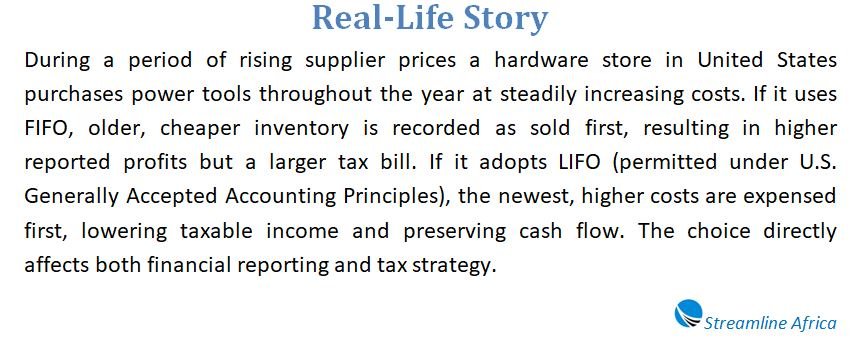
When prices are rising, FIFO tends to produce a lower COGS because older, cheaper costs are recognized first. This results in higher reported profits and, consequently, higher taxable income. Although this increases tax obligations, it also enhances financial performance from the perspective of shareholders and investors.
Understanding LIFO
LIFO, or Last-In, First-Out, assumes that the most recently purchased goods are sold first. Unlike FIFO, this method emphasizes newer costs in calculating COGS, leaving older costs in the ending inventory. This approach has historically been attractive during inflationary periods because it increases expenses on the income statement, thereby reducing taxable profits.
LIFO is allowed under U.S. Generally Accepted Accounting Principles (GAAP) but is prohibited under International Financial Reporting Standards (IFRS). This regulatory difference explains why LIFO is largely confined to American businesses, especially in industries with significant cost fluctuations such as oil, manufacturing, and retail.
Example of LIFO in Action
Using the same GreenMart data:
- 120 units at $40 each
- 100 units at $45 each
- 80 units at $48 each
If 230 units are sold under LIFO, the company would expense the most recent purchases first:
- 80 × $48 = $3,840
- 100 × $45 = $4,500
- 50 × $40 = $2,000
Total COGS = $10,340
The ending inventory would consist of the remaining 70 units at $40 each, totaling $2,800.
Comparing FIFO and LIFO Outcomes
The difference between the inventory valuation under these two methods is often referred to as the “LIFO reserve.” It highlights how much profit or tax liability is affected simply by the choice of method. In the GreenMart example, FIFO leaves ending inventory at $3,840, while LIFO values it at $2,800—a difference of $1,040.
This disparity not only influences reported profits but also alters key financial ratios such as gross margin, current ratio, and return on assets. Stakeholders often consider the LIFO reserve when comparing companies that use different inventory accounting methods.
Broader Implications of Method Choice
Selecting between FIFO and LIFO is not merely a technical accounting decision. It can shape how a company presents itself to investors, creditors, and regulators. Higher profits from FIFO may enhance stock performance but raise tax costs. Conversely, LIFO can improve cash flow during inflationary times but may make financial results appear weaker.
Moreover, U.S. companies that use LIFO for tax reporting are required by the LIFO conformity rule to also use it in their financial reporting. This ensures consistency but sometimes reduces comparability with international competitors who follow IFRS.
Global Standards and Inventory Valuation
International accounting standards emphasize the principle of valuing inventory at the lower of cost or market value. While FIFO complies easily with IFRS, LIFO does not, leading to its prohibition outside the United States. This global divergence has fueled debates about whether the U.S. should eliminate LIFO to harmonize with international practice. However, industry groups argue that repealing LIFO would increase tax burdens and reduce competitiveness.
Practical Considerations for Businesses
When deciding on an inventory costing method, managers must weigh several factors:
- Tax planning: LIFO may reduce tax bills in inflationary settings.
- Financial presentation: FIFO often shows stronger profitability and healthier balance sheets.
- Industry norms: Certain industries tend to favor one method over the other.
- Compliance: International firms usually must follow FIFO due to IFRS rules.
Ultimately, the method chosen must reflect both the economic environment and the company’s long-term strategy.
Take-home
FIFO and LIFO represent two contrasting yet legitimate ways of valuing inventory. FIFO emphasizes older costs, aligning with real-world product flows and often enhancing financial results, but it comes with higher tax liabilities in times of rising prices. LIFO, while tax-efficient in inflationary periods, is restricted to the United States and can portray a less favorable picture of profitability. The choice between the two is more than an accounting preference; it shapes financial performance, tax obligations, and stakeholder perceptions.
Frequently Asked Questions
Why do businesses use FIFO?
FIFO is commonly used because it reflects the natural flow of goods, especially perishables, and often shows stronger financial results.
Why do some companies prefer LIFO?
LIFO can lower taxable income during inflation by matching higher recent costs with current sales, reducing tax liabilities.
Is LIFO allowed worldwide?
No, LIFO is only permitted in the United States under GAAP. International standards like IFRS prohibit its use.
How does FIFO affect taxes?
FIFO usually leads to higher profits in periods of rising prices, which means higher taxable income and greater tax expense.

How does LIFO affect financial reporting?
LIFO often results in lower reported profits, which may reduce how attractive financial statements look to investors.
What is the LIFO reserve?
The LIFO reserve is the difference between inventory valued under FIFO and under LIFO, showing how much income has been deferred by using LIFO.
Which method better reflects actual product movement?
FIFO usually aligns more closely with the real flow of goods, since businesses tend to sell older stock first.
How should a business choose between FIFO and LIFO?
The decision depends on factors like tax strategy, industry practices, reporting requirements, and whether the company operates internationally.
Which method is best overall?
There is no universal “best” method—FIFO is often better for showing stronger profits and matching real product flow, while LIFO can be advantageous for tax savings during inflation. The right choice depends on the company’s goals, financial environment, and reporting requirements.