Accounting is often seen as a single discipline, but in practice, it contains several distinct branches that serve different purposes. Among these, financial accounting and managerial accounting are two of the most important. Both play crucial roles in understanding a company’s financial health and shaping its strategy, but they are designed for very different audiences and follow different approaches. To grasp how businesses make informed decisions and remain compliant with regulations, it is essential to understand the differences between these two branches of accounting.

What Is Financial Accounting?
Financial accounting is the structured process of recording, summarizing, and reporting an organization’s financial transactions over a specific time frame. The goal is to provide an accurate and standardized representation of the company’s performance and position. These results are presented in financial statements, such as the balance sheet, income statement, and statement of cash flows.
The distinguishing feature of financial accounting is its reliance on established standards, such as Generally Accepted Accounting Principles (GAAP) in the United States or International Financial Reporting Standards (IFRS) used globally. These rules ensure consistency and comparability between companies, allowing investors, creditors, regulators, and analysts to assess financial data with confidence.
Publicly traded firms, in particular, must regularly publish their financial results. This ensures transparency, satisfies legal requirements, and builds trust with shareholders and the wider market.
What Is Managerial Accounting?
Managerial accounting takes a different approach. Instead of focusing on compliance or external reporting, it concentrates on providing relevant information to a company’s management team. Its purpose is to help leaders plan, make informed decisions, and manage day-to-day operations more effectively.
Managerial accounting uses tools such as budgeting, cost analysis, break-even studies, variance analysis, and activity-based costing. Reports are tailored to the unique needs of managers and may include detailed forecasts, performance evaluations, and operational insights. Because these reports are used internally, they are not bound by external standards, giving companies flexibility in design and format.
In short, managerial accounting emphasizes forward-looking information, whereas financial accounting largely captures the past.
Different Objectives and Audiences
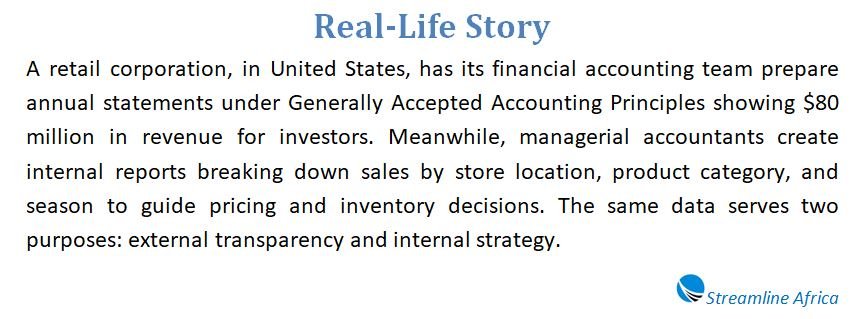
One of the most important distinctions between the two fields is their intended users. Financial accounting is created for external parties—shareholders, government agencies, creditors, and potential investors—who rely on clear, standardized data to evaluate a business. Managerial accounting, on the other hand, is directed at those within the company, particularly executives, managers, and department heads.
For example, a financial accountant might prepare an income statement showing overall profit for the last quarter. A managerial accountant, however, might prepare a detailed report breaking down production costs by region, identifying inefficiencies, and suggesting where resources could be allocated more effectively.
Historical vs Forward-Looking Focus
Financial accounting is primarily backward-looking. Reports summarize transactions and financial performance for a defined period that has already passed, such as the previous fiscal quarter or year. This historical perspective makes it easier for investors to compare results over time or against competitors.
Managerial accounting is both backward- and forward-looking. While it often uses historical data as a starting point, the emphasis is on predicting outcomes and guiding strategic choices. Forecasting demand, planning budgets, and evaluating whether a new project will be profitable are typical applications of managerial accounting.
Regulation and Compliance
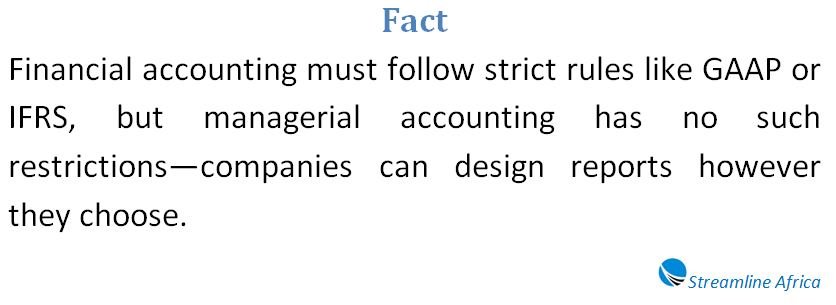
A defining characteristic of financial accounting is its high level of regulation. Because financial statements are released publicly, they must conform to strict rules about how information is presented. The Financial Accounting Standards Board (FASB) sets GAAP rules in the U.S., while the International Accounting Standards Board (IASB) oversees IFRS globally.
Managerial accounting does not face these restrictions. Since the information is intended for internal use only, companies can structure their reports however they find most useful. A small start-up might rely on simple cost summaries, while a large corporation could implement complex forecasting models.
Level of Detail in Reports
Financial accounting emphasizes clarity and aggregation. Reports are concise, standardized, and general in scope, providing a broad overview of a company’s finances. This ensures accessibility to readers who may not have an accounting background, such as investors or the general public.
Managerial accounting takes the opposite approach, delivering highly detailed, technical, and specific information. Reports might include breakdowns of costs by department, product line, or even machine efficiency. The detail helps managers understand operations at a granular level, but it may appear overwhelming or irrelevant to outside observers.
Practical Examples of Each
To illustrate the contrast, consider two scenarios.
In financial accounting, a company’s income statement might report $50 million in sales revenue for the year, $35 million in expenses, and $15 million in net income. This simple summary informs shareholders and regulators about overall performance.
In managerial accounting, the same company might examine how much of those sales came from different product lines, which geographic regions were most profitable, or how much raw material wastage occurred in production. The goal is not just to show results but to highlight where improvements or adjustments are needed.
The Four Main Types of Accountants
Accounting is not limited to these two branches. Other specializations also play critical roles:
- Tax accountants prepare returns for individuals or companies and advise on tax strategy.
- Auditors review financial statements to confirm accuracy and compliance.
- Financial accountants prepare standardized reports for regulators and shareholders.
- Managerial accountants create internal reports that guide decision-making.
Together, these professionals ensure that companies remain compliant, efficient, and strategically sound.
A Day in the Life of an Accountant
Regardless of their specialization, accountants spend much of their time recording transactions, reconciling accounts, and analyzing financial data. They document everything from vendor payments and payroll expenses to equipment purchases. Over time, this meticulous record-keeping becomes the foundation for either financial or managerial reporting.
Financial accountants focus on ensuring these records meet standards for external reporting, while managerial accountants use them as raw material for more detailed analyses and forecasts.
Career Paths and Compensation
Accounting careers can vary widely in scope and salary. Among the most lucrative positions are company controllers, certified management accountants (CMAs), and certified public accountants (CPAs).
A controller oversees the accounting department and plays a key role in executive decisions. A CMA combines accounting knowledge with strategic analysis, making them valuable for long-term planning. A CPA, licensed at the state level in the U.S. (or as a chartered accountant in other countries), is highly respected for expertise in financial reporting and auditing. These advanced roles often require postgraduate education and years of experience.
Why Both Are Essential
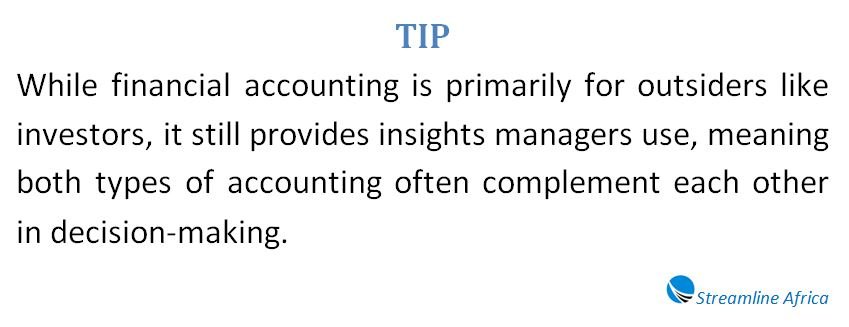
It would be misleading to think of financial accounting and managerial accounting as competing approaches. Instead, they complement one another. Financial accounting ensures transparency, accountability, and comparability across companies and industries. Managerial accounting ensures efficiency, strategy, and operational insight within an organization.
Without financial accounting, companies would struggle to gain the trust of investors and regulators. Without managerial accounting, they would lack the internal information needed to stay competitive and profitable.
Final Thoughts
Financial accounting and managerial accounting share common ground in their reliance on accurate record-keeping and analysis. Yet their differences in purpose, audience, focus, regulation, and detail make each uniquely valuable. Financial accounting looks outward, satisfying stakeholders with standardized reports. Managerial accounting looks inward, empowering managers with tailored insights and forecasts.
For businesses to thrive, both perspectives must work together. One secures credibility in the market, while the other drives performance within the organization. In today’s competitive environment, mastery of both forms of accounting is not just a technical requirement but a strategic advantage.
Frequently Asked Questions
What is the main purpose of financial accounting?
Financial accounting aims to provide an accurate and standardized record of a company’s financial performance and position so that external stakeholders like investors, regulators, and creditors can make informed decisions.
Who uses managerial accounting information?
Managerial accounting is designed for internal use by company leaders, department heads, and executives who need detailed data to plan, forecast, and improve efficiency.
How do financial and managerial accounting differ in focus?
Financial accounting is primarily historical, reporting on past transactions, while managerial accounting looks forward, using data to forecast outcomes and guide strategy.
Why is financial accounting heavily regulated?
Because financial reports are shared with the public and regulators, they must comply with strict standards such as GAAP or IFRS to ensure accuracy, consistency, and comparability across companies.
Are managerial accounting reports regulated?
No. Managerial accounting reports are not subject to outside standards, allowing businesses to customize the format, detail, and timing of information to best meet their operational needs.
What types of reports are produced by each accounting branch?
Financial accountants prepare standardized documents such as balance sheets, income statements, and cash flow statements. Managerial accountants prepare detailed budgets, cost analyses, and performance evaluations.
What careers exist in financial and managerial accounting?
Financial accountants focus on external reporting, while managerial accountants provide internal insights. Other roles include tax accountants, auditors, controllers, CMAs, and CPAs.
Do investors rely on managerial accounting reports?
No. Investors, lenders, and regulators typically rely only on financial accounting statements. Managerial accounting reports remain internal to help guide company strategy.
Why is managerial accounting more detailed?
Managerial reports break information into specific categories, such as costs by product or department, so managers can pinpoint inefficiencies and identify opportunities for improvement.
Why are both forms of accounting important?
Financial accounting ensures transparency and credibility with the outside world, while managerial accounting helps businesses operate efficiently and make smart decisions for the future.