

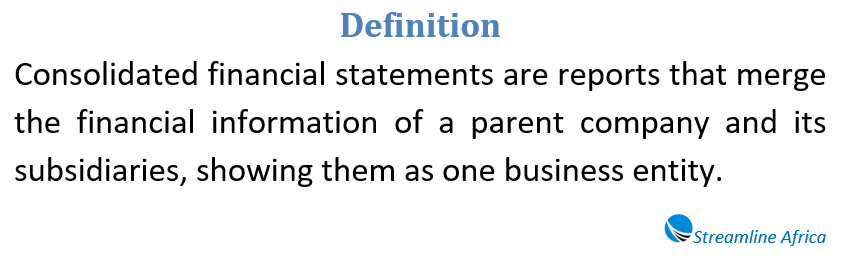
A consolidated financial statement is essentially a report that merges the financial information of a parent company and its subsidiaries. Instead of looking at each entity in isolation, it presents the combined financial performance and position as though they were a single business. This type of reporting captures assets, liabilities, revenues, expenses, and cash movements for the entire group.
For private companies, reporting obligations are often flexible, but public companies are required to prepare their reports under standardized frameworks. In the United States, this falls under the Generally Accepted Accounting Principles (GAAP), while companies reporting internationally typically follow the International Financial Reporting Standards (IFRS).

Why Consolidation Matters
Consolidated statements are not just about compliance. They provide a clearer picture of a company’s full scope, particularly when the parent owns and manages multiple subsidiaries. Investors, regulators, and even employees benefit from these combined reports since they show the actual strength and financial stability of the whole enterprise.
Without consolidation, financial health may appear fragmented. A subsidiary might be doing poorly while the parent company is profitable, or vice versa. By consolidating, the results balance out and give stakeholders a true sense of overall performance.
Ownership and Reporting Methods
The approach a company uses to record subsidiary ownership depends on how much control it holds:
- Cost method: Used when ownership is small, usually less than 25%. The parent simply records the investment at its purchase price.
- Equity method: Applied when ownership ranges from 25% to 55%. The parent adjusts the value of its investment based on its share of the subsidiary’s profits or losses.
- Full consolidation: When ownership exceeds 55%, or when the parent demonstrates effective control, the subsidiary’s accounts are fully merged into the parent’s financial statements.
This tiered approach prevents companies from overstating influence in situations where they hold only minor stakes.
The Mechanics of Consolidation
The actual process of preparing consolidated statements is complex. Each subsidiary has its own accounting system, and these must be aligned with the parent’s framework. Once adjusted, the financial data are merged into three main reports:
- Balance sheet: Shows combined assets, liabilities, and equity.
- Income statement: Merges revenues and expenses across entities.
- Cash flow statement: Tracks the inflows and outflows of cash for the entire group.
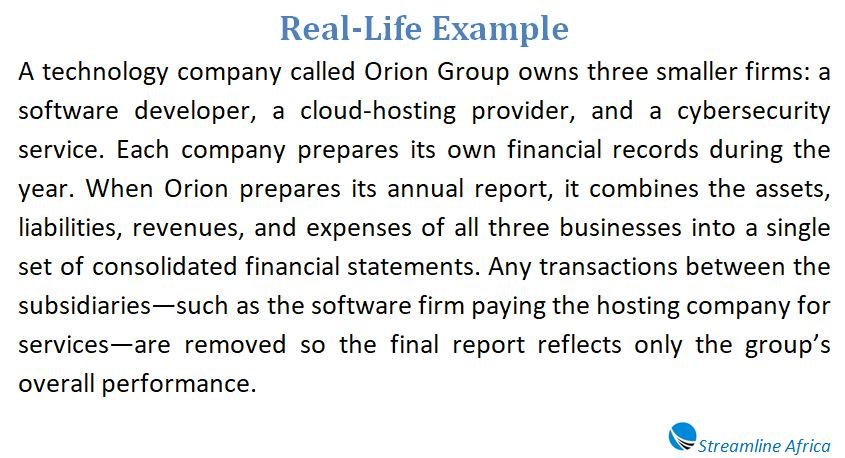
During this process, intercompany transactions—such as sales from one subsidiary to another—are eliminated. This prevents double-counting and ensures the consolidated results reflect only external activities.
Annual Decisions and Long-Term Impact
Private companies often decide each year whether to consolidate their subsidiaries’ results. The choice may hinge on tax implications, financial advantages, or the need to present a stronger position to lenders. Public companies, however, generally stick with consolidation once adopted, as frequent changes can raise questions from investors and regulators.
There are exceptions. If a company spins off a subsidiary, acquires a new one, or undergoes major restructuring, it may need to adjust its consolidation approach. In such cases, transparency and communication with stakeholders become critical to avoid confusion.
Reporting Frameworks and Compliance
For publicly traded firms, adherence to GAAP in the U.S. or IFRS internationally is non-negotiable. These frameworks dictate not only when consolidation is required but also how it should be executed.
For example, GAAP outlines how parent and subsidiary accounts must align, while IFRS emphasizes uniform accounting policies across all entities within a group. Both frameworks stress consistency, transparency, and fairness, preventing companies from shifting assets or liabilities across subsidiaries to minimize taxes or manipulate results.
The investment in infrastructure needed to produce consolidated reports can be substantial. Larger organizations often implement sophisticated software systems to integrate financial data from multiple subsidiaries seamlessly.
Key Requirements and Thresholds
Generally, when a parent owns more than 60% of another company, consolidation is expected. But ownership percentage is not the only factor. Even with less than 60%, if the parent has significant influence over management decisions—such as appointing directors or setting strategic policies—it may still be required to consolidate.
The main restriction is that parent companies cannot artificially enhance financial performance by moving cash, assets, or liabilities between subsidiaries. Such practices undermine the purpose of consolidated reporting, which is to present a truthful picture of financial health.
Practical Examples in the Business World
Consider Berkshire Hathaway, which has stakes in an array of industries, from insurance to railroads. Its financial statements show consolidated figures but also break down performance by sector. Not every investment is consolidated, though—its holdings in Kraft Heinz, for example, are recorded using the equity method rather than full consolidation, since Berkshire does not control the company outright.
Another example is Coca-Cola, a global giant with hundreds of subsidiaries. Its bottling companies, distribution channels, and brand entities are spread across the world. By consolidating financial statements, Coca-Cola presents investors with a single, cohesive picture of its worldwide operations, making it easier to assess profitability and financial position.
Separate Versus Consolidated Reporting
A separate financial statement focuses on a single legal entity. For instance, a subsidiary operating in Asia might publish its own report, covering only its activities in that region. While useful, this does not capture the company’s role within the wider group.
A consolidated statement, in contrast, blends these results with those of other subsidiaries and the parent company. It tells the full story of the organization, showing how each part contributes to the whole. For stakeholders interested in the bigger picture, consolidated statements are far more informative.
Challenges in Consolidation
Despite their benefits, consolidated reports are not easy to produce. Challenges include:
- Alignment of policies: Subsidiaries may use different accounting methods or reporting schedules, requiring standardization.
- Currency translation: Multinational companies must convert results from subsidiaries operating in various currencies.
- Intercompany eliminations: Transactions between group members need to be identified and removed.
These issues require strong internal controls and close collaboration between finance teams across different entities.
The Role of Investors and Regulators
For investors, consolidated statements are a valuable tool. They provide assurance that the financial data they are reviewing reflects the company’s complete operations rather than isolated fragments. Regulators also rely on them to ensure compliance with accounting standards and to protect market integrity.
When companies attempt to present unconsolidated data in situations where consolidation is required, it can raise red flags. Auditors play a crucial role here, ensuring accuracy and consistency.
Long-Term Benefits of Consolidation
Although the process demands resources and effort, consolidated reporting strengthens credibility. It shows a company’s ability to coordinate across subsidiaries, highlights the scale of operations, and builds trust with external stakeholders.
For management, these reports also serve as a decision-making tool. By reviewing consolidated data, executives can identify trends, allocate resources effectively, and plan long-term strategies.
Final Thoughts
Consolidated financial statements combine the financial realities of a parent company and its subsidiaries into a single, unified view. They are critical for public companies, required under GAAP and IFRS, and increasingly common among private firms seeking transparency and financial advantages.
While the process can be complicated—requiring elimination of intercompany transactions, alignment of accounting policies, and strict adherence to reporting standards—the benefits far outweigh the costs. Consolidated statements not only comply with regulatory demands but also offer stakeholders a clear understanding of a company’s overall financial health.
In a globalized economy where corporations often span multiple industries and countries, consolidation is the key to presenting a reliable, comprehensive financial story.
Frequently Asked Questions about Consolidated Financial Statements
Why do companies prepare consolidated statements?
They give investors, regulators, and stakeholders a complete view of the company’s overall financial health instead of fragmented results.
When is full consolidation required?
Generally, when a parent owns more than 55–60% of another company or has clear control over its management decisions.
What happens if ownership is less than 25%?
The cost method is usually applied, meaning the investment is recorded at purchase price without ongoing adjustments.
How does the equity method work?
If ownership is between 25% and 55%, the parent reflects its share of the subsidiary’s profits or losses in its financials.
What reports are included in consolidation?
The consolidated balance sheet, income statement, and cash flow statement, with intercompany transactions removed.
Do private and public companies follow the same rules?
No. Private firms have more flexibility, while public companies must follow strict frameworks like GAAP or IFRS.
Can a company switch from consolidated to separate reporting?
Yes, but it usually requires regulatory approval and may raise concerns with investors unless driven by structural changes.
What are the main challenges in consolidation?
Standardizing accounting policies, dealing with multiple currencies, and eliminating intercompany transactions are common hurdles.
How do regulators view consolidated reports?
They see them as essential for transparency and fair reporting, helping prevent manipulation of financial data.
What benefits do consolidated statements bring to management?
They give leaders a complete picture, helping with resource allocation, strategic planning, and long-term decision-making.
Can you give real-world examples?
Yes. Large corporations like Berkshire Hathaway and Coca-Cola consolidate financials to show a unified global picture of their operations.