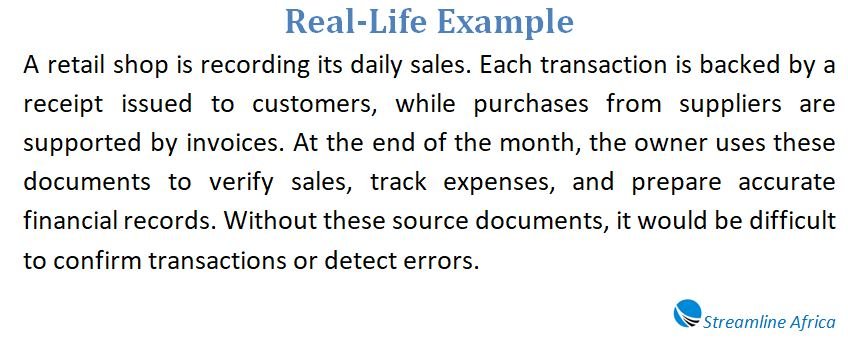
Whenever a business exchanges money, goods, or services, a record of that transaction is created. These records are known as source documents in accounting. They represent the very first evidence that a financial activity took place. For example, when a company issues an invoice, pays a bill with a check, generates a sales receipt, or logs employee hours through a timesheet, each of these is considered a source document.
Traditionally, these documents were always paper-based, but technology has shifted this process. Today, they may exist as digital files such as scanned receipts, emailed invoices, or electronic payroll records. Regardless of the format, they form the backbone of a company’s financial history.

Why Source Documents Matter
The primary role of a source document is to provide proof. Without it, recording a financial entry would be based on assumption rather than fact. Source documents ensure that every figure in the books can be traced back to an authentic record.
They also play a vital role during audits. Auditors rely on a clear trail of documentation to confirm that a business’s financial statements are accurate. If all documents are stored and organized, the audit process becomes smoother and strengthens the company’s credibility. For managers and business owners, keeping these records is not just about compliance but also about building transparency and trust with stakeholders.
Information Found in Source Documents
Most source documents include similar key details that make them reliable for accounting purposes. They usually specify the date of the transaction, the parties involved, a description of what occurred, the amount of money exchanged, and in some cases, authorization signatures. This consistency allows accountants to record transactions precisely and minimizes the risk of disputes later.
Different Types of Source Documents
Businesses generate many kinds of documents in their daily operations, each serving a particular purpose. Some of the most common include:
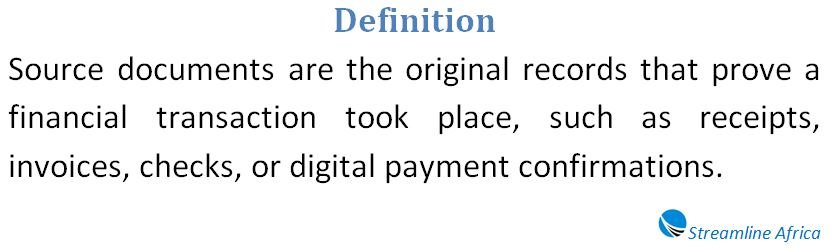
- Invoices: Sent by suppliers to request payment for goods or services.
- Receipts: Provided to customers as evidence of payment received.
- Checks: Issued to pay for expenses or settle obligations.
- Purchase orders: Created by a company to request specific products or services.
- Employee time cards or timesheets: Used to calculate payroll accurately.
- Deposit slips: Records of money placed into a bank account.
- Credit memos: Issued when a customer is owed a reduction in the amount payable.
Each document helps capture different aspects of financial activity, ensuring that nothing is overlooked in the accounting process.
Storing and Organizing Source Documents
Simply generating these documents is not enough; they must be properly stored for future reference. In practice, this often means entering the information into accounting software or recording it in ledgers before filing the original documents.
A good filing system is essential. Businesses may choose to organize by transaction type, date, or vendor. Many companies are now adopting cloud-based storage solutions to keep their records safe, searchable, and easily accessible. Alongside storage, businesses should establish internal controls. For example, they should clearly define which employees are authorized to approve payments or create purchase orders. This prevents errors and reduces the risk of fraud.
Original Documents Versus Copies
A common question is whether photocopies or digital scans carry the same weight as original documents. In most cases, the answer is yes. Tax authorities in the United States and Canada, for instance, allow copies as long as they are clear, accurate, and accessible. This flexibility allows businesses to reduce clutter and rely more heavily on digital systems.
That said, it is still important to handle the process carefully. Poorly scanned or incomplete documents may be rejected, leading to compliance issues. A best practice is to ensure that any copy, whether physical or electronic, mirrors the original in full detail.
Benefits of Maintaining a Strong Paper Trail
Although organizing financial records can feel tedious, the long-term benefits are substantial. Having a well-maintained archive saves time when preparing tax returns, undergoing an audit, or resolving disputes with suppliers and customers. It also helps businesses make better decisions since managers can look back at detailed records to identify spending patterns or evaluate profitability.
Beyond efficiency, keeping a reliable trail of documents adds credibility to a business. Investors, lenders, and partners are more likely to trust a company that can clearly demonstrate where its money has gone. In a world where financial integrity is critical, maintaining thorough documentation is an investment in reputation as much as compliance.
Conclusion
Source documents may appear simple at first glance, but they are the foundation of every business’s financial reporting system. They prove that a transaction happened, provide essential details for accounting, and ensure that financial statements are trustworthy. From invoices and receipts to digital scans and electronic payments, these records tell the complete story of a company’s economic activity.
Whether in paper or digital form, organizing and safeguarding source documents is not just about keeping the tax authorities happy—it’s about building a system of accountability and transparency that supports long-term success.
FAQs about Source Documents
Why do businesses need to keep source documents?
They provide evidence that every entry in the books is real, which helps with accurate accounting and builds trust with auditors, investors, and partners.
Are digital copies acceptable?
Yes, most tax authorities accept clear and accurate photocopies or scanned files, as long as they faithfully represent the original.
What details do source documents usually include?
They typically show the transaction date, description, amount, parties involved, and sometimes an authorizing signature.
How should businesses organize these documents?
Companies should record them in accounting software or ledgers, then store them in a well-structured system—either physical files or secure digital storage.
What is the biggest benefit of maintaining a good paper trail?
It saves time, reduces stress during audits or tax season, and strengthens a company’s credibility by proving every transaction is legitimate.