

Origins of IAS 1
The standard known today as IAS 1, Presentation of Financial Statements, has its roots in the late 20th century. Initially issued in 1997 by the International Accounting Standards Committee (IASC), it brought together various rules on disclosure and presentation that had previously been scattered across separate standards. By the time the International Accounting Standards Board (IASB) replaced the IASC in 2001, IAS 1 had already begun shaping how companies prepared financial statements on a global scale.
Its early versions consolidated and replaced three existing standards: those covering the disclosure of accounting policies, information to be shown in financial statements, and the classification of current assets and liabilities. The adoption of IAS 1 marked a turning point, setting out the first comprehensive framework for the presentation of financial statements under international accounting rules.
Early Revisions and Structural Changes
Over the years, IAS 1 has been subject to repeated amendments as business practices, regulatory needs, and investor expectations evolved. A notable revision arrived in 2003, when the IASB included it in its first round of technical projects. The changes began aligning financial reporting more closely with a global perspective, reinforcing the importance of comparability and transparency.
By 2007, the IASB issued further amendments, refining the way equity changes and comprehensive income were displayed. These adjustments also introduced new terminology for financial statements. For example, the familiar “balance sheet” became the “statement of financial position,” a move designed to provide greater clarity about what the document represented.

Emphasis on Comprehensive Income
In 2011, IAS 1 was amended once again to improve the way “other comprehensive income” (OCI) was shown. The amendment required grouping OCI items based on whether they might be reclassified into profit or loss in the future. This provided investors with clearer insights into the sustainability of a company’s financial performance. It also reflected a broader push to ensure that the performance of an entity could be understood not only through profit and loss but also through wider changes in value.
The Disclosure Initiative
Concerns had long been raised that IAS 1 sometimes encouraged excessive or boilerplate disclosures, overwhelming users of financial statements. Responding to this, the IASB launched the Disclosure Initiative in 2014. The amendments emphasized judgment and flexibility, clarifying that entities should focus on material information rather than ticking every box. These updates reinforced the principle that financial statements should be informative, not cluttered with immaterial details.
Clarifying the Concept of Materiality
A further refinement came in 2018 when the IASB addressed the definition of “material.” This amendment improved guidance on how to judge what information is material enough to include in financial reports. The new definition brought together explanations scattered across various standards and made the concept consistent across the IFRS framework. The emphasis was clear: companies should focus on presenting information that influences users’ decisions.
Classification of Liabilities
Another critical change occurred in 2020, with amendments clarifying how to classify liabilities as current or non-current. The focus was on whether the entity had the right to defer settlement for at least twelve months after the reporting date. This change was intended to eliminate confusion and ensure that liabilities were consistently classified across industries and jurisdictions.
Later in 2020, the IASB decided to defer the effective date of this amendment to 2023, recognizing the challenges companies faced during the COVID-19 pandemic.
Accounting Policies and Materiality Judgments
In 2021, the IASB further refined IAS 1 by revising the requirement around accounting policies. Instead of simply disclosing “significant” accounting policies, entities were instructed to highlight “material” accounting policy information. This change, supported by IFRS Practice Statement 2, encouraged companies to prioritize clarity, ensuring that disclosures served practical decision-making rather than compliance alone.
Other Related Amendments
In addition to these major revisions, IAS 1 has been subject to smaller, consequential updates whenever new standards were introduced. For example, amendments were triggered by the release of standards such as IFRS 10 on consolidated financial statements, IFRS 13 on fair value measurement, IFRS 15 on revenue, and IFRS 16 on leases. These ensured consistency across the wider IFRS framework, reinforcing IAS 1’s central role as the standard governing how financial information is presented.
Purpose of Financial Statements
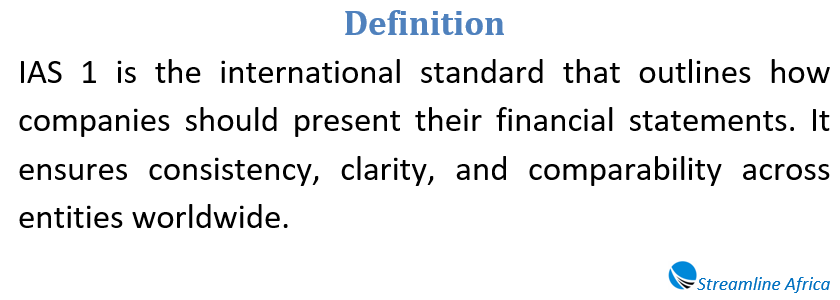
At its core, IAS 1 defines financial statements as tools to provide information about an entity’s financial position, performance, and cash flows. This information helps investors, lenders, and other stakeholders make informed decisions. Financial statements present key categories such as assets, liabilities, income, expenses, contributions by owners, distributions to owners, and cash movements.
IAS 1 identifies which components together form a complete set of financial statements. These include the statement of financial position, the statement of profit or loss and other comprehensive income, the statement of changes in equity, the statement of cash flows, and accompanying notes. Each document complements the others, offering a full picture of the company’s financial health.

Key Characteristics of Financial Statements
To meet IAS 1 requirements, financial statements must adhere to specific principles. They should:
- Provide a fair presentation and comply with IFRS standards.
- Be prepared on a going-concern basis, unless liquidation or closure is intended.
- Use the accrual basis of accounting.
- Distinguish material classes of items separately.
- Avoid offsetting assets against liabilities or income against expenses, except where specifically allowed.
- Be prepared at least annually.
- Include comparative figures from prior periods.
- Maintain consistency in presentation across reporting periods.
These features ensure that financial statements remain transparent, reliable, and useful to users.
Structure and Content
IAS 1 lays out the minimum line items that must appear in financial statements, ensuring comparability across entities. For instance, assets and liabilities must be classified into current and non-current categories, with clear criteria provided for each. The notes to the statements are also critical, as they explain accounting policies, assumptions, and additional details that provide context for the figures.
The structure emphasizes clarity and accessibility. By setting minimum content requirements, IAS 1 ensures that even as companies differ in complexity and size, their financial statements can be understood and compared consistently.

Evolution of Terminology
As accounting practices modernized, IAS 1 adapted its terminology. Key changes in 2007 reflected this trend: the “balance sheet” became the “statement of financial position,” the “cash flow statement” turned into the “statement of cash flows,” and the “income statement” evolved into the “statement of comprehensive income.” These changes better aligned with the global language of finance, reducing ambiguity for users across different regions.
Ongoing Role of IAS 1
IAS 1 continues to serve as the foundation for presenting financial statements under IFRS. While it has undergone numerous refinements since its original issue, its purpose remains the same: to ensure that financial reporting communicates meaningful, reliable, and comparable information. As business practices grow more complex, the IASB will likely continue to refine the standard, balancing consistency with the need for adaptability.
FAQs about the IAS 1
Why was IAS 1 introduced?
It was created to unify fragmented disclosure rules from earlier standards and provide a single comprehensive framework for presenting financial information.
What makes IAS 1 important?
The standard ensures financial statements fairly represent a company’s position, performance, and cash flows, giving stakeholders reliable information for decision-making.
What are the key components of financial statements under IAS 1?
A complete set includes the statement of financial position, statement of profit or loss and other comprehensive income, statement of cash flows, statement of changes in equity, and accompanying notes.
How has IAS 1 evolved over time?
It has been updated repeatedly since 2003, with changes in terminology, disclosure rules, liability classifications, and how other comprehensive income is presented.
What principles must financial statements follow under IAS 1?
They must be fairly presented, prepared on a going-concern and accrual basis, presented consistently, and include comparative information from prior periods.
How does IAS 1 handle liabilities?
Liabilities are classified as current or non-current based on whether a company has the right to defer settlement for at least twelve months after the reporting date.
Why is materiality emphasized in IAS 1?
Recent amendments clarified that companies should focus on disclosing information that truly impacts decisions, reducing clutter from immaterial details.