

Every individual and business faces moments when money, time, or energy has been spent but cannot be retrieved. Economists call this a sunk cost—a past expenditure that should no longer factor into rational decisions. While the concept is straightforward, human behavior often complicates matters. People have a natural tendency to let prior investments shape future choices, leading to what is widely known as the sunk cost fallacy.
This article explores what sunk costs are, why economists say they should be ignored, and why people struggle to do so. It also examines the psychological underpinnings of the fallacy, its impact on businesses and governments, and how to avoid falling into the trap.
What Is a Sunk Cost?
A sunk cost refers to money, effort, or time already spent that cannot be reclaimed. Once resources are used, they become irrelevant to future decision-making, no matter how much was invested.
Consider a simple example: you purchase a non-refundable online course for $900 but quickly realize it has no value for your goals. Continuing to attend simply because you already paid is irrational—the payment is gone and should not influence whether you dedicate further time. Economists urge people to evaluate only future costs and benefits, not the irrecoverable past.

The Bygones Principle
Classical economics introduces the bygones principle, which insists that past expenses are irrelevant to current choices. Just as spilled milk cannot be put back into the glass, resources that are already consumed should not dictate future commitments. Rational actors, according to microeconomic theory, look only at present options and their likely outcomes.
Take the case of a factory project originally estimated at $150 million in costs with an expected value of $170 million. If $45 million has been spent and new estimates show the project will only return $80 million, the rational decision is to stop immediately, even though $45 million is gone. Conversely, if the expected return is $95 million, continuing makes sense because it still provides a net gain.
The principle aligns with rational choice theory and expected utility models, which suggest individuals should compare only the outcomes that can still be influenced. Past investments should be canceled out when making new choices.
Sunk Costs vs. Prospective Costs
To better understand the distinction, economists compare sunk costs to prospective costs. Prospective costs are future expenses that can still be avoided. For instance, if you’re considering pre-ordering concert tickets worth $120 but haven’t paid yet, that cost remains prospective—you can walk away with no penalty. Once you make the payment, however, it becomes a sunk cost, regardless of whether you attend the concert.
Both sunk and prospective costs can take the form of fixed or variable expenses. For example, a business might pay $600 million upfront for a one-time software installation. That payment is a sunk cost. However, monthly maintenance fees tied to usage would be fixed costs, and server electricity might be variable. Economists often argue sunk costs should remain a separate category because they represent irrecoverable one-time expenditures.
Why People Struggle to Ignore Sunk Costs
Despite the logic of ignoring sunk costs, people frequently let them influence decisions. This is the sunk cost effect—continuing to commit resources simply because of what has already been spent. Common expressions like “throwing good money after bad” capture the essence of this behavior.
The tendency surfaces in many areas:
- Staying in unfulfilling relationships because “too much has been invested.”
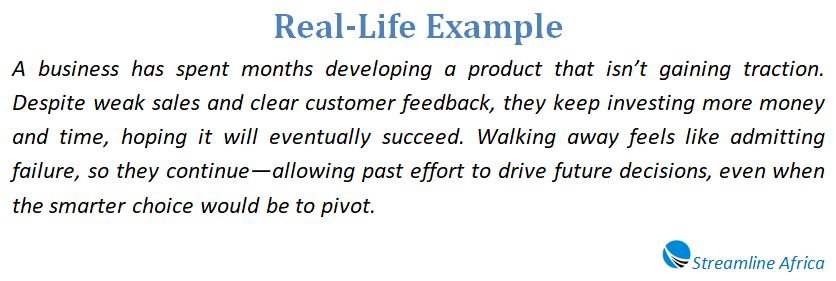
- Businesses persisting with failing products to justify prior R&D spending.
- Governments funding projects like the Concorde supersonic jet, long after it was clear there was no commercial viability.
In each case, the rational choice would have been to cut losses and focus on future opportunities. Instead, people justify more spending to avoid admitting failure.
Real-World Examples of the Fallacy
History offers striking illustrations of the sunk cost fallacy:
- The Concorde Project: Britain and France continued funding development of the supersonic aircraft even after it was evident the economics no longer worked. The project became so infamous it gave rise to the phrase “Concorde fallacy.”
- U.S. Utility Companies: In the 1980s, several firms continued pouring funds into nuclear plants despite regulatory reviews showing projects were uneconomical. Managers often persisted to avoid blame for wasted investments.
- Everyday Life: A person might finish a bland meal at a restaurant simply because they already paid $35, or keep watching a bad movie because they bought a $15 ticket.
In each case, past expenditures became psychological anchors, leading to inefficient or personally unsatisfying choices.
Emotional and Psychological Drivers
Behavioral economics and psychology explain why sunk costs are so difficult to ignore:
- Loss aversion: People feel losses more intensely than gains, so admitting a sunk cost feels like acknowledging a painful loss.
- Commitment bias: Once people commit to a path, they struggle to change course, even when new evidence suggests they should.
- Endowment effect: Ownership increases perceived value. Once we’ve invested, we believe what we own is worth more than it may actually be.
- Desire not to appear wasteful: People worry about looking foolish or irresponsible if they abandon an investment midway.
These forces make it harder to “cut one’s losses,” even when doing so would be rational.
Experiments and Studies
Researchers have conducted numerous studies confirming the sunk cost effect:
- Horse Betting: A 1968 experiment showed bettors who had just placed a $5 bet were significantly more confident in their horse’s chances of winning than those about to place the same bet. The commitment increased optimism irrationally.
- Relationship Studies: Experiments revealed that people invested with time or money in relationships were more likely to continue them, even when dissatisfied.
- Business Students: In one study, participants were asked to make a new investment of $25 million after inheriting a poorly performing project. Those told they had made the earlier decision invested an average of $16 million, while those told another manager was responsible invested around $11 million.
These results highlight the consistent human bias toward justifying past decisions.
Plan Continuation Bias
Closely related to the sunk cost fallacy is plan continuation bias—the tendency to persist with a chosen plan even when changing circumstances demand reconsideration. This bias has been cited as a factor in aviation and maritime accidents. Pilots or captains sometimes stick to risky courses to avoid delays or admit error, even when evidence shows the plan is unsafe.
For example, the Torrey Canyon oil spill occurred when a tanker captain stuck to a dangerous course instead of delaying, leading to environmental disaster. Similar biases have been found in aviation studies, where crews continued landings in unsafe conditions, often with tragic results.
Consequences for Businesses and Governments
The sunk cost fallacy is particularly dangerous in large organizations where billions may be at stake. Political leaders and executives often face pressure to avoid admitting mistakes, which can result in excessive spending on doomed ventures.
One classic business example is research and development (R&D). While companies must consider costs before committing to R&D, once those costs are sunk, they should not affect pricing or production decisions. Yet businesses often justify high product prices by referencing past R&D spending, even though the market does not care what was already invested.
Similarly, marketing campaigns represent sunk costs. Money spent promoting a brand name cannot be recovered, and decisions about future advertising should be based on effectiveness going forward, not on justifying what was spent before.
Neuroscience Insights
Recent work in neuroeconomics explores how the brain processes sunk costs. Experiments across humans and even animals suggest that sensitivity to sunk costs may be deeply ingrained evolutionarily. Brain circuits appear to evaluate sunk costs depending on emotional state, stress levels, and environmental context.
For instance, studies show anxious individuals under stress are more likely to fall victim to the sunk cost effect, continuing to invest in failing projects as a way of coping with discomfort. Understanding these neural processes may help explain why ignoring sunk costs feels so unnatural.
Avoiding the Trap
Though difficult, there are strategies to avoid letting sunk costs dictate decisions:
- Focus on future returns: Always ask, “Would I make this choice if I hadn’t already spent resources?”
- Set stop-loss rules: Predetermine limits for investments or projects, so decisions aren’t clouded by past spending.
- Seek outside perspective: An external advisor without emotional attachment can provide clearer judgment.
- Review goals regularly: Check if ongoing commitments still align with original objectives.
By consciously applying these techniques, businesses and individuals can make decisions based on future potential rather than past regret.
The Bottom Line
Sunk costs are a fact of life—resources spent cannot be recovered. Rational decision-making requires us to treat them as bygones, irrelevant to future planning. Yet human psychology often draws us into the sunk cost fallacy, where emotions, pride, or fear of waste lead us to invest even more into failing ventures.
From billion-dollar government projects to small personal choices, the consequences of ignoring the bygones principle can be costly. The best practice is to recognize sunk costs for what they are: water under the bridge. By focusing on prospective outcomes, setting clear limits, and seeking unbiased advice, individuals and organizations can avoid compounding their losses and make decisions that truly serve their future interests.