

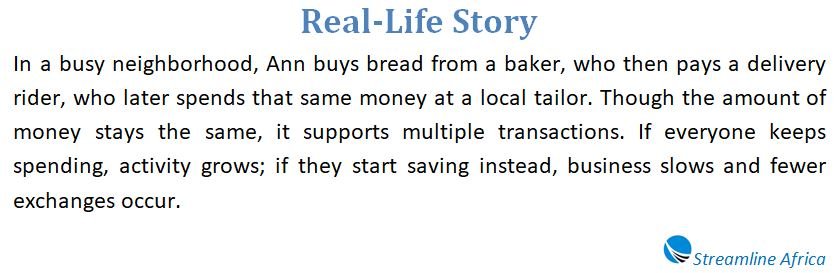
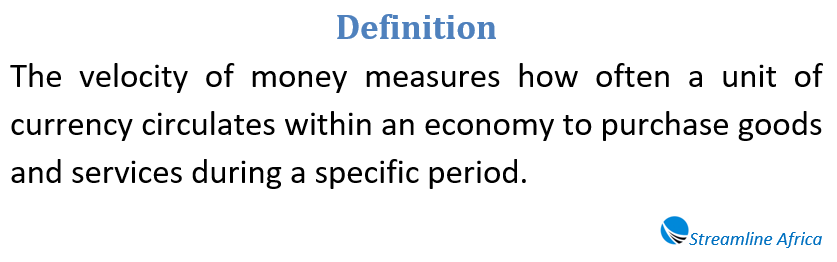
The velocity of money describes how rapidly money circulates within an economy—how frequently a unit of currency is used to purchase goods and services during a specific period. It essentially measures the “speed” of economic activity by showing how often money changes hands. A higher velocity means people and businesses are spending frequently, reflecting confidence and robust activity. A lower velocity, however, indicates that funds are being held rather than spent, often a sign of caution or recessionary pressure.
Economists calculate money velocity by dividing a nation’s gross domestic product (GDP) by its total money supply, which is typically measured as M1 or M2. M1 includes cash and demand deposits, while M2 is broader, incorporating savings accounts and money market funds. The resulting ratio demonstrates how efficiently money supports production, consumption, and investment in an economy.
How Money Moves Through an Economy
Consider a small island community where two residents—Kai and Lila—regularly trade with each other. Suppose there’s only $80 circulating in this mini-economy. Kai spends $80 buying fish from Lila. Lila then uses that same $80 to pay Kai for building her boat. The total value of these transactions equals $160, even though there is only $80 in existence.
In this case, the velocity of money is two because each dollar was used twice within the year. This example illustrates how limited money can generate significant economic activity when it circulates quickly. But if both individuals decide to save their money instead of spending, the flow slows, and economic output declines.

The Formula and How It’s Measured
The velocity of money can be calculated using a simple formula:
Velocity = GDP ÷ Money Supply
Economists apply this formula using either M1 or M2, depending on how broadly they define the money supply. GDP represents the total market value of all goods and services produced, while the money supply is the total amount of currency available for spending.
For instance, if a nation’s GDP is $18 trillion and its money supply (M2) is $9 trillion, the velocity equals two—meaning each dollar changed hands twice during that year.
While this seems straightforward, measuring velocity accurately can be tricky. Modern financial systems include digital payments, informal markets, and complex banking instruments, many of which are difficult to quantify precisely.
What Velocity Reveals About the Economy
The velocity of money provides a useful snapshot of economic sentiment and activity. A higher velocity reflects optimism, as consumers and companies are eager to spend, invest, and circulate cash. This typically coincides with economic growth. A lower velocity, on the other hand, signals restraint and uncertainty, as people hold on to money due to concerns about the future.
During boom periods, rising consumer confidence leads to greater spending, driving demand for goods and services. This can sometimes result in inflation if supply cannot keep up. Conversely, in slowdowns or recessions, spending decreases, causing businesses to cut production and prices to stagnate or fall.
While velocity alone isn’t a direct predictor of GDP or inflation, it serves as a valuable companion indicator alongside others like employment rates, consumer spending, and price levels.
Real-World Changes in Money Circulation
Historically, the pace at which money moves has shifted with global and national events. In the 1970s and 1980s, many developed economies experienced relatively high money velocity due to rapid consumer spending and investment. In contrast, since the late 2000s, velocity has slowed sharply as people began saving more and borrowing less.
After the financial turmoil of 2009, countries such as the United States, Canada, and Japan experienced persistent declines in velocity despite efforts by central banks to stimulate activity. The trend deepened during the global health crisis of 2020, when people worldwide became more cautious, hoarded cash, and reduced consumption. In that period, the velocity of broad money (M2) in major economies fell to historic lows, hovering around 1.05 before recovering slightly in 2022.
Read Also: How the Quantity Theory of Money Explains Inflation and Price Levels
Key Factors That Shape Money Velocity
Several elements influence how fast money circulates through an economy:
1. Money Supply
An increase in money supply doesn’t automatically mean faster circulation. If individuals or companies choose to save rather than spend newly created money, the velocity can actually decline.
2. Consumer Confidence
When people feel secure in their jobs and optimistic about the future, they spend more readily, which raises velocity. Fear of job loss, inflation, or unstable markets can slow spending dramatically.
3. Interest Rates
When borrowing costs are high, consumers and businesses tend to save more and delay spending. Low interest rates, on the other hand, make borrowing cheaper, stimulating purchases and investment.
4. Technology and Payment Systems
Digital wallets, online banking, and real-time payment networks can increase transaction speed. However, the effect depends on user behavior—if consumers still prefer to save, the technological advantage might not boost velocity significantly.
5. Fiscal and Monetary Policy
Government actions such as tax reductions, public spending programs, or stimulus payments can temporarily accelerate money flow. Conversely, tightening credit or increasing taxes can slow it down.
The Connection Between Velocity and Inflation
The velocity of money plays an indirect role in determining inflation. According to the Quantity Theory of Money, if the money supply grows while output stays constant, prices should rise because more money chases the same amount of goods. This assumes velocity remains stable.
However, real-world behavior complicates this theory. Since 2010, many central banks have expanded money supply aggressively without triggering immediate inflation because velocity fell at the same time. People saved more, offsetting the increase in available cash.
For example, when the Bank of England and the European Central Bank implemented large-scale stimulus programs, money supply soared, but spending stayed muted. The result was a sluggish increase in prices despite high liquidity. This demonstrates that inflation depends not just on the amount of money but also on how actively it moves through the economy.
Why Money Velocity Has Slowed in Modern Times
Several structural and social factors have contributed to declining velocity in recent decades. Aging populations in developed economies tend to save more as they approach retirement, reducing spending. Stricter banking regulations, introduced after the 2008 crisis, required institutions to hold larger reserves, limiting the flow of credit.
The global pandemic in 2020 further amplified this decline. With widespread lockdowns and uncertainty, households built up emergency savings and delayed major purchases. Businesses also hoarded cash reserves rather than investing in expansion. Even though central banks injected large sums into the economy, much of it stayed parked in deposits rather than circulating.
By 2022, data from multiple central banks indicated only a mild rebound in velocity as global economies reopened. Despite improvements, spending habits remained conservative compared to pre-2008 patterns, highlighting a fundamental behavioral shift toward financial caution.

How Velocity Relates to Economic Strength
The velocity of money is more than an abstract concept—it’s a reflection of confidence, stability, and growth potential. When money moves quickly, businesses thrive, employment rises, and governments collect more revenue through taxes. When circulation slows, it can indicate hesitation or systemic weakness.
In developing nations, a high velocity of money often reflects an expanding middle class and increased access to financial services. In contrast, advanced economies with aging demographics and high savings rates may naturally experience slower velocity even during stable times.
While velocity alone doesn’t dictate prosperity, it complements other measures of economic well-being. Policymakers, investors, and analysts use it to gauge whether economies are overheating, stable, or contracting.
A Modern Lens on Financial Movement
The velocity of money continues to evolve in the digital era. Innovations such as mobile banking, cryptocurrency transactions, and fintech platforms are reshaping how people transfer and store value. These developments could accelerate money movement over time—though whether they translate into real-world economic growth depends on how people use them.
Ultimately, the velocity of money reflects the heartbeat of an economy. It tells us not only how much money exists but how energetically it circulates to create goods, services, and opportunities. When spending is frequent and confidence is high, velocity propels growth. When fear or uncertainty take hold, money slows, and economies lose their rhythm.
In essence, understanding the velocity of money helps us grasp one of the simplest yet most revealing truths of modern economics: prosperity depends not merely on the quantity of money but on the speed with which it moves.
Frequently Asked Questions about the Velocity of Money
How is the velocity of money calculated?
It is calculated by dividing a country’s gross domestic product (GDP) by its total money supply, typically measured using M1 or M2.
What does a high velocity of money indicate?
A high velocity means money is moving quickly between people and businesses, signaling strong consumer spending and a growing economy.
What does a low velocity of money mean?
A low velocity suggests that consumers and companies are saving rather than spending, often indicating economic slowdown or uncertainty.
How does consumer confidence affect money velocity?
When people feel optimistic about jobs and income, they spend more, increasing velocity. When they’re uncertain, they save more, slowing it down.
Why has the velocity of money slowed in recent decades?
Aging populations, stricter bank regulations, and cautious saving habits since the 2008 crisis have caused a long-term decline in money velocity.
What role does the central bank play in money velocity?
Central banks influence velocity through monetary policy—lower interest rates encourage spending, while higher rates promote saving.
How does the velocity of money relate to inflation?
When money moves quickly, demand rises, which can push prices higher. Slow velocity tends to reduce inflationary pressure.
Can technology increase the velocity of money?
Yes. Digital payments, mobile banking, and instant transfers make transactions faster and easier, potentially boosting money circulation.
Why is understanding money velocity important?
It helps policymakers and investors gauge economic health, showing how efficiently money supports trade, investment, and overall growth.