
What Opportunity Cost Really Means
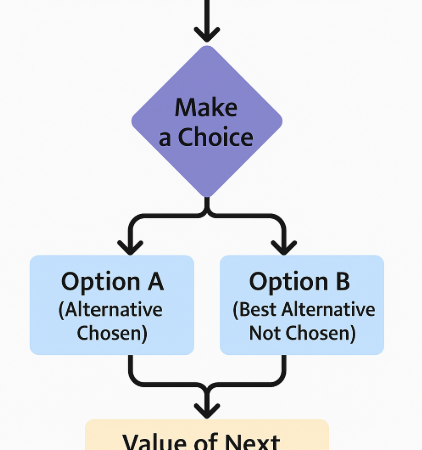
Every decision we make has a hidden cost — something we give up to gain something else. This principle defines opportunity cost, the value of the next best alternative that is sacrificed when one choice is made over another. Whether it’s a business deciding how to invest its funds, a government allocating its budget, or an individual choosing how to spend time, opportunity cost underscores the trade-offs in every action.
This concept reminds us that resources such as time, money, and labor are finite. Once they are used in one way, they cannot easily be recovered or redirected. Recognizing opportunity costs enables individuals and organizations to make wiser, more efficient choices that maximize benefit and minimize waste.
The Formula for Opportunity Cost
Economists summarize opportunity cost through a straightforward equation:
Opportunity Cost = Return on Best Alternative – Return on Chosen Option
Imagine an investor who expects a 12% return from a real estate venture but instead chooses to invest in new factory machinery expected to yield 9%. The opportunity cost is 3%, representing the return that could have been earned had the investor chosen the better-performing alternative.
Though simple in structure, this formula highlights a complex reality — that every financial or personal decision involves uncertain outcomes, influenced by risk, time, and changing market conditions.
Why Opportunity Cost Matters in Decision-Making
The strength of opportunity cost lies in its ability to clarify trade-offs. It forces decision-makers to look beyond immediate gains and consider long-term consequences. For example, a company that spends its last $100,000 on a marketing campaign may miss out on expanding production, while a student choosing to work full-time may lose the chance to finish a degree that could increase future earnings.
Understanding opportunity cost helps prioritize what truly delivers lasting value. It also encourages future-oriented thinking, guiding individuals and organizations toward choices that create sustainable benefits rather than short-term wins.
Opportunity Cost in Business
For companies, opportunity cost drives decisions about investments, production, and financing. Suppose a business has $60,000 in extra capital. It could use that money to buy upgraded technology or invest in government bonds with a predictable return. If the bonds yield 7% and the new technology could increase profit margins by 10%, the opportunity cost of choosing the bonds is 3%.
Opportunity cost also shapes a firm’s financial strategy. Borrowing funds through loans may restrict future credit opportunities, while issuing new shares could dilute ownership and reduce control. Every financing decision involves unseen trade-offs that affect long-term profitability and flexibility.
Opportunity Cost for Individuals
Individuals face opportunity costs constantly, often without noticing. If you receive a $2,000 year-end bonus, you could use it for a short vacation or invest it for future growth. Investing it in a certificate of deposit with a 6% annual return would yield $2,120 in a year, meaning the opportunity cost of that spontaneous trip is $120 in missed earnings.
Time also carries opportunity costs. Spending a weekend binge-watching shows might provide relaxation now, but the same time could have been used to complete a course, build a side business, or develop a valuable skill. Recognizing opportunity cost helps people align their daily choices with their long-term goals.
Explicit and Implicit Costs
Opportunity cost includes two major types of expenses — explicit and implicit costs.
Explicit costs are straightforward and measurable, such as rent, utilities, or employee salaries. They represent actual outflows of money recorded in accounting ledgers. For example, if a company spends $350 on supplies, that’s an explicit cost.
Implicit costs, however, are less tangible. They represent the value of resources used that could have been deployed elsewhere. For instance, if a small business owner chooses not to pay themselves for several months to help the company grow, their foregone salary is an implicit cost. Similarly, a freelancer taking unpaid time off for training incurs an implicit cost in lost income.
Both explicit and implicit costs are essential for understanding true profitability and making informed choices. Ignoring one side of the equation often leads to underestimating the real cost of decisions.

How Opportunity Cost Differs from Sunk Cost
Sunk costs are past expenditures that cannot be recovered, whereas opportunity cost looks forward to future possibilities. For example, if a company spent $15,000 on outdated equipment, that money is gone—it’s a sunk cost. The opportunity cost, however, concerns what could be gained by investing that same amount in modern machinery or research.
Sound decision-making means not letting sunk costs influence future actions. What matters most is which option will yield the highest return from this point onward, not what has already been spent.
Risk and Opportunity Cost
While both concepts deal with uncertainty, risk and opportunity cost are not the same. Risk involves the chance that an investment’s actual return will differ from expectations. Opportunity cost, by contrast, compares the potential outcomes of two or more choices.
For instance, putting $5,000 into a high-yield savings account at 4% versus investing in a start-up that could earn 12% (or nothing at all) illustrates both ideas. The opportunity cost of choosing the savings account is 8%, while the risk lies in whether the start-up succeeds. Considering both helps investors balance safety with potential reward.
Economic Profit Versus Accounting Profit
Traditional accounting profit includes only explicit costs, while economic profit accounts for both explicit and implicit costs—including opportunity cost.
For example, if a company earns $80,000 in accounting profit but could have earned $100,000 by investing elsewhere, its economic profit is actually negative $20,000. This approach provides a more realistic picture of financial performance, showing whether the firm truly maximized the use of its resources.
Opportunity Cost in Government Decisions
Governments constantly face opportunity costs in their spending choices. Allocating $950 billion to defense might mean less funding for healthcare, infrastructure, or education. These trade-offs influence not only public policy but also national welfare.
During global crises, such as the pandemic of recent years, governments faced tough decisions. Many spent trillions on public health and economic relief, which saved lives but also diverted funds from other long-term investments. The opportunity cost of these choices includes lost economic output, reduced productivity, and rising public debt.
Comparative and Absolute Advantage
Opportunity cost also forms the foundation of international trade theory. A country has a comparative advantage when it can produce a good at a lower opportunity cost than another nation.
Imagine Country X gives up 25 tons of rice to produce 100 tons of cocoa, while Country Y sacrifices 100 tons of rice to make the same amount of cocoa. Country X, with the lower sacrifice, has a comparative advantage in cocoa production. Conversely, if Country Y produces rice more efficiently with less labor, it holds a comparative advantage in rice.
Even if one nation is less efficient overall, trade allows both to specialize in what they do best, improving total global output and economic welfare.
Opportunity Cost in Healthcare and Public Policy
Healthcare decisions vividly illustrate opportunity cost. Hospitals often face limited capacity and must prioritize who receives treatment. During health emergencies, allocating beds, ventilators, or staff to one group of patients often means delaying care for others.
This trade-off underscores the importance of opportunity cost in medical resource allocation. Policymakers and hospital administrators must weigh the benefits of various interventions to achieve the greatest overall health impact within available resources.
During the pandemic, many countries redirected billions toward vaccines, medical infrastructure, and stimulus programs. While these were essential measures, they came at the opportunity cost of reduced funding for chronic disease management, education, and mental health services.
Opportunity Cost in Production and Marginal Analysis
In manufacturing, opportunity cost connects closely to marginal cost—the cost of producing one more unit of output. When production expands, resources must be diverted from other uses, creating opportunity costs.
Consider an automaker that can produce 1,000 vehicles for $20 million. Producing 1,100 vehicles may raise the total cost to $21.2 million. The marginal cost of the additional 100 vehicles is $1.2 million, which represents both the added expense and the resources that could have been used elsewhere. Efficient production balances this trade-off to maximize profitability.
The Role of Opportunity Cost in Modern Accounting and Strategy
Modern accounting and financial planning increasingly factor in opportunity cost. When companies perform discounted cash flow (DCF) analyses to decide whether to pursue a project, the discount rate used often reflects the opportunity cost of capital—the potential return that could have been earned elsewhere.
For example, if a firm invests $2 million in a project with a 9% expected return, but could have earned 11% in the bond market, its opportunity cost is 2%. Factoring in such comparisons ensures that investment decisions truly create value and do not simply appear profitable on paper.
Final Thoughts
Opportunity cost is more than an economic theory—it’s a practical mindset for decision-making in every area of life. Every choice carries an unseen cost, whether in time, money, or potential benefit. Understanding these trade-offs helps individuals, businesses, and governments use resources more efficiently and make smarter, forward-looking decisions.
In the end, opportunity cost teaches a timeless lesson: every gain comes at a price, and the wisest decisions are those made with full awareness of what we stand to give up. Recognizing this helps turn ordinary decisions into truly strategic ones that shape long-term success.
Commonly Asked Questions Opportunity Cost
Why is opportunity cost important?
It helps individuals, businesses, and governments make smarter decisions by comparing potential benefits and sacrifices. Recognizing opportunity cost ensures resources are used efficiently and not wasted on less valuable choices.
How do you calculate opportunity cost?
You subtract the expected return of your chosen option from the expected return of the best alternative. For example, if investing in a project earns 8% but another could earn 10%, the opportunity cost is 2%.
What’s the difference between opportunity cost and sunk cost?
A sunk cost is money already spent and unrecoverable, while opportunity cost looks at future benefits you miss by choosing one path over another. Sunk costs shouldn’t influence current or future decisions.
How does opportunity cost affect businesses?
Businesses use opportunity cost to decide where to invest, produce, or expand. It helps compare profits, risks, and long-term benefits between options like buying new equipment, hiring staff, or investing in stocks.
What’s the difference between explicit and implicit costs?
Explicit costs are direct, like rent or wages. Implicit costs are hidden—such as the owner’s unpaid time or potential earnings from another opportunity. Together, they form the total opportunity cost of a decision.
How does opportunity cost apply to governments?
Governments face opportunity costs when allocating budgets. Spending billions on defense or infrastructure means sacrificing funding for education, healthcare, or debt reduction. Each policy decision involves trade-offs.
How does opportunity cost relate to comparative advantage?
A country has a comparative advantage when it can produce a good at a lower opportunity cost than another nation. This principle drives international trade, allowing countries to specialize and benefit mutually.
What lesson does opportunity cost teach in daily life?
It reminds us to think before deciding—whether about money, time, or energy. Every hour or dollar spent in one way could have been used differently, so weighing the trade-offs helps achieve better outcomes.