Seigniorage is one of the most intriguing economic concepts, blending history, finance, and politics into one idea: the profit made from creating money. It represents the gap between what currency is worth in circulation and what it costs to produce. The term comes from medieval Europe, when feudal lords — or “seigneurs” — enjoyed the exclusive right to mint coins and claim the profits from them. Over the centuries, that right evolved into a powerful monetary tool that modern governments and central banks still use today.
The Core Idea Behind Seigniorage
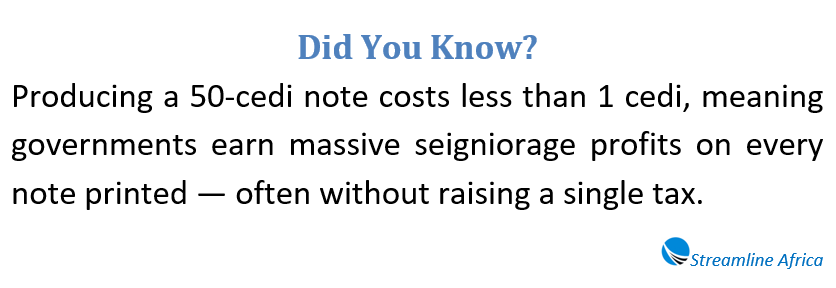
Seigniorage happens when a government earns more from issuing money than it spends to produce it. Imagine that printing a fifty-cedi note costs only fifty pesewas — the remaining forty-nine cedis and fifty pesewas become the government’s profit. That difference represents seigniorage, which can be used to finance expenditures or reduce reliance on taxes and borrowing.
However, seigniorage doesn’t always yield a profit. Some currencies cost more to produce than their face value. For instance, if it costs twenty-five pesewas to mint a ten-pesewa coin, the result is a loss. In such cases, governments often keep the coin in circulation only for convenience, not for profit.

From Metal to Paper: The Evolution of Seigniorage
In ancient times, seigniorage referred to the profit made when rulers minted coins using less precious metal than the face value implied. For example, if a silver coin contained metals worth only 80% of its declared value, the remaining 20% was profit for the ruler. The British pound, long ago, consisted of roughly 91% silver — the remaining alloy and the retained metal at the mint accounted for the seigniorage.
As money evolved from metal to paper, and eventually to digital form, the mechanics of seigniorage changed. Today, the cost of printing a note or producing a coin is minimal compared to its value in circulation. Modern seigniorage arises not from melting metals but from the difference between a currency’s face value and its printing or minting expense. Central banks now earn seigniorage mainly through interest on government securities purchased using newly created money.
Seigniorage in Modern Practice
In contemporary economies, seigniorage takes place whenever a central bank issues currency or expands the money supply. For instance, if the central bank buys treasury bills with newly printed money, it creates liquidity for the government without traditional borrowing.
Suppose the Bank of Ghana prints 10 billion cedis worth of new notes at a cost of 40 million cedis. The difference — 9.96 billion cedis — represents seigniorage. That profit supports government operations and circulates through the economy. Later, interest earned on bonds and other assets purchased with this new money adds even more revenue.
However, this money creation must be carefully managed. If too much currency enters circulation relative to goods and services, inflation can follow. That’s why seigniorage is both a financial opportunity and a potential economic risk.
The Relationship Between Seigniorage and Inflation
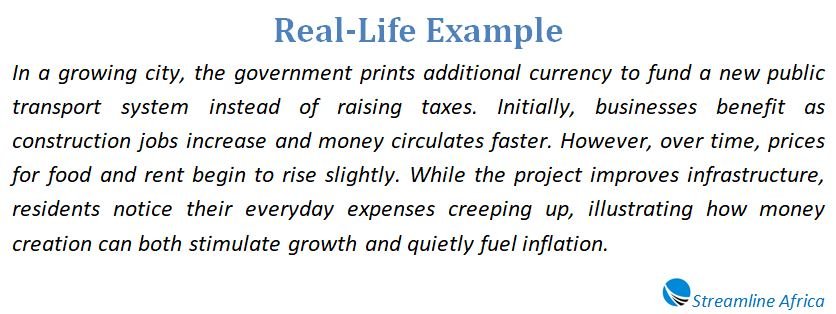
When used responsibly, seigniorage helps finance national spending and stabilizes cash flow. But when abused, it becomes one of the main drivers of inflation. Printing excessive money without matching economic output dilutes purchasing power — an indirect form of taxation often referred to as the “inflation tax.”
A notorious example comes from Venezuela in the 2010s, when the government printed massive amounts of money to cover deficits. Inflation spiraled beyond 1,000,000% in a single year, and the bolívar lost nearly all its value. What started as an attempt to raise seigniorage revenue ended as a collapse of public trust in the currency.
Seigniorage as a Source of Government Revenue
Under normal circumstances, seigniorage generates modest but steady income for governments. For example, in 2019, the United States earned about $20 billion in seigniorage, while the Bank of Canada reported roughly $110 million in 2018. Even coin-collecting programs can boost revenue: when the U.S. Mint launched its “America the Beautiful Quarters” series, millions of collectors removed coins from circulation. Each of those coins, costing around eight cents to produce but worth twenty-five cents, produced seventeen cents in seigniorage.
Beyond domestic markets, seigniorage also arises internationally. The U.S. dollar and euro are widely held as reserve and transactional currencies around the world. Economists estimate that around 55–70% of U.S. banknotes circulate outside the country, bringing in roughly $7–8 billion per year in seigniorage income. These foreign holders effectively provide interest-free loans to the United States, since they trade real goods and services for paper money that rarely returns home.
Gresham’s Law and the Value of “Good” vs. “Bad” Money
The economic principle known as Gresham’s Law — “bad money drives out good” — is deeply connected to seigniorage. In earlier centuries, when two types of coins circulated, one with more precious metal content and one with less, people would hoard the more valuable coins and spend the cheaper ones. Eventually, only the lower-quality currency remained in circulation.
Though metallic standards have faded, the same pattern appears today in different forms. When people lose faith in a nation’s currency due to inflation, they switch to more stable options — foreign money, gold, or even cryptocurrencies. This shift drains domestic currency from use, reducing seigniorage revenue and weakening the economy further.
The Balance Between Seigniorage and Economic Stability
A moderate level of inflation can actually increase seigniorage revenue because people need more money for everyday transactions. For example, if inflation rises to 6%, the government may issue additional currency to meet the higher nominal demand. But beyond a certain threshold — say, 20% or more — the benefits disappear. Citizens start rejecting local currency, using alternatives or hoarding hard assets instead.
To prevent this, central banks use policy tools such as adjusting interest rates or controlling money supply growth. These measures ensure that new currency creation matches the economy’s productive capacity rather than exceeding it. Successful seigniorage management depends on maintaining that delicate balance.
Seigniorage in an International Context
Currency circulation beyond borders is one of the most profitable forms of seigniorage. For instance, by 2022, nearly $1 trillion worth of U.S. notes were estimated to circulate worldwide, and about three-quarters were $100 bills. Based on this figure, the United States earned an estimated $250 billion in cumulative seigniorage since the 1980s from foreign-held cash.
The euro has become a major competitor, especially through its €200 and €500 notes, which are convenient for large-value transfers. One million euros in €500 notes weighs less than two kilograms — much easier to move discreetly than $1 million in $100 bills, which weighs nearly ten kilograms. The Swiss 1,000-franc note, worth roughly $1,120, also plays a similar role for wealth storage and discreet transactions.
Meanwhile, some countries limit high-denomination notes to curb illicit use. The United Kingdom, for example, has capped its highest note at £50 since the 1980s, partly to discourage counterfeiting and money laundering.
Seigniorage in the Age of Cryptocurrency
In the digital era, seigniorage extends beyond governments and banks. Cryptocurrencies, especially those using proof-of-work systems like Bitcoin, exhibit a new form of seigniorage. Miners earn newly created coins as rewards for validating transactions — essentially profiting from the act of money creation itself.
In 2024, for example, Bitcoin miners collectively earned around $10 billion in newly minted tokens. While this isn’t seigniorage in the traditional government sense, the mechanism parallels how issuing money can generate value for its creator. Some algorithmic stablecoins even regulate supply and demand automatically, mimicking central bank controls but through code rather than policy.
When Seigniorage Turns into Hyperinflation
Seigniorage becomes dangerous when it replaces sustainable fiscal policy. In extreme cases, governments facing budget crises print massive amounts of money to pay debts or wages, undermining confidence in their currency.
One example is the Weimar Republic in the early 1920s, where hyperinflation reached astronomical levels — a loaf of bread that cost one mark before the war rose to 200 billion marks by 1923. In more recent times, Zimbabwe’s inflation rate reached 500 billion percent in 2009, rendering its currency useless. Both episodes illustrate how uncontrolled seigniorage can devastate entire economies.
Conclusion
Seigniorage remains a critical but double-edged financial tool. When managed carefully, it provides governments with a valuable source of revenue without direct taxation. But when exploited recklessly, it fuels inflation, erodes savings, and damages trust in the monetary system.
In an era where both traditional and digital currencies coexist, seigniorage continues to reveal the invisible mechanics of money. Ultimately, its power lies not in the metal, paper, or code that carries value, but in the collective faith that people place in that value — the real foundation of every economy.
Frequently Asked Questions
Why Is Seigniorage Important for Governments?
It allows governments to generate revenue without raising taxes or borrowing. The profit can fund public projects, pay off debts, or support national reserves.
How Does Seigniorage Actually Work?
When a central bank issues new currency or buys government securities with newly created money, it earns revenue from the difference between the value of that money and its production cost.

Can Seigniorage Cause Inflation?
Yes, but only when overused. If too much money is printed without a matching increase in goods and services, the money’s value drops, leading to inflation.
What Is the Link Between Seigniorage and the “Inflation Tax”?
When new money enters circulation, existing currency loses some purchasing power. This loss acts as a hidden “tax” on the public, as their money buys less than before.
Do All Countries Benefit Equally from Seigniorage?
No. Countries with strong and trusted currencies, like the U.S. and Eurozone nations, benefit more because their money circulates globally, earning ongoing seigniorage revenue.
How Does Seigniorage Differ for Coins and Banknotes?
For coins, the profit comes from the metal value versus its face value. For paper money, it’s the difference between the note’s production cost and its printed value.
What Are the Risks of Relying on Seigniorage?
Overreliance can lead to runaway inflation or even hyperinflation, as seen in places like Zimbabwe and Weimar Germany, where excessive money printing destroyed the currency’s value.
How Much Profit Can Seigniorage Generate?
It varies by nation and demand for currency. For example, the U.S. has earned more than $250 billion from foreign-held dollars since the 1980s.
Can Digital Currencies Generate Seigniorage?
Yes. Cryptocurrencies like Bitcoin reward miners with newly created coins, a digital version of seigniorage that mirrors how governments profit from money creation.
What Role Does the Central Bank Play in Seigniorage?
Central banks control the money supply, manage inflation, and use seigniorage revenue to support stable economic growth while preventing excessive money creation.
How Can Seigniorage Be Managed Responsibly?
By ensuring new currency issuance aligns with real economic output. Responsible seigniorage supports fiscal balance, while reckless use undermines public trust and price stability.