

Many small businesses today are working hard to expand and build sustainable success, yet one area often overlooked is procurement — the way an organization sources the goods and services it relies on. While the business environment has seen significant growth among small enterprises across the country, their purchasing practices do not always evolve at the same pace. This is not about a lack of skill or dedication among staff. Instead, it reflects the fact that many smaller companies simply do not have the structure, systems or support to manage procurement strategically.
However, strategic procurement is not something that only large corporations can benefit from. Small and midsize businesses can also harness smarter purchasing methods to reduce costs, improve supplier relationships and strengthen operational resilience. Even without large procurement departments, smaller organizations can still access the same strategic advantages by using shared purchasing programs, consultant guidance or digital tools.
Rethinking What Procurement Means
A common misunderstanding is that procurement is just the act of buying supplies when the business needs them. This view oversimplifies the importance of how spending decisions are made. A strategic procurement approach considers not only what is being purchased, but why it’s needed, who is supplying it, and how the company can ensure consistency, quality and value over time.
Better procurement does not always mean hiring a larger team. It may mean documenting who is allowed to make purchasing decisions, negotiating better pricing structures with reliable vendors, or joining collaborative buying networks that use collective purchasing power to secure more competitive rates. When done properly, procurement becomes a key contributor to business stability and growth, rather than simply an administrative function.
How Strategic Procurement Supports Growth
There are several ways a thoughtful procurement strategy can play a direct role in business expansion. Three key factors are particularly influential:
Strong and Stable Supplier Relationships
When a company has reliable suppliers and a clear understanding of its supply chain, it can better withstand unexpected disruptions, price shifts or demand changes. A dependable supplier network also helps avoid production delays and stock shortages. In periods of growth or uncertainty, these relationships help ensure business operations continue smoothly.

Better Control of Spending
Without a central procurement system, different departments may purchase similar items from separate vendors, pay different prices for equivalent products or unintentionally select suppliers that are less cost-effective. This uncoordinated spending, sometimes referred to as “maverick purchasing,” can quickly accumulate into unnecessary costs. Strategic procurement helps eliminate duplication and ensures purchases align with company priorities, improving cash flow and reducing waste.
Access to Useful Data and Market Insight
External procurement partners, industry networks and purchasing cooperatives can provide data that many small businesses do not have the capacity to track internally. This includes cost trends, supplier performance metrics and market pricing benchmarks. Such insights support informed decision-making and help leaders negotiate better contracts or shift strategies when necessary.
Why Smaller Businesses Have an Advantage
While large corporations may have sizable procurement departments and sophisticated systems, smaller businesses possess something equally valuable: agility. Small organizations can make decisions faster, test new suppliers more easily and pivot when market conditions change without layers of bureaucracy slowing them down.
In a smaller business, the owner or senior leader is often closer to the day-to-day operations. This direct involvement allows them to evaluate supplier relationships personally, negotiate pricing with more context and respond swiftly when performance concerns arise. These closer relationships can also help build stronger trust between supplier and buyer, leading to more favorable service and pricing terms.
This nimble structure also allows small businesses to continually refine and adjust procurement strategies rather than being locked into rigid, long-term frameworks.
Steps to Strengthen Procurement Practices
Improving procurement does not require a large-scale overhaul all at once. Instead, small businesses can begin by examining how purchases are currently made and identifying where inconsistencies or inefficiencies exist. Useful questions to ask include:
- Who is responsible for approving purchases?
- Which goods or services are bought most frequently?
- Are multiple departments buying the same items from different suppliers?
- Do we have contracts in place with our vendors, or are purchases ad-hoc?
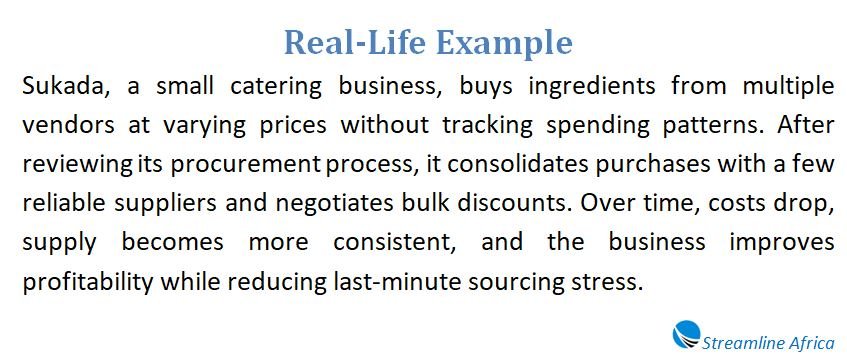
Answering these questions often reveals immediate opportunities to save costs or improve processes. For instance, a company may discover that two team members repeatedly buy the same equipment from different sources. Consolidating these purchases could secure better pricing and simplify supplier administration.
Once an organization has visibility into its purchasing habits, it can begin implementing more strategic solutions. These may include:
- Creating approved supplier lists
- Consolidating purchases to increase bargaining power
- Joining group purchasing networks to access pre-negotiated pricing
- Working with procurement consultants for specialized guidance
There is no need to make this journey alone. Industry associations, peer businesses and shared procurement programs exist specifically to help smaller organizations benefit from buying advantages usually associated with larger enterprises.
Why Strategic Procurement Matters Now
Business environments continue to change rapidly, and organizations that proactively strengthen their procurement practices will be better positioned to grow. Strategic procurement is not a luxury reserved for large companies — it is an essential part of running a sustainable business of any size.
Those who invest in improving their procurement processes today are setting themselves up for stronger financial health, reduced risks and more confident decision-making tomorrow. The question for every small business leader becomes: Is your procurement approach supporting your long-term goals, or is it holding your growth back?