When businesses manufacture products, they need to determine how much it costs to produce each unit. This cost calculation influences pricing, profit measurement, and overall financial strategy. Two common methods used in accounting for this purpose are absorption costing and variable costing. Although both methods ultimately help businesses understand their cost of goods sold, they differ in how they handle certain expenses—especially fixed manufacturing costs. These differences affect profit reporting, tax obligations, management decisions, and how financial statements are presented.
Absorption costing captures every cost associated with production, including both variable expenses and fixed overhead. In contrast, variable costing includes only the production costs that change with output levels, ignoring fixed overhead in the calculation of product cost and instead recording it as an operating expense. Because of this fundamental difference, the same product can appear more or less profitable depending on which costing method is used.
Direct and Indirect Costs in Production
To truly understand these costing methods, it is essential to distinguish between direct and indirect production costs.
Direct costs are expenses that can be directly traced to making a product. These include the raw materials used in manufacturing, wages paid to workers assembling or processing goods, and operating costs that fluctuate with production levels such as power consumption during active production runs. Direct costs are always included in the cost of goods sold because they relate specifically to what the company is producing.
Indirect costs, on the other hand, are expenses that support the business but cannot be tied to a single unit of output. These may include administrative salaries, marketing campaigns, research and development, office supplies, insurance, and depreciation on buildings or equipment used for more than one purpose. These costs are recorded as operating expenses rather than production expenses, impacting the final operating profit. The way businesses classify and allocate these costs has a meaningful impact on how profits and inventory values appear on financial statements.

How Absorption Costing Works
Absorption costing is often referred to as “full costing” because every cost associated with manufacturing is absorbed into the cost of each unit. Not only are direct labor and raw materials included, but so are fixed manufacturing overhead expenses. These overhead expenses can include property rent or mortgage payments for factory space, equipment depreciation, and salaried supervisors’ pay.
This method is the standard required by financial reporting regulations in many countries, including under Generally Accepted Accounting Principles (GAAP) in the United States. Because absorption costing spreads fixed production costs across all units manufactured, it increases the reported cost of goods sold. The result is that the gross profit reported on the income statement can appear smaller when sales remain constant.
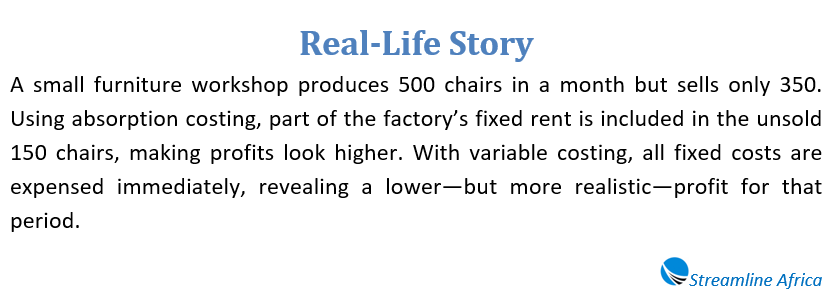
However, this method reflects the idea that every product requires a share of the factory’s resources, whether the production volume is high or low. If production increases but sales remain steady, some of the fixed overhead is stored on the balance sheet as inventory rather than expensed immediately. This can temporarily make the business appear more profitable.
Businesses using absorption costing must monitor how changes in production volumes influence inventory values and gross margins. If more goods are produced than sold, profit may appear artificially inflated. Once the excess inventory is eventually sold, those deferred costs return to the income statement.
Variable Costing and Managerial Insight
Variable costing takes a more streamlined approach by assigning only variable production costs to each product. These costs rise or fall depending on how much is produced. Fixed overhead does not affect per-unit cost in this method; instead, it is recorded as a lump-sum expense in the period in which it occurs.
This approach can provide a clearer view of the true marginal cost of producing one additional unit. Because fixed overhead is not spread across units, managers can better understand how much extra profit is earned by increasing production or sales. This makes variable costing especially useful for break-even analysis, pricing decisions, and evaluating short-term financial strategies.
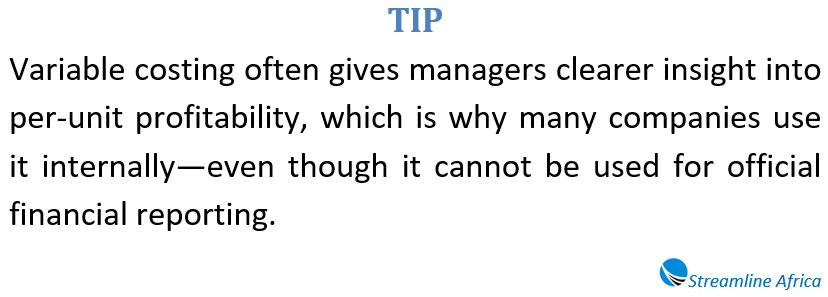
While variable costing provides stronger insights for internal planning, it does not comply with GAAP. This is because it does not match all production costs to the period in which related revenue is earned, and therefore cannot be used for preparing audited financial statements submitted to external stakeholders.
Read More: FIFO vs LIFO Accounting: Definitions, Examples, Tax Implications, and Key Differences
Comparing the Two Costing Methods
The primary difference between absorption and variable costing lies in how each method treats fixed manufacturing overhead costs.
Under absorption costing, fixed overhead is included in the cost of each product. Under variable costing, fixed overhead is recorded as a business expense for the period, rather than part of product cost.
This creates several practical differences:
- Inventory Values: Absorption costing results in higher inventory values, as some fixed costs are stored in inventory. Variable costing assigns lower inventory values because only variable costs are included.
- Income Statements: Companies using absorption costing may report higher income if they produce more than they sell, because some overhead remains in inventory. Variable costing shows expenses immediately, leading to clearer visibility of profit tied to actual sales.
- Decision-Making: Variable costing produces more accurate per-unit cost information for pricing and production planning, while absorption costing aligns better with external reporting rules.
Both systems offer value, so many companies use variable costing internally and absorption costing externally.
Illustrating the Difference with a Simple Scenario
Imagine a company manufacturing 10,000 units of a product in one year. Each unit requires raw materials and labor that cost $9 in total, and the factory overhead—such as rent and equipment depreciation—amounts to $20,000 annually.
Using absorption costing, this fixed overhead would be divided across each unit. That means $2 of overhead is applied per unit ($20,000 ÷ 10,000 units). The total cost per unit would then be $11.
Using variable costing, the overhead is not included in product cost. The cost per unit remains just the $9 variable cost, while the $20,000 overhead is listed separately as an operating expense.
This difference affects the income statement and profit calculation, especially when not all products are sold within the same period.
Which Method Is More Useful?
There is no universally “better” method—each serves a different purpose.
Absorption costing is necessary for legal reporting, tax filings, and compliance. It provides a standardized view of product cost and profit. Variable costing, however, is often more helpful for day-to-day decision-making because it reveals how production volume affects profits more transparently.
Most well-run companies rely on both: absorption costing for reporting, and variable costing for internal planning and strategic decision-making.
Final Thoughts
Understanding the distinction between absorption and variable costing helps businesses price products correctly, analyze performance, and convey financial results accurately. Absorption costing ensures compliance and consistency, while variable costing offers valuable insight into how costs behave as production changes. When used together, these methods support smarter decisions and stronger financial control.
FAQs
What Is the Main Difference Between Absorption and Variable Costing?
The key difference is how each method treats fixed manufacturing overhead. Absorption costing spreads it across all units produced, while variable costing treats it as a period expense instead of including it in product cost.
Why Do Public Companies Use Absorption Costing?
Public companies are required to use absorption costing because it follows GAAP rules for external reporting, ensuring consistency and comparability across financial statements.

When Is Variable Costing More Helpful?
Variable costing is more useful for internal management decisions. It shows how costs change with production levels, helping managers analyze pricing, break-even points, and profit planning more clearly.
How Does Absorption Costing Affect Inventory Values?
Absorption costing results in higher inventory values because fixed overhead is included in the cost of each unit. This means some overhead costs stay on the balance sheet until the inventory is sold.
Why Can Absorption Costing Affect Reported Profits?
If production exceeds sales, some fixed overhead costs are held in inventory instead of being expensed. This can temporarily increase reported profits even if sales haven’t changed.
Does Variable Costing Provide a More Accurate Unit Cost?
Yes. Variable costing reflects only the costs directly tied to producing each unit, making it clearer how much it actually costs to make one additional product.
Can Companies Use Variable Costing for Tax or External Reporting?
No. Variable costing is not GAAP-compliant and cannot be used for external reporting or taxes. It is mainly used for internal planning and decision-making.
Should Businesses Rely on Only One Method?
Ideally, no. Many businesses use absorption costing for compliance and financial reporting, while also using variable costing internally to guide pricing, production, and strategic planning.