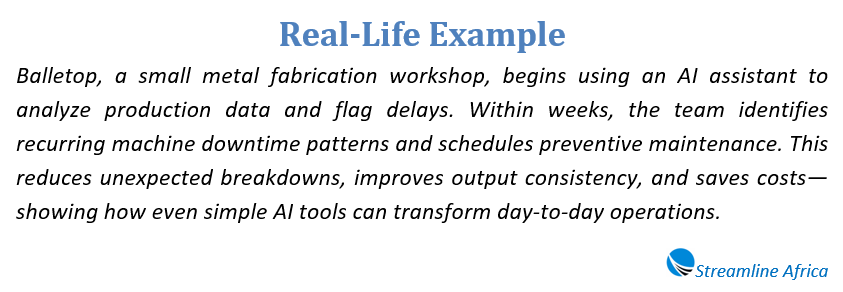
Artificial intelligence (AI) is no longer an abstract concept reserved for tech giants or futuristic startups. It has entered the world of small manufacturing, offering new opportunities for efficiency, cost reduction, and smarter decision-making. While you might not have the resources of global players like Toyota or Amazon, AI technology is becoming increasingly affordable and adaptable for smaller enterprises. The question is no longer if you should adopt it—but how you can do so effectively and safely.
In 2026, the manufacturing industry is expected to undergo a wave of AI-driven transformation. From predictive maintenance to smarter design and streamlined production, small manufacturers can begin integrating AI into their daily operations without breaking the bank. Here’s how you can take advantage of this shift and set your business up for long-term success.
Start With AI Assistants To Improve Everyday Operations
The easiest entry point into artificial intelligence is through AI assistants such as ChatGPT, Gemini, Copilot, Claude, Perplexity, or Grok. These tools are designed to simplify tasks, save time, and enhance decision-making. By subscribing to one or two of these assistants, you can instantly introduce AI into your company’s workflow.
Encourage your managers and team leads to use these assistants when drafting proposals, reports, client emails, or presentations. AI can check for clarity, tone, and accuracy, ensuring that no important communication leaves your business unchecked. You can also use AI tools for internal research—ask them for guidance on pricing strategies, supply chain solutions, or productivity ideas.
Connect your assistant to company data platforms like Google Drive, Microsoft Teams, Dropbox, or Gmail. Doing so allows you to query your business’s information quickly, turning scattered data into actionable insights. With a good AI assistant, you’re not just speeding up tasks—you’re making smarter, data-driven decisions every day.
Train Your Team To Use Microsoft And Google AI Tools
If your company already operates with Microsoft Office 365 or Google Workspace, you have a built-in advantage. Both platforms now include AI-powered tools—Copilot for Microsoft and Gemini for Google. These features can automate tasks such as creating presentations, writing professional emails, translating multilingual meetings, and summarizing discussions.
Consider hiring a short-term consultant to train your staff in using these tools. A one-time investment in training can result in lasting efficiency gains. Once your employees become comfortable with AI, they’ll not only save time but also feel more confident about adapting to future technological changes.
By 2026, these productivity suites will likely become even more integrated with AI, offering predictive analytics for project management, forecasting inventory needs, and improving collaboration across teams. Early adoption now ensures you’re ahead of the curve.
Build Your Own AI Model For Tailored Manufacturing Solutions
If you’re looking to go beyond surface-level tools, consider building an internal AI system customized for your business. Thanks to advancements in machine learning platforms, small manufacturers can now create their own models using internal data.
By connecting your ERP, accounting, HR, CRM, and inventory management systems, you can develop a unified AI-driven data hub. This system can then generate insights, automate repetitive processes, and even predict future trends—like supply shortages or equipment failures—based on past data.
While creating such a system can be costly and require technical expertise, it’s an investment that pays off in the long run. The key is to start small—build simple automation tasks and scale gradually as your team becomes more experienced with the technology.
Partner With AI-Enabled Software Providers
If developing your own AI tools seems too complex or expensive, you can turn to external providers. Many leading manufacturing software systems—such as Sage, Epicor, SAP, Infor, Acumatica, and NetSuite—now integrate AI functionalities directly into their platforms.
Reach out to your software vendors and ask them to walk you through their AI capabilities. These may include predictive maintenance alerts, quality control automation, or demand forecasting models. Evaluate which features align most closely with your operations, then roll them out in phases to ensure smooth adoption.
The key is to combine automation with human oversight. Train your employees to interpret AI-generated insights rather than relying on them blindly. When technology and human expertise work hand in hand, small manufacturers gain a powerful competitive edge.
Tap Into The Internet Of Things (IoT)
AI is even more powerful when paired with connected devices. The Internet of Things (IoT) is already transforming manufacturing by embedding sensors into machinery and equipment. These sensors collect real-time data on temperature, performance, vibration, and output—data that AI systems can analyze to detect problems before they escalate.
For instance, predictive maintenance systems use AI to monitor equipment health and notify you when a component is likely to fail. This proactive approach minimizes downtime and repair costs.
Ask your suppliers whether their machines come with built-in sensors or AI-enabled monitoring tools. Major companies like Caterpillar and Hitachi already do this, and smaller manufacturers can now access similar technology at more affordable rates.
Use Smart Devices And Augmented Reality
Beyond sensors, wearable and augmented reality (AR) devices are quickly becoming standard tools for modern manufacturers. Devices such as HoloLens, Ray-Ban Meta, and VisionPro can assist in training, inspections, and remote support.
Imagine a new employee wearing AR glasses during an equipment walkthrough—seeing visual prompts on safety procedures, component parts, or repair instructions. These technologies make training faster and more interactive while reducing the chance of human error.
Additionally, drones from companies like Gather AI and Vimaan can automate warehouse monitoring, track inventory, and inspect hard-to-reach areas. With these tools, you can maintain efficiency and safety across your facilities without significant labor increases.
Keep An Eye On Robotics And Automation
Robotics is advancing rapidly, and smaller manufacturers are starting to benefit. Companies such as ABB, FANUC, and KUKA now offer scalable robotic systems that can handle repetitive tasks like packaging, welding, or palletizing. These robots often include AI algorithms that allow them to learn from experience, improving accuracy over time.
You don’t need to invest in an entire fleet—start with one or two robots to automate high-volume or hazardous tasks. Attend industry exhibitions such as the Consumer Electronics Show (CES) or the International Robot Exhibition (IREX) to explore practical and affordable robotics solutions designed for smaller operations.
In just a few years, robotics may become as essential to small factories as computers once were to offices. By familiarizing yourself now, you’ll be ready to integrate this technology when it becomes more accessible and cost-effective.
Strengthen Data Management And Cybersecurity
As you integrate more AI tools into your operations, protecting your data becomes crucial. AI systems thrive on accurate, clean data—but they also introduce potential vulnerabilities.
Review your data storage policies and ensure that sensitive information is encrypted. Train employees on basic cybersecurity practices, such as recognizing phishing attempts and using secure passwords. Consider using cloud platforms that comply with global security standards and provide built-in AI monitoring for threat detection.
Strong data governance ensures your AI tools perform optimally while keeping your business protected from cyber risks.
Adopt AI Incrementally And Strategically
Transitioning to AI doesn’t mean overhauling your entire system overnight. The best approach for small manufacturers is gradual adoption. Start with one tool—perhaps an AI assistant or data analytics platform—and evaluate its impact before scaling up.
You’ll likely find that AI doesn’t just reduce costs but also improves creativity and problem-solving within your team. Employees can shift focus from manual data processing to more meaningful, strategic tasks that drive business growth.
The next few years will see AI evolve from novelty to necessity in manufacturing. Businesses that start experimenting now will be better positioned to compete as the technology matures.
Looking Ahead: The Future Of AI In Small Manufacturing
By 2026 and beyond, AI will be embedded in nearly every part of manufacturing—from raw material sourcing to customer delivery. While small manufacturers may not have deep pockets, they do have the advantage of agility. You can adopt and adapt faster than large corporations, experimenting with new ideas on a smaller scale.
The time to prepare is now. Learn, experiment, and train your workforce to work alongside AI tools. In just two or three years, these technologies will no longer be optional—they will define who thrives in the modern industrial landscape.
If you begin your AI journey today, your small manufacturing business won’t just survive the coming transformation—it will lead it.
FAQs
Why Should Small Manufacturers Care About AI?
AI is no longer exclusive to big companies. It’s becoming accessible, affordable, and essential for small manufacturers who want to stay efficient, reduce costs, and make data-driven decisions.

How Can AI Assistants Help Manufacturing Businesses?
AI assistants such as ChatGPT, Copilot, Gemini, and Claude can help managers draft proposals, analyze data, create policies, and streamline communication—saving time and improving accuracy across departments.
What Is The Role Of Microsoft Copilot And Google Gemini?
These built-in AI tools automate daily office tasks like summarizing meetings, writing emails, analyzing data, and managing documents, allowing teams to focus more on operations and innovation.
Should Small Manufacturers Build Their Own AI Systems?
Building an internal AI system is possible but costly. It involves integrating data from systems like ERP, accounting, and HR into a custom language model, ideal for those ready to invest long-term.
What Are The Benefits Of Buying External AI Solutions?
Using existing AI tools from manufacturing software providers like SAP, Epicor, or NetSuite saves time and money. These solutions are ready-made, tested, and come with training and support.
How Does The Internet Of Things (IoT) Tie Into AI?
IoT devices and sensors on manufacturing equipment collect real-time data about performance, safety, and efficiency. When linked with AI, they predict issues, optimize output, and reduce downtime.
Can AR Devices Improve Manufacturing Operations?
Yes. Augmented reality tools like HoloLens or VisionPro can enhance safety checks, assist with training, and streamline inventory management through visual and interactive guidance.
Are Robots A Realistic Option For Small Manufacturers?
While robotics used to be expensive, prices are dropping. Smaller factories can now explore AI-powered robots for packaging, inventory counting, or repetitive tasks to boost productivity.
What Should Small Manufacturers Do Right Now?
They should begin integrating AI gradually—starting with assistants and office tools—train their teams, clean up data, and explore industry-specific AI applications to stay ahead in the next two to three years.