

Overview of Ghana’s Economic Landscape
Ghana, located on the West African coast, has evolved into one of the region’s most dynamic economies. With a landmass of roughly 239,000 square kilometers and a population estimated at around 25 million in the early 2010s, the country has long relied on its natural resources and agricultural capacity to sustain growth. Agriculture has historically served as the backbone of the economy, employing a large share of the workforce and contributing significantly to national output. Key staples such as cassava, plantain, millet, sorghum, yam, and maize dominate local farming activities, while export-oriented crops—particularly cocoa—play a central role in generating foreign exchange.
Beyond agriculture, Ghana’s abundant mineral wealth contributes substantially to economic performance. Commodities like gold, bauxite, manganese, and diamonds form the core of its extraction sector and drive much of its export revenue. Over the past decade, new energy resources, especially crude oil and natural gas, have deepened Ghana’s profile as a rising economic player. These combined resources have not only attracted foreign investors but also strengthened the country’s reputation as one of Africa’s fastest-growing economies.
Agriculture and Natural Resource Contribution
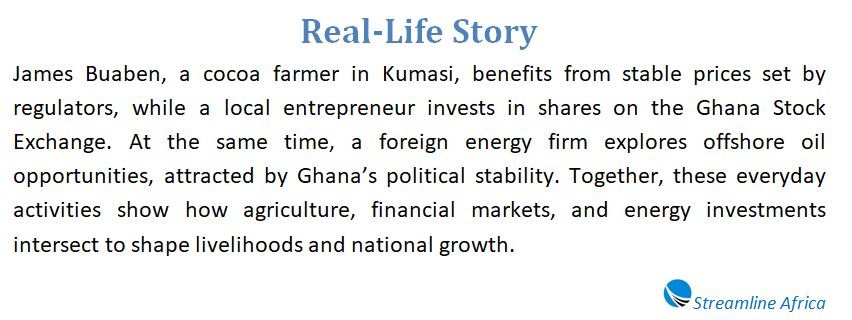
Agriculture has remained a stabilizing force for Ghana’s economy for decades. A significant proportion of the population works in farming, and the sector supports livelihoods in both rural and peri-urban communities. To safeguard export earnings and minimize illegal trade in cash crops, Ghana established specialized regulatory bodies responsible for overseeing production and export processes. Agencies supervising cocoa, shea, cashew, and other major crops ensure quality control, stabilize prices, and curb illicit market activities. Their efforts have strengthened government revenue streams from agricultural exports and provided job opportunities for thousands of citizens.
Mining, too, has cemented its role as a core economic engine. Ghana is consistently ranked among the world’s top gold producers, attracting multinational corporations seeking stable operations in Africa. The country also possesses large deposits of phosphates and bauxite, making mining an important pillar of industrial output. As the sector continues to modernize, Ghana’s mineral industry remains strategically important, offering employment, stimulating infrastructure development, and expanding the country’s footprint in global commodity markets.

Energy Production and Economic Growth
One of Ghana’s most notable economic transformations began with the discovery of major oil fields in the mid-2000s. Commercial oil production has enhanced government revenue and drawn new investments into energy exploration, petrochemicals, and other auxiliary industries. Early projections estimated daily crude output of more than 100,000 barrels, with national aspirations to increase production significantly by 2020. Though operational challenges and fluctuating global oil prices affect progress, energy discoveries have undeniably strengthened Ghana’s growth trajectory.
Strong private-sector performance and improvements in public-sector institutions have also contributed to Ghana’s economic expansion. Investors have shown increasing interest in the country’s gas resources, while large projects in power generation, manufacturing, and banking have deepened the sophistication of the corporate environment. These trends have helped Ghana maintain growth rates that surpass many neighboring economies.
Financial Markets and Investment Climate
Ghana’s financial sector has undergone significant modernization, with its stock exchange emerging as one of the largest and most active in Africa. The Ghana Stock Exchange has grown notably in market capitalization, encouraging participation from both domestic and international investors. Companies listed on the exchange represent sectors such as banking, telecommunications, manufacturing, mining, and consumer goods. This broad representation enhances liquidity and provides investors with diverse entry points into Ghana’s business ecosystem.
Despite these achievements, certain systemic obstacles continue to affect investor confidence. Property rights procedures in Ghana often face criticism for being slow and vulnerable to bureaucratic inconsistencies. Corruption, though lower than in some regional counterparts, remains a challenge. Weak enforcement of legal standards can complicate business operations, affecting both local entrepreneurs and global investors. Addressing these issues is essential if Ghana is to strengthen its competitiveness and fully unlock its investment potential.
Population Structure and Social Dynamics
Ghana’s population is ethnically diverse, with more than 70 ethnic groups contributing to the nation’s cultural richness. Literacy rates have improved over the years, although disparities persist between males and females. Rural communities make up a major share of the population, and regional urbanization patterns show higher concentration of people in the southern parts, especially around major cities such as Accra, Kumasi, Tema, and Sekondi-Takoradi.
English serves as the official language due to Ghana’s colonial history, providing an advantage in international business and global trade relations. Family structures remain influential in Ghanaian society, shaping social interactions and sometimes affecting workplace practices. While strong family bonds reinforce community support systems, they can also contribute to challenges like favoritism in employment settings.
Religious diversity is significant, with Christianity being the majority faith, followed by Islam and traditional belief systems. Some northern communities have experienced ethnic conflicts in past decades, often driven by disputes over leadership or land. Although the government has taken steps to stabilize these regions, periodic tensions highlight the importance of sustained peacebuilding efforts.
Political Stability and Democratic Governance
Ghana is widely recognized for its stable political environment and commitment to democratic governance. Since returning to multi-party democracy in the 1990s, the country has held several competitive elections accompanied by peaceful transitions of power. This consistency has strengthened its standing as a model democratic state in Africa.
A defining moment for Ghana’s political credibility occurred when the presidency changed hands following the sudden passing of a sitting president. The seamless transfer of power reinforced global confidence in Ghana’s institutions. Elections held in subsequent years continued to uphold democratic traditions, solidifying the country’s reputation as a reliable destination for investment and international partnerships.
Political stability plays a major role in Ghana’s economic success. Investors are more likely to commit capital to countries where governance frameworks are predictable, disputes are settled peacefully, and economic policies are consistently implemented. Ghana’s performance in these areas makes it one of the most attractive business environments in West Africa.

Evaluating Cash Offers: Key Considerations
When assessing a cash-based takeover proposal, shareholders and decision-makers must look beyond the immediate payout. While the appeal of instant liquidity is powerful, the long-term financial implications also matter. One of the first factors to examine is whether the offered price truly reflects the value and future potential of the company. A generous cash proposal may seem attractive, but if the business is poised for significant growth, accepting a lump sum today might mean missing out on greater returns in the future. Because of this trade-off, investors often compare the cash offer to projected earnings and anticipated market conditions to evaluate whether the deal maximises their long-term interests.
Another important consideration involves the tax impact of accepting cash. In many jurisdictions, receiving cash for your shares triggers immediate capital gains taxes. This can significantly reduce the net amount shareholders ultimately keep. In contrast, offers structured with stock sometimes allow taxes to be deferred until the new shares are sold. As such, even an all-cash proposal with an impressive headline value may leave investors with less money after taxes. Financial advisors often recommend consulting a tax professional to understand how much of the payment would remain after legal and personal tax consequences are considered.
The financial stability of the acquiring company also plays a crucial role in evaluating the merits of the deal. If the buyer plans to fund a large cash acquisition using substantial debt, it may raise concerns about the combined company’s post-merger performance. High leverage can restrict a company’s ability to invest in new opportunities or weather sudden economic changes. Although cash offers give shareholders immediate payment, they still benefit indirectly from the long-term success of the merged enterprise. When the acquirer takes on excessive financial risk, this perceived stability can be called into question, making some shareholders hesitant to approve the transaction.
Shareholders should also consider the timing and broader market backdrop when reviewing a cash offer. Volatility, inflation, interest rates, and economic trends can influence whether an immediate payout is preferable to holding the investment longer. For example, during periods of market downturn or rising uncertainty, an all-cash acquisition may appear more attractive because it delivers guaranteed value quickly. Conversely, when markets are thriving and growth forecasts are strong, shareholders might prefer stock-based offers that allow them to participate in rising valuations. Understanding the broader economic context helps provide a clearer picture of whether the cash acquisition aligns with current financial realities.
Lastly, the transparency of the proposal and the clarity of the buyer’s intentions can influence the decision-making process. Shareholders often prefer deals where the acquiring company clearly outlines its operational plans, integration approach, and long-term vision. When the buyer provides detailed information about the future direction of the business, investors feel more confident that the acquisition is being pursued for strategic and sustainable reasons rather than speculative gain. This level of clarity helps shareholders make informed decisions about whether accepting a cash offer is in their best interest.
How Companies Use Cash Offers Strategically
In corporate mergers and acquisitions, companies use cash offers as a strategic tool to gain competitive advantage. This approach is particularly common when the acquiring company wants to complete the transaction quickly and avoid the complexities associated with stock-based deals. By offering cash, the acquirer can streamline the process and reduce the involvement of regulatory hurdles related to issuing additional shares. Speed is often an essential factor, especially in competitive bidding scenarios where multiple companies are vying for the same target. A fast, straightforward deal can give one bidder a clear edge over others.
Cash offers are also useful in situations where the acquirer wants to preserve its capital structure. Issuing new shares can dilute ownership and potentially affect the company’s market valuation. If the acquiring firm believes that maintaining its existing share distribution is important for investor confidence or future financing plans, paying cash allows it to retain its current equity structure. This approach ensures that existing shareholders of the acquiring company maintain their influence and stake without the complications of a diluted shareholder base.

Additionally, companies sometimes use cash acquisitions to take advantage of favourable economic conditions. When interest rates are low, borrowing becomes cheaper, making it more attractive for firms to fund acquisitions using debt. This strategy allows companies to leverage borrowed funds instead of using equity, enabling them to acquire promising businesses without sacrificing ownership. In some cases, companies with strong financial reserves prefer to deploy excess cash holdings through strategic acquisitions rather than letting capital sit idle. This helps improve return on assets and strengthens long-term growth potential.
Another strategic motivation behind cash offers relates to the alignment of incentives. When shareholders receive cash, they benefit immediately and completely exit their stake, allowing the acquiring company greater freedom to restructure operations without resistance. This is particularly advantageous when the buyer intends to make significant changes to the business, such as revising management structures, modifying product lines, or adopting new operational strategies. With former shareholders fully bought out, integration becomes more streamlined and less contentious.
Finally, cash offers can help acquirers avoid absorbing the target company’s stock-related volatility. Share prices fluctuate based on market sentiment, news cycles, and investor speculation. By offering cash, the acquiring company eliminates the uncertainty that share-based deals introduce. This ensures that the agreed-upon value remains consistent from negotiation to closing, protecting both parties from market swings that could complicate or derail the transaction. For buyers seeking certainty and control, cash offers provide a clear and predictable path forward.
Read More: A New Beginning: Why More Black Americans Are Moving to Ghana to Build Wealth and Find Freedom
Examples of Cash Offers in Corporate Transactions
Cash offers have been part of many high-profile acquisitions across industries. One common example involves technology companies using cash to acquire smaller firms with specialised expertise or strong intellectual property. Large technology corporations often accumulate substantial cash reserves, and buying emerging companies outright allows them to integrate valuable innovations quickly. This strategy helps them stay ahead in competitive markets while avoiding the complexities of stock issuance.
In the retail and consumer goods sector, cash acquisitions are frequently used to consolidate market share. Companies may purchase competitors, suppliers, or distributors to streamline operations, reduce costs, and expand their reach. Paying cash helps avoid disputes over share valuations, which can be especially volatile in markets driven by consumer sentiment. These deals often proceed smoothly because the certainty of cash appeals to both investors and company leadership.
The pharmaceutical and healthcare industries provide additional examples, where companies often acquire promising startups developing new treatments. Because drug development is costly and risky, large firms prefer to use cash to quickly secure intellectual property or research pipelines. The reliability of cash offers encourages early-stage companies to sell, giving them immediate funding while allowing the acquirer to take over long-term development efforts.
Real estate investment firms also commonly use cash to secure property portfolios. Cash transactions allow them to move rapidly, beating out buyers who require financing approval. In competitive property markets, speed can determine whether a deal succeeds or falls apart, making cash offers a powerful tool for serious investors.
Across these examples, the common theme is that cash provides speed, clarity, and certainty. Whether the goal is to obtain technology, expand into new markets, or secure valuable assets, cash offers often deliver a straightforward and appealing path to closing the deal.
Conclusion
Cash acquisitions are a popular strategy in the world of mergers and acquisitions because they offer clarity, speed, and immediate value. For sellers, they remove uncertainty and provide quick access to funds, making them particularly enticing in volatile economic climates. For buyers, they eliminate the complexities associated with issuing stock and help safeguard ownership structures, enabling companies to remain competitive while executing bold strategic moves. However, cash offers also come with challenges, including tax implications, financing concerns, and the pressure of accurately valuing the deal. By understanding the advantages, drawbacks, and long-term considerations, businesses and investors can make informed decisions that align with their goals. Cash offers will continue to play a significant role in shaping corporate transactions, providing a powerful option for companies looking to seize opportunities with confidence and precision.
Frequently Asked Questions
What Makes Ghana’s Economy Stand Out?
Ghana stands out for its mix of agriculture, minerals, and fast-growing energy resources, creating one of West Africa’s most dynamic economies.

Why Is Agriculture So Important to Ghana?
Agriculture employs a large portion of the population, supports rural livelihoods, and provides major export income—especially through cocoa.
How Do Regulatory Bodies Support Agricultural Exports?
They oversee quality control, pricing, and trade practices to reduce illicit activities and protect both farmers and national revenue.
Why Is Mining a Major Driver of Ghana’s Growth?
Ghana is a top global gold producer and holds significant bauxite, manganese, and phosphate deposits, attracting investment and supporting industrial activity.
How Has Oil and Gas Changed Ghana’s Economic Outlook?
The discovery of commercial oil transformed revenue streams, boosted investor interest, and expanded the country’s energy industry.
What Attracts Investors to Ghana’s Financial Markets?
A growing stock exchange, diversified listed companies, and ongoing financial modernization make Ghana an appealing investment destination.
What Challenges Still Affect Investor Confidence?
Slow property rights processes, corruption concerns, and inconsistent enforcement of regulations continue to pose risks.
How Does Ghana’s Population Structure Influence Its Development?
A youthful, diverse population with improving literacy supports economic growth, though rural inequalities and regional tensions persist.
Why Is Political Stability a Key Strength for Ghana?
Peaceful transitions of power and strong democratic institutions make Ghana one of Africa’s most stable environments for business.

What Should Shareholders Consider in Cash Acquisition Offers?
They must weigh immediate liquidity against taxes, future company value, market conditions, and the financial health of the acquiring firm.
Why Do Companies Prefer Using Cash in Acquisitions?
Cash speeds up deals, avoids share dilution, reduces regulatory hurdles, and provides certainty in volatile markets.
How Do Cash Offers Shape Corporate Strategy?
They help companies acquire innovation quickly, expand market share, secure assets, and maintain control without market-driven valuation swings.