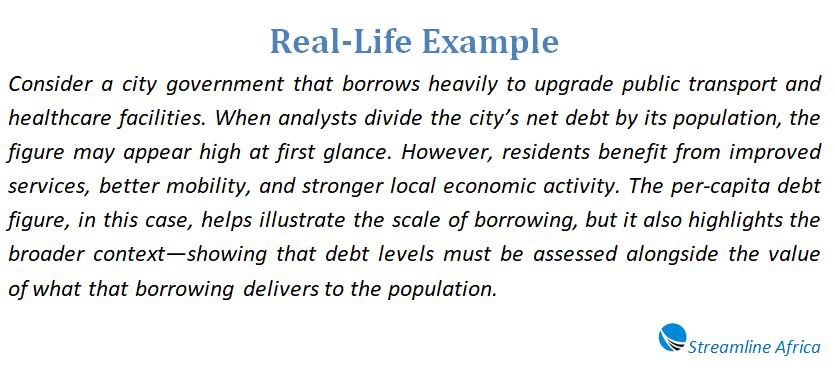
Net debt per capita is a concept that frequently surfaces in discussions about public finance, especially when the conversation turns toward how heavily indebted a government may be. While the phrase itself might sound technical, its underlying idea is straightforward: it represents the amount of government debt that would theoretically be assigned to each individual living within the boundaries of that government’s authority. This metric is used in many political debates, economic assessments, and financial analyses as a simplified way of illustrating the burden of public debt. Although it is not a perfect measure, it can help the public visualize the scale of a government’s financial obligations in relation to its population size.
In practice, no government would ever ask each citizen to pay their portion of the national debt directly, nor is such a scenario feasible. Nonetheless, the figure serves as a symbolic tool—a way of showing how a government’s borrowing choices accumulate over time and what that accumulation might look like if evenly distributed across the population. For policymakers, analysts, and voters, understanding how this measure works can offer useful perspective on broader economic conditions and long-term fiscal sustainability.
What Net Debt Per Capita Represents
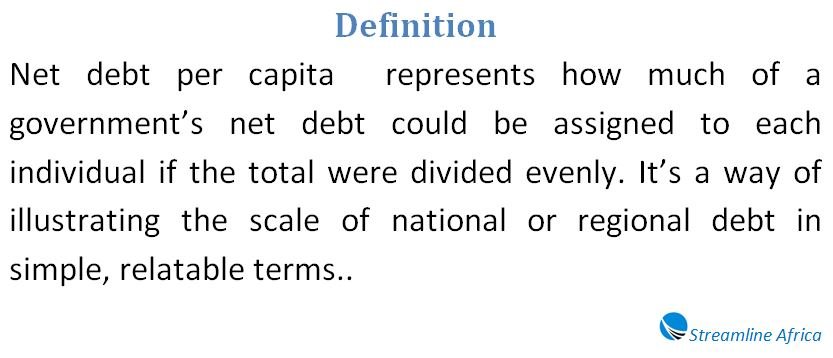
At its core, net debt per capita expresses a government’s outstanding debt after subtracting its most liquid assets, and then dividing the result by the total population. In other words, it takes the government’s gross borrowing, reduces it by the amount of cash or near-cash reserves it holds, and allocates the remainder across the individuals living in the country, state, or municipality. Although the calculation is often applied at the national level, it can just as easily be used for state or city governments, provided the necessary financial data is available.
The “net” portion of the term matters. Governments often hold substantial cash reserves, short-term investments, or other assets that can offset the total amount they owe. Subtracting these assets results in a more realistic depiction of the government’s financial position than looking at gross debt alone. The population number used in the denominator of the calculation is most often drawn from census data, population estimates, or official administrative records.
The formula can be expressed as:
Net Debt Per Capita = (Short-Term Debt + Long-Term Debt – Cash and Cash Equivalents) / Total Population
Because many organizations track and publish these figures regularly, individuals rarely need to compute the value themselves. International organizations, research institutes, and financial agencies frequently update public databases that allow users to explore debt levels across different regions of the world.
How the Calculation Works in Practice
To see how net debt per capita functions, consider a hypothetical example. Suppose a country with 300 million residents owes a total of $950 billion in combined short- and long-term liabilities. If it possesses $20 billion in liquid financial reserves, its net debt would be $930 billion. Dividing this amount by the population results in a per-person debt burden of approximately $3,100.
This number does not imply that every citizen personally owes $3,100 to lenders or that the government intends to collect such an amount from each person. Instead, it offers a way to visualize the magnitude of the debt by assigning a proportional share to each resident. Because national debt figures can be enormous, breaking them down into per-capita terms helps make otherwise abstract government financial obligations more comprehensible.
Why Governments and Analysts Pay Attention to Net Debt Per Capita
While the debt per capita measure is frequently employed for communication in political settings, it also provides useful insights for analysts evaluating the fiscal health of a government. Investors, for instance, may examine the figure when considering the risk of default by a sovereign borrower. A high per-capita debt load could signal a heavy debt burden relative to the size of the population supporting it, though it is not the only factor investors consider. A country with high productivity, strong institutions, and consistent economic growth may be able to sustain a higher per-capita debt than one with weaker economic fundamentals.
Still, its most common use remains political. Politicians often cite net debt per capita as a way of making government borrowing levels feel immediate and personal. Saying that a government owes trillions of dollars may not resonate with voters, but dividing that number into a hypothetical “share” per citizen can feel more direct. This technique is particularly prevalent in debates over budget deficits, spending cuts, or tax policies.
A more frequently used metric in global economic comparisons is the debt-to-GDP ratio, which measures a government’s outstanding debt in relation to the size of its economy. This ratio is often preferred by economists because it accounts for economic capacity. However, net debt per capita still holds value when comparing regions with similar population sizes or when attempting to convey debt levels in an intuitive way that the general public can grasp.
Using Net Debt Per Capita for Broader Economic Comparisons
Although net debt per capita is not the primary indicator used for international comparisons, it can still illuminate significant differences among nations. For instance, when comparing two countries with similar economic structures but different population sizes, debt per capita may reveal striking disparities in how much borrowing each government relies on.
Analysts sometimes pair net debt per capita with GDP per capita to identify regions where economic output per person is either well-supported or weighed down by government borrowing. However, producing such comparisons can be tricky without context. A region with high per-capita debt and high per-capita income may still be economically healthy, while one with moderate debt and low income may be more vulnerable to fiscal strain.
Charts that visualize these relationships often reveal clusters of countries where high-income economies tolerate higher debt loads because they generate strong, stable tax revenues. In contrast, countries with more fragile economic structures may struggle with even modest levels of borrowing. Thus, while net debt per capita alone does not determine economic stability, it can serve as a starting point for deeper analysis.

Why Some Countries Have Rising or Falling Debt Levels
In the case of the United States, for example, the national debt has risen significantly over the past decade. A major driver of the increase came from extraordinary government spending during the COVID-19 pandemic, when large fiscal packages were enacted to support workers, households, and businesses. The pandemic forced governments worldwide to deploy massive stimulus programs, leading to rapid rises in debt levels in many advanced economies. As a result, the per-capita debt burden of the United States climbed sharply.
Other countries experience shifts in debt levels for different reasons. Nations with strong export sectors or substantial natural resource revenues may accumulate surpluses and avoid borrowing altogether. Some governments choose to maintain low or near-zero net debt as a policy priority, placing strict controls on spending or saving substantial revenues from key industries.
Examples include certain resource-rich nations that collect significant income from natural gas or petroleum production and deposit portions of that income into sovereign wealth funds. Likewise, financially robust city-states with high-income populations may maintain low borrowing needs due to efficient public administration and consistently strong investment flows.
Countries With Little or No Net Debt
A few nations stand out for maintaining minimal or negligible levels of national debt. Some resource-rich economies, for example, rely heavily on the revenues generated from energy production to fund public services without using debt markets extensively. Others serve as global financial centers, attracting investment inflows that allow them to maintain strong fiscal positions.
There are also countries that, because of historical experiences with financial crises or defaults, intentionally avoid taking on new obligations. Their governments may choose to operate with conservative fiscal policies to prevent a repeat of past instability. While such approaches can promote long-term stability, they often require strict spending discipline and careful management of public finances.
The Practical Meaning of Debt Per Capita
Although net debt per capita is commonly presented as though every person would owe a fixed sum to eliminate public debt, the figure does not reflect any actual repayment obligation. Governments meet debt service requirements by raising taxes, issuing new debt, or adjusting spending—not by billing citizens individually. The figure instead acts as a communication tool to demonstrate the relative scale of public borrowing.
Despite its limitations, the number remains a useful part of the public finance conversation. It helps translate complex macroeconomic topics into concepts that individuals can understand more readily. When used alongside other indicators—such as economic growth, interest rates, or budget balances—it contributes to a fuller picture of a government’s financial condition.
The Significance of Understanding This Metric
In the end, net debt per capita helps bridge the gap between vast national debt figures and everyday experience. It makes the consequences of fiscal decisions more relatable and helps highlight the long-term implications of government borrowing. While it should not be used in isolation to judge a country’s financial health, it remains a valuable tool for discussion, comparison, and public awareness.
Governments, analysts, and citizens benefit from understanding this measure not because it predicts individual financial responsibility, but because it offers clarity and perspective. By expressing debt in per-person terms, the concept encourages informed debate about fiscal policy and helps shine a light on how government decisions echo through the economic landscape over time.
FAQs about Net Debt Per Capita
How is net debt per capita calculated?
It’s found by subtracting a government’s cash or liquid assets from its total debt, then dividing that figure by the population. This yields a per-person share of the government’s net debt.
Why do governments subtract cash and liquid assets?
Doing so provides a clearer picture of what the government truly owes. Cash reserves can offset some of the debt, so removing them creates a more realistic estimate of financial exposure.
Does net debt per capita reflect what each citizen must pay?
No. It’s purely symbolic. Citizens aren’t billed for their portion of the debt. The measure simply helps people grasp the size of the government’s obligations.
Why is this metric often used in political discussions?
It makes large, abstract debts feel personal. Politicians and advocacy groups use it to highlight fiscal concerns or push for changes in spending, taxation, or borrowing policies.
How do analysts use net debt per capita?
Analysts may look at it to gauge fiscal pressure or compare different regions. While not as commonly used as the debt-to-GDP ratio, it provides context about how much debt is being supported by each resident.
How does it compare with the debt-to-GDP ratio?
Debt-to-GDP is more widely used because it links debt to economic capacity. Net debt per capita, on the other hand, focuses on the burden relative to the population rather than economic output.
Why has U.S. net debt per capita grown rapidly in recent years?
A major surge in borrowing occurred during the COVID-19 pandemic, when the government spent heavily to stabilize the economy, support households, and sustain businesses.
Do any countries have little or no net debt?
Yes. Some resource-rich nations and financially strong city-states keep extremely low debt levels, often by using revenue surpluses from natural resources or strong investment inflows.
What is the value of understanding net debt per capita?
It helps citizens and policymakers translate massive national debt figures into something easier to visualize, encouraging clearer conversations about government borrowing and long-term fiscal stability.