

Economists often look for ways to understand whether an economy is running smoothly or facing strain, and one of the key tools used to make this judgment is the output gap. This measure compares what an economy is currently producing with what it could produce if all resources—labour, capital, and technology—were being used efficiently. Although the concept is widely used in fiscal and monetary policymaking, especially in regions like the European Union, it remains heavily debated because the idea of “potential output” is based on estimates rather than concrete data. Despite its limitations, the output gap continues to shape central bank decisions, budget policies, and national forecasts.
What the Output Gap Represents
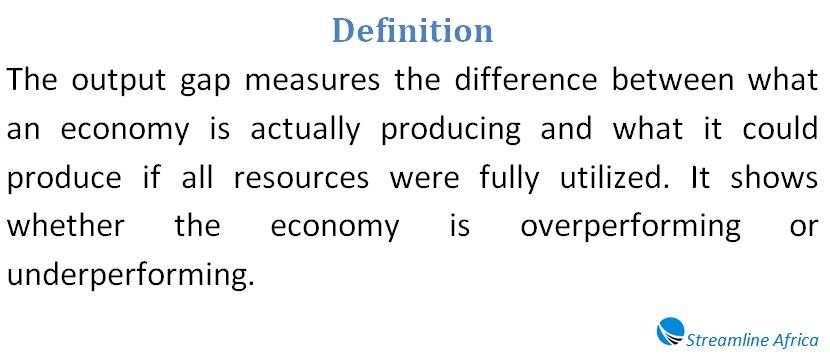
The output gap reflects the difference between actual economic output and the level of output an economy could sustain without sparking instability. When actual production exceeds its estimated limit, the economy enters what is known as a positive output gap, usually associated with rising prices as demand stretches resources. Conversely, a negative output gap signals underused capacity—factories not running at full capacity, workers unable to find jobs, and businesses experiencing weak demand.
Economists express the gap as a percentage of potential GDP, making it easier to compare across countries and time periods. A negative value indicates that the economy is underperforming, while a positive value suggests excessive demand pressures. Policymakers often keep a close eye on this number because it helps them determine whether they should stimulate growth, cool down inflation, or stay on course.
A Simple Economy in Motion
A country’s factories and workforce are capable of producing more goods than they currently are, but weak consumer demand leads to lower production and rising unemployment. In response, the government reduces interest rates and increases spending to stimulate activity. As demand recovers, businesses expand output, jobs return, and the economy gradually moves closer to its full potential.
Calculating the Gap
Although the formula is simple, the underlying assumptions are complex. The basic calculation subtracts potential output from actual output and divides the result by potential output. If the value is above zero, the economy is running hot; if below, it is struggling to keep pace. Yet this simplicity hides a major challenge: potential GDP is not an observable variable. Economists estimate it using historical data, long-term trends, or various mathematical filters. This lack of a standard method is the root of many criticisms.
Some economists rely on a logarithmic approach to approximate percentage differences more smoothly, comparing the natural log of actual GDP with the log of potential GDP. In practice, both approaches aim to capture the same basic question: how much is the economy deviating from where it should ideally be?
Okun’s Law and the Link to Unemployment
A well-known economic relationship, Okun’s law, helps connect the output gap with unemployment. The law suggests that for every one-percentage-point increase in cyclical unemployment—unemployment above the natural or expected level—GDP falls below its potential by a predictable percentage. Although the exact number varies by country and over time, the implication is clear: when fewer people have jobs, the economy’s output suffers. This connection provides one reason governments often pay close attention to labour market data when making economic decisions.
Effects of a Persistent Output Gap
When an output gap lasts for a long time, especially when it is negative, the consequences can be far-reaching. A weak labour market means many people who want to work are unable to do so, reducing household income and slowing overall spending. Prolonged unemployment may also damage individuals’ skills and limit their ability to rejoin the workforce later—a phenomenon known as hysteresis. When workers remain idle, their productivity may decline, and businesses may invest less in training, technology, and innovation.
There are also consequences for public finances. Lower output translates to lower tax revenue, while higher unemployment increases government spending on support programmes. This combination widens budget deficits and can limit a government’s ability to respond to future crises. Studies suggest that each dollar the U.S. economy moves away from its potential level results in a sizable increase in cyclical deficits, illustrating how interconnected output and public budgets are.
The Debate Over Output Gap Estimates
While the output gap is a widely used indicator, it is also one of the most contentious. In the European Union, estimates produced for fiscal oversight have faced heavy scrutiny from academics, economists, and think tanks. Critics argue that the models used to estimate potential GDP are overly complex, internally inconsistent, and often produce results that are too sensitive to the economic cycle. Some countries, such as Italy, have been cited as examples where the calculated gaps appear implausible or excessively pro-cyclical.
EU officials have defended their methodology, claiming that it reflects expert consensus and is necessary for standardised oversight. Nonetheless, critics maintain that inaccurate estimates can lead to misguided policy recommendations, such as unnecessary austerity or misaligned spending rules. This debate underscores a central issue: because potential output is not directly measurable, any policy built on it must be treated with caution.
How Policymakers Use the Output Gap
Despite its imperfections, the output gap remains an important guide for economic policy. Central banks use it to determine whether to tighten or loosen monetary conditions. A positive gap may prompt interest rate hikes to control inflation, while a negative gap often leads to lower rates or stimulus measures aimed at reviving demand. Governments also use output gap estimates when designing budgets, adjusting spending, or evaluating whether the economy needs additional support.
The metric also informs everyday decisions. Investors may look at output gap trends to anticipate interest rate changes, while businesses might use the information to gauge demand or plan expansions. Even homeowners or borrowers may pay attention if they expect that shifting economic conditions will affect loan rates or job security.
Strengths and Limitations of the Output Gap
One of the advantages of the output gap is its ability to summarise how an economy is performing relative to its potential. It provides insights into inflationary pressures, resource utilisation, and overall economic health. Because it incorporates GDP, it captures broad economic activity and helps decision-makers maintain balance in the economy.
However, its biggest weakness lies in its reliance on estimated potential output. Different economists may use wildly different models and still arrive at estimates they consider reasonable. Potential GDP can be influenced by numerous factors, including demographics, technological progress, business confidence, and financial conditions. During periods of major disruption—such as global recessions, pandemics, or sudden structural shifts—estimating potential output becomes even more uncertain.
These challenges mean that the output gap should not be the sole basis for major economic decisions. Instead, it should be used alongside other indicators, such as inflation, employment data, productivity trends, and business sentiment.
Real-World Examples
The United States provides several useful illustrations of how the output gap works in practice. For instance, in 2013 the Congressional Budget Office estimated that the U.S. economy was operating roughly six percent below its potential, reflecting the lingering effects of the financial crisis. This negative output gap was one reason policymakers maintained low interest rates and adopted stimulus measures.
In contrast, data from late 2020 showed the U.S. experiencing a positive output gap, with actual GDP exceeding potential GDP according to some estimates. Even though other analysts produced slightly different figures, the general consensus was that demand was strong. In such circumstances, central banks often raise interest rates to prevent overheating. Indeed, the Federal Reserve had been steadily increasing rates before sudden global disruptions forced a reversal.
Questions People Commonly Ask
Many people wonder what potential output really means. In simple terms, it refers to the highest level of production an economy can sustain without triggering instability. Another common question is how the output gap changes during a recession. During downturns, actual output typically falls below potential, creating a negative gap. Governments may react by adjusting taxes, spending, or borrowing to support recovery.
There are also questions about how policymakers can reduce inflationary gaps. Governments might lower spending, adjust bond issuances, or coordinate with central banks to cool demand. Ultimately, the right approach depends on whether the gap is positive or negative and how severe it is.
Bringing It All Together
The output gap remains a valuable but imperfect measure of economic performance. It helps economists gauge whether an economy is operating above or below its ideal capacity and provides guidance for decisions on interest rates, taxation, and fiscal support. A positive output gap suggests mounting demand-driven inflationary pressure, while a negative gap reflects sluggish activity and underused resources. Although potential output can only be estimated and may vary across models, the output gap continues to play a central role in shaping economic policy. Used carefully and in combination with other economic indicators, it can help governments and central banks guide their economies toward more stable and sustainable growth.
FAQs about the Output Gap
Why Is the Output Gap Important?
It helps policymakers, economists, and investors understand economic health, forecast growth, and make informed decisions about interest rates, taxes, and government spending.
How Is the Output Gap Calculated?
It’s calculated by subtracting potential GDP from actual GDP and dividing the result by potential GDP, usually expressed as a percentage. Positive values indicate overheating, negative values show underperformance.
What Does a Positive Output Gap Mean?
A positive gap suggests the economy is producing above its sustainable capacity, often creating inflationary pressures as demand outpaces supply.
What Does a Negative Output Gap Mean?
A negative gap indicates the economy is below full capacity, with idle workers and resources, often linked to slower growth, lower wages, or even recession risks.
How Is Potential GDP Determined?
Potential GDP is estimated using historical trends, long-term growth patterns, and statistical models since it cannot be directly observed.
How Does the Output Gap Affect Unemployment?
Through Okun’s Law, a larger negative gap generally corresponds to higher unemployment, as fewer workers are needed when output is below potential.
Read More: Genuine Progress Indicator (GPI) vs GDP: Meaning, Formula, Examples, and Why It Matters
What Are the Risks of a Persistent Negative Output Gap?
Long-term underperformance can damage worker skills, reduce investment, and weaken public finances by lowering tax revenue and increasing social spending.
Can the Output Gap Influence Inflation?
Yes, a positive gap often leads to rising prices because strong demand pushes businesses and workers to operate beyond normal capacity, driving inflation.
How Do Policymakers Respond to Output Gaps?
Governments and central banks adjust interest rates, taxes, or spending to bring the economy closer to potential GDP, stimulating growth in a negative gap or cooling demand in a positive gap.
What Are the Limitations of Using the Output Gap?
The main limitation is that potential GDP is an estimate. Different models can produce different results, making the output gap an imperfect but useful guide.
Can the Output Gap Predict Economic Recessions or Booms?
While not perfect, the output gap can indicate economic trends: a negative gap may signal slowdown or recession, and a positive gap can warn of overheating and potential inflation.