In financial analysis, one challenge investors, managers, and lenders face is separating true business performance from the noise created by taxes, financing choices, and accounting adjustments. Earnings Before Interest and Taxes, commonly known as EBIT, helps solve this problem. It strips away the effects of borrowing and tax obligations to reveal the profit generated solely from a company’s daily business activities. Whether a company sells doughnuts, builds cars, or develops software, EBIT reveals how well it performs before external factors influence its bottom line.
The value of this metric lies in its simplicity. By ignoring interest payments and tax expenses, EBIT creates a consistent measure of operating strength that can be used to compare companies regardless of how they choose to finance their operations or what tax jurisdictions they operate in. This makes EBIT a widely relied-on tool among analysts, particularly when evaluating companies with very different capital structures.
What EBIT Really Measures
EBIT focuses strictly on the profit earned from running the business. It does not incorporate interest expenses—which depend on a company’s borrowing decisions—or taxes, which vary with jurisdiction and tax planning strategies. Instead, EBIT reveals the outcome of core activities like manufacturing, distribution, service delivery, and sales.
This metric often appears on the income statement under the name operating profit or operating income. In some cases, companies include routine non-operating income within EBIT if those sources form part of their regular operations. Still, because the term is not formally defined under accounting rules, professional analysts often compute EBIT themselves to ensure accuracy.
At its heart, EBIT answers a straightforward question: How much money does this business make from its essential operations, before financing and tax considerations come into play? By focusing on this core profitability, decision makers can assess whether the business model itself is strong and sustainable.
Why EBIT Matters for Analysts and Investors
EBIT has become an essential benchmark across industries because it cuts through external influences and exposes underlying performance. Many investor decisions hinge on understanding how well a company converts its activities into profit.
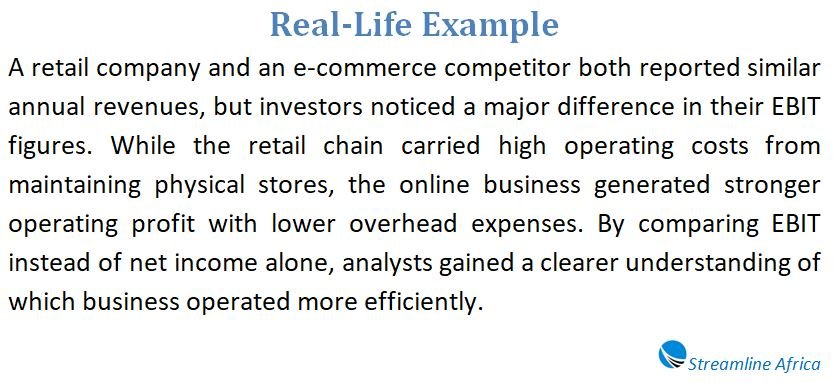
One important use of EBIT is operational profitability assessment. When revenue grows but EBIT declines, it signals an increase in operating costs or inefficiencies. Managers use this insight to examine processes, pricing strategies, or cost structures. Similarly, lenders often evaluate whether a company’s operating profit is sufficient to cover its interest obligations. A business generating EBIT far greater than its interest payments is typically considered stable.
EBIT also helps investors compare companies more fairly. Two competitors may show dramatically different net incomes because one carries substantial debt while the other is free of loans. EBIT eliminates this distortion, allowing analysts to measure the true operational performance of each business. This makes it especially helpful in industries where some players are heavily leveraged while others prefer conservative financing.
Additionally, EBIT plays a central role in acquisitions. Buyers want to know how much profit the business generates before they apply their own financing structure. Since acquirers often rearrange debt after a deal closes, EBIT acts as a neutral measure of operating performance.

How to Calculate EBIT
There are two standard approaches to calculating EBIT, and both rely on publicly available financial data.
The first method begins with revenue and subtracts the core expenses needed to operate the business. These include the cost of producing goods or delivering services—known as COGS—and the operating expenses required to support the business, such as marketing, salaries, and administrative costs.
EBIT = Revenue − COGS − Operating Expenses
The second method starts with net income and adds back the expenses that EBIT intentionally excludes: interest and taxes.
EBIT = Net Income + Interest Expense + Tax Expense
Both approaches lead to the same result, though analysts often prefer the first because it directly reflects the business’s cost structure.
To illustrate how this calculation works, imagine a technology company that manufactures smart home devices. Over a year, it earns one million dollars in sales from products and subscriptions. Producing and delivering these devices costs six hundred thousand dollars, and day-to-day operations—including marketing, salaries, office rent, and customer service—use another two hundred thousand dollars. Subtracting these expenses from revenue yields an EBIT of two hundred thousand dollars. This figure represents the profit generated solely through the company’s operations.
EBIT and EBITDA: Understanding the Difference
While EBIT focuses on operating profit before interest and taxes, EBITDA goes a step further by adding back depreciation and amortization. These are noncash expenses related to the gradual consumption of physical and intangible assets. By excluding them, EBITDA often provides a clearer picture of a company’s short-term cash-generating ability.
EBIT is generally more conservative because it acknowledges the cost of using assets over time. This makes it especially useful for industries that are not highly capital-intensive. On the other hand, EBITDA is commonly used in industries with heavy investment in equipment or infrastructure, where depreciation can significantly affect reported profit even when operating cash flow remains strong.
Both metrics inform different aspects of financial analysis, and investors often look at them together to form a complete picture.
Limitations of Relying on EBIT Alone
Despite its usefulness, EBIT has several limitations that analysts must consider. Because it excludes interest and tax expenses, it cannot show a company’s full financial obligations. A business may appear strong from an EBIT perspective yet struggle to make interest payments if it is heavily indebted.
EBIT also includes depreciation and amortization, which can differ widely even among similar companies due to distinct accounting methods or asset bases. These differences can lead to misleading comparisons, especially for firms with very different types or ages of assets.
Furthermore, EBIT does not reflect cash flow. A company may show high EBIT but still face liquidity challenges if it requires significant ongoing investment in equipment or inventory. For this reason, many analysts complement EBIT with cash-flow-based metrics.
Finally, because EBIT is influenced by accounting judgments—such as how expenses are classified or when revenue is recognized—it can be adjusted in ways that make a company look more profitable than it really is.
Using EBIT in Financial Ratios
EBIT forms the backbone of several key ratios used to evaluate financial health and valuation. One widely used measure is the interest coverage ratio, which divides EBIT by interest expense. This ratio indicates how comfortably a business can meet its debt obligations. A high ratio suggests sound financial stability, while a low one warns of potential difficulty.
Another important measure is the EV/EBIT ratio, which compares a company’s enterprise value—its market capitalization plus debt, minus cash—to its EBIT. This valuation tool helps analysts determine whether a company is relatively cheap or expensive compared to peers. A low multiple may indicate an undervalued business.
EBIT margin, calculated by dividing EBIT by revenue, reveals how efficiently a company converts sales into operating profit. A higher margin often signals strong cost control and competitive advantage.
Putting EBIT Into Perspective
In professional investing, EBIT is one of the first metrics analysts examine when evaluating a company. By focusing on core operations and stripping away financing and tax effects, it provides a cleaner lens through which to assess long-term profitability. But no single measure should guide all decisions. EBIT must be interpreted alongside cash flow, capital expenditure needs, and industry dynamics to form an accurate understanding of financial strength.
Still, when used correctly, EBIT offers a powerful way to compare performance across companies, monitor trends, and support strategic decisions. It remains one of the most widely used indicators of operational health and continues to serve as a key metric in valuation, lending, and investment judgment.
Frequently Asked Questions about EBIT
What does EBIT really measure?
EBIT measures how much profit a company earns from its regular business operations before accounting for interest payments and taxes. It focuses on operational strength rather than financial structure.
Why do analysts rely on EBIT?
Analysts use EBIT because it filters out the effects of financing decisions and tax environments, allowing them to compare different companies based purely on operating performance.
How is EBIT different from net income?
Net income includes all expenses, including interest and taxes. EBIT excludes those two items, giving a clearer view of how well the core business performs on its own.
Is EBIT the same as operating income?
Often yes, but not always. Some companies include routine non-operating income in their EBIT, and reporting practices can vary since EBIT is not a formal GAAP term.
When should businesses use EBIT instead of EBITDA?
EBIT is more useful when you want a conservative view of profitability that includes depreciation and amortization. EBITDA is better when evaluating cash flow, especially in capital-intensive industries.
Can EBIT help assess debt repayment ability?
Yes. Lenders calculate the interest coverage ratio using EBIT to see whether a company generates enough operating profit to comfortably pay interest on its debt.
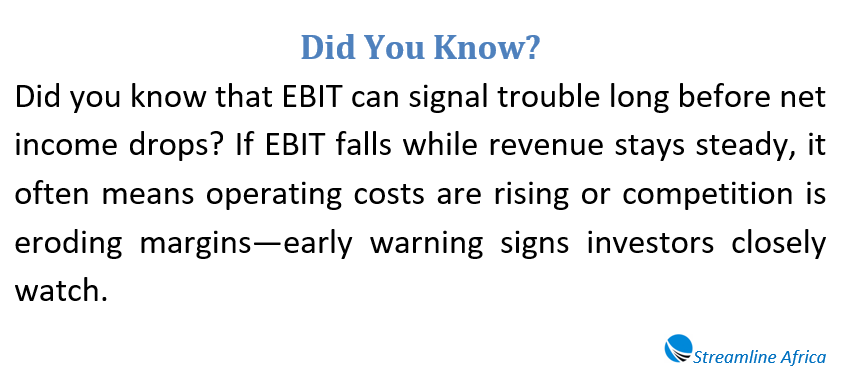
What causes EBIT to decline even when revenue is steady?
If EBIT decreases while revenue remains unchanged, the business may be facing rising operating expenses, inefficiencies, or competitive pressure.
Does EBIT reflect cash flow?
No. EBIT is an accrual-based measure and doesn’t account for cash requirements like capital expenditures, which is why it should be analyzed together with cash flow statements.
Why do investors compare companies using EBIT?
EBIT neutralizes differences in borrowing levels and tax strategies, creating a fair basis for comparing companies across capital structures and regions.
Can EBIT be manipulated?
Yes. Because EBIT depends on accounting classifications—such as how expenses are categorized—companies can influence the number through timing and reporting choices.