

Growing a business is never just about securing more customers or increasing production capacity. Leaders often talk enthusiastically about breaking into new markets, widening their footprint or investing in innovation. Yet beneath the surface, many companies stall not because of lack of ambition, but because essential financial planning foundations are missing.
Working with founders across Latin America, Europe and parts of West Africa, I’ve repeatedly seen that adopting the mindset of a strategic financial planner can be the difference between sustainable scale and a painful plateau. Here are five frequently overlooked planning mistakes that hinder otherwise promising growth journeys—and how leaders can avoid them.
1. Forecasts Built On Hope Rather Than Market Reality
A common pitfall in fast-moving firms is optimistic forecasting. Leaders—often subconsciously—plan based on the rosiest version of their pipeline, assuming that past momentum will continue uninterrupted. I once worked with a logistics company in São Paulo that expected a 10% revenue dip in a slowdown; instead, demand dropped nearly 30% when a regional strike crippled transportation networks. Their models never accounted for volatile conditions, and the gap nearly collapsed their expansion project.
Businesses benefit from creating three to four scenario models: a high-growth path, a moderate case and a stress case that tests resilience under difficult conditions. Pair revenue projections with constraints such as staffing capacity, supplier reliability and customer churn trends. That combination of ambition and realism dramatically improves long-term decision-making.

2. Overlooking Cashflow Timing And Liquidity Windows
Many companies celebrate strong profit margins yet struggle to stay afloat simply because cash does not arrive when it’s needed. A renewable-energy firm in Nairobi recently posted record profits but still faced a payroll crisis due to delayed grants and slow customer reimbursements.
Poor liquidity planning often results in late supplier payments, inability to fund inventory, unnecessary borrowing and damaged credibility with partners. The solution is to embed cashflow modeling directly into the growth roadmap. Establish minimum liquidity thresholds, renegotiate payment terms where possible, analyze accounts receivable frequently and simulate scenarios where inflows are delayed. Growth becomes safer when cash timing—not just profit—is managed intentionally.
3. Resource Allocation That Doesn’t Match Strategic Priorities
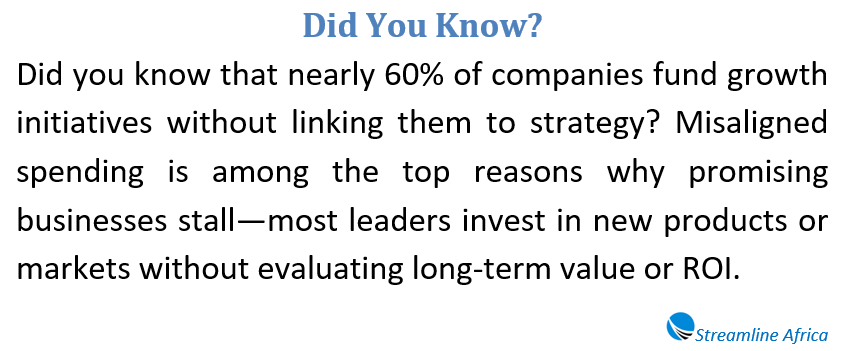
Ambitious companies often invest aggressively in product launches or customer acquisition initiatives without clearly linking those expenditures to their long-term value plan. A technology startup in Dublin spent heavily on new-user marketing, yet retention was so weak that each quarter began at “zero.” Their spending wasn’t mapped to the real drivers of value: customer lifetime usage and infrastructure scalability.
Strategic allocation requires leaders to ask difficult but necessary questions:
• What specific return are we expecting from this investment?
• At what point should we stop funding it if results are poor?
• How will this spending affect cash reserves or debt levels?
A financial-planner approach ensures every major expense is tied to an objective—strengthening retention, expanding capacity, improving margins or enabling scalability. When allocations match strategy, growth becomes purposeful instead of reactive.
4. Outdated Financial Governance And Missing Decision-Critical KPIs
A company experiencing rapid expansion cannot rely on the informal tracking systems that worked at the early stage. Without strong governance, fast-paced businesses often make decisions based on outdated assumptions, partial data or inconsistent reporting practices.
An agricultural aggregator in northern Ghana learned this firsthand. As their trader network doubled, they still relied on quarterly financial checks and manual spreadsheets. They lacked visibility into their cash conversion cycle and customer acquisition cost, leading them to miss early warning signs of margin erosion.
Growth requires upgraded infrastructure: rolling forecasts, real-time dashboards, cross-functional planning rhythms and clearly defined KPIs that help anticipate problems months—not weeks—before they occur. Metrics like burn rate, customer lifetime value and cost of growth initiatives should inform decisions continuously, not only during annual review cycles.
When companies operate without these decision-driven metrics, they risk misjudging their true financial health and losing the window to course-correct.
5. Expanding Faster Than The Organization Can Sustain
Rapid growth feels exhilarating—until systems buckle under its weight. Companies often push into new markets or introduce new product lines without evaluating whether their operational and financial foundations can support the surge.
A boutique food manufacturer in Cape Town learned this after doubling production to meet demand from a new supermarket chain. They had not upgraded procurement systems, warehousing capacity or risk buffers. Within months, production delays wiped out margins and the partnership faltered.
Before scaling, leaders must test the strength of their organizational “scaffolding”:
• Are internal controls reliable?
• Do we have working capital flexibility?
• Is staffing aligned with projected growth?
• Do we have contingency reserves for supply-chain shocks or regulatory changes?
Without these prerequisites, growth becomes fragile rather than empowering.
What Leaders Should Take Away
Growth is not an event—it is a disciplined, ongoing financial design process. Adopting a planner’s mindset helps leaders replace wishful thinking with structured decision-making. By grounding forecasts in reality, synchronizing spending with strategy, modernizing governance systems and preparing for operational shocks, businesses shift from chasing expansion to engineering it.
As you guide your organization into its next chapter, ask your leadership team:
• What core assumptions underlie our 12- to 24-month projections, and how vulnerable are they?
• Do we understand the timing—not just the amount—of cash inflows and outflows?
• Are our budget priorities genuinely tied to long-term value creation?
• Which metrics tell the truth about our future, and how often do we consult them?
• If disruption hits tomorrow, do we have the structural readiness to continue growing?
Answering these questions consistently transforms planning from a routine requirement into a reliable growth engine—today, next year and for the business you are building for the long haul.
FAQs
What is the biggest financial planning mistake growth-focused businesses make?
Many companies rely on overly optimistic forecasts that don’t reflect market realities or operational constraints, creating gaps that later affect revenue stability.
Why is cashflow timing more important than profit?
Profit shows long-term performance, but cashflow determines whether a business can pay suppliers, staff and operational costs in real time.
How can scenario planning support business expansion?
Scenario planning forces leaders to model multiple outcomes—optimistic, moderate and stressed—so they can make resilient decisions even when conditions shift unexpectedly.
What causes resource misallocation in scaling companies?
Leaders often invest heavily in growth initiatives like marketing or expansion without linking those expenses to long-term value creation or ROI.
Which financial metrics are most critical during rapid growth?
Metrics such as customer lifetime value, customer-acquisition cost, burn rate and cash-conversion cycle help leaders understand whether growth is sustainable.
Why do early-stage financial systems fail as a business grows?
Manual or informal tracking methods cannot keep up with increased complexity, leading to outdated reports, poor visibility and delayed decision-making.
How often should financial leaders review KPIs?
High-growth companies benefit from monthly—or even weekly—reviews to identify patterns early and adjust before problems escalate.
What does structural readiness for growth include?
It includes reliable financial systems, adequate staffing, operational capacity, risk buffers and contingency plans for supply-chain or market disruptions.
How do liquidity buffers support long-term expansion?
Liquidity reserves provide breathing room when payments are delayed, costs spike or unforeseen shocks occur, preventing operational breakdowns.
Why should spending always align with strategy?
When budgets reflect strategic priorities, each dollar contributes to sustainable value creation, rather than supporting scattered or reactive decisions.
What questions should leaders ask before scaling into new markets?
They should examine internal capacity, financial stability, operational readiness, working-capital needs and the risks associated with expanding too quickly.
How can financial planning transform from routine to strategic?
By integrating real-time metrics, scenario modeling, governance upgrades and strategic alignment, financial planning becomes a proactive engine that fuels growth rather than merely recording it.