
A transposition error occurs when two numbers are accidentally switched during data entry, such as writing 58 instead of 85. While the mistake may appear minor at first glance, its consequences can be far-reaching, especially in environments where accuracy is critical. In accounting, banking, healthcare, and taxation, even a small numerical reversal can distort records, misrepresent financial health, or lead to costly compliance issues.
These errors most often emerge during manual processes, where information is copied from one source to another. Despite the rise of automation, transposition errors remain common because humans still review, input, approve, and adjust data. When left undetected, these mistakes can quietly spread across reports, filings, and systems, creating a chain reaction of inaccuracies that becomes harder to unwind over time.
How Transposition Errors Differ From Other Data Entry Mistakes
Not all numerical errors are created equal. Transposition errors belong to a broader family known as transcription errors, which include omissions, duplications, and incorrect figures. What sets transposition errors apart is that the digits themselves are correct, but their order is reversed. This subtle distinction makes them harder to detect through simple visual checks, especially when dealing with large datasets or long strings of numbers.
For example, mistyping 4,920 as 4,290 may not immediately raise suspicion, particularly if both figures fall within a reasonable range. Unlike an obvious typo, such as adding an extra zero, transposition errors often look believable. This is why they frequently survive initial reviews and surface only during audits, reconciliations, or financial disputes.

Why Transposition Errors Happen So Often
At their core, transposition errors are human mistakes. Fatigue, multitasking, time pressure, and repetitive work all increase the likelihood of digits being entered in the wrong order. Bookkeepers, payroll administrators, data clerks, and analysts often work with dense numerical information for extended periods, making small slip-ups almost inevitable.
Environmental factors also play a role. Poorly designed spreadsheets, cluttered interfaces, unclear source documents, or switching between systems can all contribute to confusion. Even something as simple as copying handwritten figures or working from scanned documents can increase the risk of reversing numbers. In fast-paced workplaces, speed is often prioritized over careful verification, further raising the odds of transposition errors slipping through.
Common Areas Where Transposition Errors Occur
Transposition errors appear across many industries, but they are especially prevalent in financial and administrative functions. Accounting departments frequently encounter them during invoice processing, ledger entries, and expense reporting. A single reversed digit can throw off account balances, distort profit calculations, or complicate month-end reconciliations.
Banking and payments are another high-risk area. Writing the wrong amount on a check, entering an incorrect transfer figure, or misrecording an account number can result in failed transactions, overdraft fees, or delayed payments. In customer databases, transposed digits in phone numbers, postal codes, or identification numbers can disrupt communication and create compliance risks.
Outside finance, transposition errors can be even more serious. In healthcare, a reversed dosage figure or patient ID can lead to dangerous outcomes. In logistics, an incorrect address or shipment quantity can delay deliveries and inflate costs. These examples highlight how a simple numerical swap can have consequences well beyond accounting discrepancies.
The Financial Impact of Transposition Errors
The monetary consequences of transposition errors depend largely on scale and timing. Small mistakes may result in negligible differences, while larger ones can materially affect financial statements, tax obligations, or investment decisions. What makes these errors particularly risky is their tendency to compound over time.
Consider a business that mistakenly records revenue as 3,640,000 instead of 3,460,000. The difference may influence tax calculations, budgeting decisions, and performance metrics. If that incorrect figure is later used in forecasts, loan applications, or investor presentations, the error becomes embedded across multiple documents. Correcting it later requires revisiting and revising everything built on that faulty number.
In regulated environments, financial misstatements—even accidental ones—can attract scrutiny from tax authorities, auditors, or regulators. Penalties, interest charges, and reputational damage may follow, turning a simple data entry mistake into a costly compliance issue.
Real-World Examples That Illustrate the Risk
To understand how impactful transposition errors can be, it helps to look at practical scenarios. Imagine a payroll administrator who records an employee’s monthly salary as 7,850 instead of 8,750. Over time, this mistake could lead to underpayment, employee dissatisfaction, and legal disputes. Alternatively, reversing digits in a vendor invoice could result in overpaying by thousands, affecting cash flow and profitability.
In capital markets, transposition errors are sometimes referred to as “fat-finger” mistakes. These occur when traders accidentally enter the wrong quantity or price while placing orders. In extreme cases, such errors have triggered sharp market movements within seconds. While many systems now include safeguards to prevent execution, the initial error still demonstrates how quickly reversed digits can escalate into major financial events.
Why the Number Nine Matters in Detecting Errors
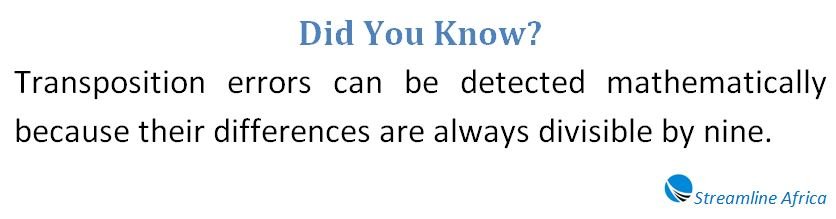
One of the most interesting aspects of transposition errors is their mathematical fingerprint. When two digits are reversed, the difference between the correct number and the incorrect one is always divisible by nine. This property has long been used by accountants, auditors, and bank clerks as a quick diagnostic tool when reconciling discrepancies.
For instance, if an account balance is off by 72, 81, or 189, dividing the difference by nine can suggest whether a transposition error is the culprit. While this method does not identify which digits were reversed, it provides a valuable clue that narrows the search. In environments where thousands of transactions must be reviewed, this rule can save significant time and effort.
Correcting Transposition Errors Once They Are Found
Once identified, correcting a transposition error requires more than simply fixing the number. The root cause must be traced to ensure the correction is applied consistently across all affected records. This may involve adjusting journal entries, updating reports, amending tax filings, or notifying external stakeholders.
Documentation is critical during this process. Clear records explaining when the error occurred, how it was discovered, and what corrective actions were taken help maintain transparency and support future audits. In some cases, businesses may also need to implement additional controls or training to prevent similar mistakes from recurring.
Preventing Transposition Errors Through Better Processes
While no organization can eliminate human error entirely, there are practical steps that significantly reduce the risk of transposition errors. Automation is one of the most effective solutions. Systems that pull data directly from source documents reduce the need for manual re-entry, minimizing opportunities for digits to be reversed.
Standardized templates, validation rules, and double-entry verification also play a key role. Requiring a second review for high-value transactions or using software that flags unusual variances can catch mistakes early. Regular reconciliations, particularly for cash accounts and payroll, ensure discrepancies are identified before they spread.
Training and workload management are equally important. Employees who understand the impact of small errors are more likely to slow down and verify their work. Reducing time pressure and encouraging accuracy over speed can make a measurable difference in data quality.
Transposition Errors in the Digital Age
Despite advances in technology, transposition errors have not disappeared. In fact, hybrid systems that combine automation with manual oversight can sometimes introduce new risks. Copying figures between platforms, overriding system defaults, or manually correcting automated entries all reintroduce the possibility of digit reversals.
However, modern tools also offer powerful defenses. Real-time error detection, anomaly alerts, and audit trails make it easier to spot inconsistencies quickly. Organizations that fully leverage these features are better positioned to catch and correct transposition errors before they cause material harm.
Why Paying Attention to Small Errors Matters
It is easy to dismiss transposition errors as minor administrative issues, but doing so underestimates their potential impact. Financial accuracy is built on thousands of small, correct entries. When even a few of those are wrong, trust in the entire system can erode.
Whether you are managing personal finances, running a small business, or overseeing complex corporate accounts, attention to detail matters. Recognizing how transposition errors occur—and why they are so persistent—helps create systems that are resilient, reliable, and transparent.
Final Thoughts
Transposition errors arise when digits are reversed during data entry, creating discrepancies that can ripple across financial, operational, and regulatory systems. Though often unintentional and seemingly insignificant, these mistakes can lead to serious consequences if left unchecked. Their unique mathematical trait, where differences are divisible by nine, offers a useful detection method, but prevention remains the best strategy.
By combining thoughtful processes, appropriate technology, and a culture that values accuracy, organizations can significantly reduce the risk posed by transposition errors. In a world driven by data, getting the numbers right is not just a technical requirement—it is a foundation for sound decision-making and long-term trust.
Frequently Asked Questions
Why Are Transposition Errors So Common?
They usually occur because of human factors like fatigue, time pressure, multitasking, or repetitive work, especially in roles that involve heavy numerical input.
How Are Transposition Errors Different From Other Mistakes?
Unlike simple typos, transposition errors involve correct digits placed in the wrong order, which makes them harder to notice at a glance.
Where Do Transposition Errors Happen Most Often?
They frequently appear in accounting, banking, payroll, tax reporting, healthcare records, and customer data management systems.
Can a Small Digit Swap Really Cause Big Problems?
Yes. Even minor reversals can affect financial statements, tax calculations, payments, or compliance filings, especially if the error spreads across systems.
How Do Transposition Errors Affect Businesses Financially?
They can lead to misstated income, incorrect tax liabilities, cash flow issues, audit complications, and sometimes regulatory penalties.
What Is the Rule of Nine and Why Does It Matter?
If the difference between two numbers is divisible by nine, it often indicates a transposition error, making it a useful tool for spotting hidden mistakes.
Are Transposition Errors Only a Manual Problem?
No. Even with automation, errors can occur when humans override systems, transfer data between platforms, or adjust automated entries.
What Are “Fat-Finger” Errors in Trading?
These are transposition or input mistakes made during trade execution, often involving incorrect prices or quantities that can move markets quickly.
How Should Transposition Errors Be Corrected?
The correct figure must be restored everywhere it appears, with clear documentation and adjustments made to all affected records or reports.
What Steps Help Prevent Transposition Errors?
Automation, double-checking high-value entries, validation rules, regular reconciliations, and employee training all reduce risk significantly.
Why Is Paying Attention to These Errors So Important?
Because financial accuracy depends on small details, and unchecked transposition errors can undermine trust, decisions, and long-term stability.