
As organizations evolve, their financial infrastructure must evolve with them. Yet many businesses continue to rely on accounting approaches designed for a very different era—paper-heavy workflows, disconnected spreadsheets and aging desktop software. Over the years, while advising mid-sized firms across the Midwest and Southeast United States, I have seen how these legacy methods slowly but consistently restrict growth, cloud decision making and increase financial risk.
The issue is not that traditional accounting practices are inherently flawed. Rather, they were built for a time when businesses were simpler, markets were slower and regulatory demands were less complex. Today’s environment demands speed, accuracy, adaptability and insight. Below, we explore the warning signs of outdated accounting systems, the operational damage they can cause and practical ways to modernize without losing control.
Warning Signs Your Accounting Is Falling Behind
Operational Drag And Lost Productivity
One of the clearest indicators of an outdated accounting setup is how much manual effort it requires. If your finance team is spending hours re-keying transactions, reconciling mismatched reports or searching through email threads for missing invoices, efficiency is already compromised.
Consider a regional logistics company based in Columbus, Ohio, that still relies on spreadsheet-based bookkeeping. Each month, its accounting staff manually imports bank statements, categorizes expenses and corrects formula errors. What should take days stretches into weeks, delaying management reports and creating stress during close periods. Over time, this inefficiency diverts attention from higher-value work such as financial analysis, strategic planning or vendor negotiations.
Even simple process upgrades—like standardized digital document collection or scheduled review meetings—can significantly reduce wasted time. However, these measures only go so far if the underlying system remains antiquated.
Errors That Compound Over Time
Manual accounting processes are vulnerable to mistakes. A single data entry error, duplicated transaction or misapplied tax code can ripple through financial statements, distorting results and eroding trust. While small inaccuracies may seem harmless at first, they often compound across payroll, sales tax, income tax and compliance reporting.
For example, a growing hospitality group in Arizona once misclassified contract labor across multiple properties. The error went unnoticed for several quarters, eventually triggering payroll tax discrepancies and an unfavorable audit outcome. The financial penalties were manageable, but the reputational impact with lenders and investors was far more damaging.
Regular financial reviews and proactive tax planning can reduce this risk, but they depend on having accurate, timely data. An experienced accountant or controller should not only reconcile numbers but also interpret them—flagging anomalies, monitoring regulatory changes and advising on how those changes affect profitability.

Systems That Cannot Grow With The Business
Accounting complexity increases alongside business expansion. New locations, additional revenue streams, cross-border transactions or multi-jurisdiction tax obligations place demands on systems that were never designed to scale.
A technology distributor headquartered in Denver learned this the hard way after expanding into three additional states. Its accounting software could not easily handle differing sales tax rules or consolidated reporting. As a result, leadership lacked clarity around cash flow, and forecasting became unreliable. What began as a manageable inconvenience soon escalated into financial blind spots and compliance concerns.
When evaluating scalability, cash flow monitoring and forecasting deserve particular attention. Without tools that adapt to higher transaction volumes and operational complexity, growth can outpace financial control.
Delayed And Incomplete Financial Visibility
In modern business, timely information is not a luxury—it is a necessity. Companies that only review financial performance at month-end or quarter-end are effectively driving while looking in the rearview mirror.
Outdated accounting systems often limit access to real-time data, making it difficult to track margins, expenses or liquidity as conditions change. This delay can result in missed opportunities, slow responses to market shifts and increased exposure to risk.
For instance, a retail brand in Portland relied on end-of-month reports to assess inventory performance. By the time underperforming product lines were identified, excess stock had already tied up working capital. With more current data, management could have adjusted purchasing decisions weeks earlier.
Consistent financial reviews supported by up-to-date information enable faster, more confident decision making—and reduce the likelihood of unpleasant surprises.
Practical Steps Toward Modern Accounting
Recognizing the problem is the first step. The next is identifying solutions that align with your organization’s size, industry and growth trajectory.
Adopt Integrated, Compliant Platforms
Modern accounting systems should do more than track debits and credits. They should operate as part of a connected ecosystem that supports compliance, reporting and operational insight.
When evaluating software, prioritize platforms that align with federal and state tax requirements while integrating seamlessly with other business systems. Enterprise resource planning tools, point-of-sale systems, customer relationship platforms, inventory management software and payroll solutions should communicate with one another. Banking and credit card integrations further reduce manual data entry and improve accountability.
In practice, this holistic approach centralizes financial data, improves accuracy and enhances oversight. Leadership gains a clearer picture of performance without relying on fragmented reports.
Use Cloud Technology And Automation Strategically
Cloud-based accounting platforms offer flexibility that traditional systems cannot match. They allow secure access from anywhere, facilitate collaboration and update automatically to reflect regulatory changes.
Automation plays an equally important role. Routine tasks such as transaction categorization, bank reconciliations and standard reporting can be handled automatically, with discrepancies flagged in real time. This reduces human error while freeing staff to focus on analysis and strategy rather than data maintenance.
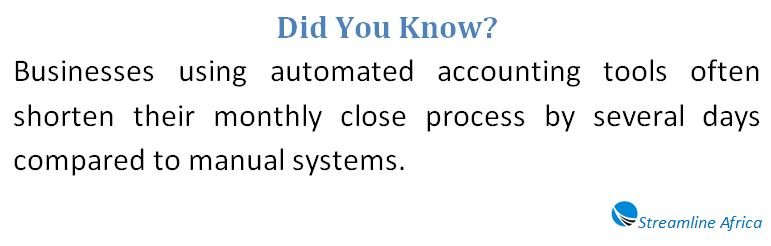
A professional services firm in Raleigh transitioned to a cloud-based solution with automated reconciliation and saw its monthly close cycle cut nearly in half. More importantly, leadership began receiving performance insights weekly instead of monthly.
Choose Solutions Designed To Scale
An effective accounting platform should not need replacement every time the business reaches a new milestone. Scalability means the system can handle increased transaction volumes, integrate with new tools and adapt to regulatory changes without disruption.
Advanced reporting features are particularly valuable. The ability to analyze profitability by product line, geographic region or department empowers leaders to allocate resources more effectively. As competition intensifies, these insights can be the difference between informed growth and reactive decision making.
Leverage Data Integration And Analytics
Financial data holds little value if it cannot be translated into insight. Modern accounting systems should integrate with analytics tools that support budgeting, forecasting and trend analysis.
Predictive analytics, for example, can improve cash flow projections by identifying seasonal patterns, payment delays or cost fluctuations. With better forecasts, management can make more confident capital allocation decisions, whether that means hiring, expanding or conserving resources.
Integration also helps uncover inefficiencies that may not be visible in isolated reports, allowing continuous improvement across operations.
Closing Perspective
Accounting is not merely a compliance function; it is the backbone of sound business management. When systems are outdated, the consequences extend beyond inefficiency. Errors multiply, insights diminish and growth becomes harder to sustain.
While legacy methods may appear adequate in the short term, their hidden costs often exceed the investment required to modernize. Businesses that adopt streamlined, technology-enabled accounting gain clarity, reduce risk and position themselves for informed, sustainable expansion.
If your current processes feel slow, opaque or overly manual, it may be time to reassess. In today’s environment, the question is not whether modern accounting tools are necessary—but how long a business can afford to operate without them.
Commonly Asked Questions
Why Do Outdated Accounting Systems Hurt Business Performance?
Outdated accounting systems slow down daily operations by relying heavily on manual input and disconnected tools. This leads to wasted time, delayed reporting and fewer insights for leadership, making it harder to respond quickly to financial or market changes.
How Can Manual Accounting Increase Financial Risk?
Manual processes are more prone to human error, such as incorrect data entry or misclassification of expenses. Over time, these small mistakes can snowball into tax penalties, inaccurate financial statements and reduced credibility with lenders or investors.
What Are The Signs That An Accounting System Cannot Scale?
If your accounting setup struggles with multi-location operations, increasing transaction volumes or complex tax requirements, it is likely not scalable. Difficulty forecasting cash flow or consolidating reports is often a clear warning sign.
Why Is Real-Time Financial Data So Important?
Real-time data allows business owners and executives to make informed decisions quickly. Without up-to-date financial visibility, companies risk missing opportunities, overspending or reacting too late to emerging problems.
How Does Modern Accounting Technology Improve Decision Making?
Modern platforms integrate automation, cloud access and analytics, turning raw financial data into actionable insights. This helps leaders understand profitability, manage cash flow more accurately and plan for growth with greater confidence.
Is Investing In New Accounting Systems Worth The Cost?
While upgrading accounting systems requires an upfront investment, the long-term benefits often outweigh the expense. Improved efficiency, reduced errors and better strategic insight typically result in cost savings and stronger financial control over time.