
Entrepreneurship often begins as a spark—an insight into a gap in the market or a better way to serve customers. But that spark only becomes a sustainable enterprise when it is structured, staffed and steered with intention. No founder builds a durable company alone. The quality of your leadership and the clarity of your strategic direction determine who joins you—and how effectively they help convert ambition into measurable profit.
Consider the story of Marcus Doyle, founder of NorthBridge Analytics in Manchester. What began as a two-person data consultancy grew into a mid-sized advisory firm serving clients across Europe. At each stage of growth, Marcus learned a critical lesson: profitability is not an accident of scale. It is engineered through people, systems and disciplined execution.
The competencies required from your team—and from you—shift as your company moves from launch to momentum to cross-border expansion. Understanding those inflection points allows you to build profitability deliberately rather than reactively.
Startup Or Reinvention
The earliest phase of a business, whether a brand-new venture or a strategic repositioning, is about constructing a stable operating platform. At this stage, credibility is fragile and margins are tight. Every decision influences cash flow, customer perception and long-term viability.
Core operational pillars typically include:
• Digital presence and user experience
• Brand positioning and visual identity
• Revenue generation and marketing systems
• Workflow and service delivery processes
• Legal structuring and regulatory compliance
• Talent management
• Financial controls and reporting
• Communications and public engagement
Take Priya Nandakumar, who rebranded her boutique skincare company in Austin after pivoting toward sustainable ingredients. Before launching the new identity, she invested in rebuilding her e-commerce platform, clarifying her brand narrative and formalizing supplier contracts. She also hired a fractional CFO to tighten cost forecasting. The result was not merely aesthetic transformation but improved gross margins within the first two quarters.
To build a team that supports profitability at this stage, founders must approach hiring with architectural precision.
First, define the functional blueprint of the organization. Map each operational requirement to a clearly delineated role. Even if some responsibilities are initially outsourced or combined, clarity prevents gaps and duplication.
Second, craft role descriptions that extend beyond technical qualifications. In a startup environment, adaptability, problem-solving ability and cultural alignment are equally important. Early hires shape norms and influence how decisions are made under pressure.
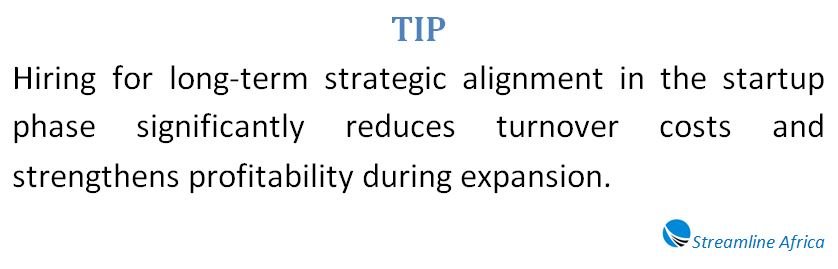
Third, communicate your forward-looking vision. Candidates want to understand trajectory. If you articulate where the company aims to be in five years—revenue targets, market positioning, geographic reach—you attract individuals who are motivated by growth rather than short-term stability.
Fourth, assess for learning agility during interviews. In a young company, processes evolve rapidly. Team members must demonstrate comfort with iteration and constructive experimentation.
In the startup phase, profitability depends less on rapid expansion and more on disciplined cost management, coherent branding and precise execution. Strong foundational hires reduce operational friction and accelerate revenue stabilization.

Scale-Up
Once product-market fit is validated and recurring revenue becomes predictable, the company enters a different strategic terrain. Scaling is not simply doing more of the same; it is increasing output and revenue without proportionally increasing overhead.
At this stage, leadership attention shifts toward:
• Brand consistency and market authority
• Institutionalized corporate culture
• Clearly articulated core values
• Formalized strategic planning cycles
• Structured client acquisition pipelines
• Business development partnerships
• Capability building within teams
• Financial modeling and margin optimization
• Process automation and digital integration
A practical illustration comes from Javier Morales, founder of a logistics software firm in Bogotá. After securing steady contracts with regional distributors, he resisted the temptation to hire aggressively. Instead, he invested in workflow automation and standardized onboarding processes for new clients. By digitizing repetitive tasks and strengthening internal training programs, he increased capacity by 40% without equivalent payroll growth.
Scaling requires reliance on team members who helped construct the original foundation. Their institutional knowledge is critical when deciding which systems can handle increased volume and which require redesign. Transparent communication during this period is essential. Rapid growth can strain morale if expectations and responsibilities shift without clarity.
Leaders must also evaluate financial resilience. Can the business withstand currency fluctuations, supply chain disruption or unexpected regulatory changes? Stress-testing your operating model protects profitability as revenues climb.
Culture becomes a central economic factor in this phase. A coherent corporate culture improves retention, reduces recruitment costs and sustains performance under pressure. As roles specialize, leaders must ensure collaboration remains fluid. Cross-functional alignment prevents silos that erode efficiency.
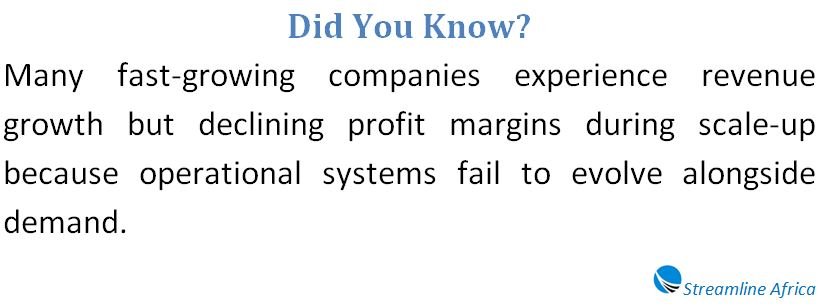
The scale-up phase is where operational sophistication directly influences margins. Companies that scale thoughtfully maintain profit ratios; those that expand haphazardly often experience revenue growth paired with diminishing returns.
Expansion
When a company achieves consistent profitability domestically, geographic expansion becomes a viable strategic objective. Entering new cities or countries introduces complexity that cannot be managed through instinct alone. Expansion demands structured research, financial planning and cultural intelligence.
Key elements of cross-border growth often include:
• Capital infusion from investors or strategic partners
• Regulatory compliance in new jurisdictions
• Adaptation of brand messaging to local markets
• Product or service diversification
• International partnerships and alliances
• Client acquisition strategies tailored to regional behavior
• Workforce localization and talent strategy
• Leadership development for global oversight
• Detailed revenue and cost mapping
• Advanced technology integration
When Sofia Petrov expanded her cybersecurity consultancy from Warsaw into Dubai and Singapore, she underestimated the cultural nuances of negotiation styles and procurement cycles. Early setbacks forced her to assemble a local advisory board in each market. With regional expertise guiding hiring and pricing models, the company regained traction and achieved profitability within eighteen months of entry.
Global expansion requires humility from leadership. Founders must invest time in understanding legal frameworks, consumer expectations and workforce norms. What motivates employees in one region may not resonate in another. Compensation structures, communication styles and performance metrics may require recalibration.
Technology also becomes a unifying infrastructure. Integrated enterprise systems allow leadership to monitor performance across geographies, maintain financial visibility and ensure consistent service standards.
At this stage, profitability hinges on disciplined capital allocation. Expansion often demands upfront investment before revenue materializes. Leaders must calculate break-even timelines realistically and maintain liquidity buffers.
Your team remains central. International growth multiplies complexity; it does not dilute the need for alignment. Strong internal communication channels and shared strategic objectives ensure that new markets strengthen rather than fragment the organization.
Sustaining Profitability Across All Stages
Across startup, scale-up and expansion phases, several constants endure. Vision provides direction, but structure generates results. Talent amplifies potential, but accountability safeguards margins. Strategy sets ambition, but execution determines sustainability.
Profitability is cumulative. Early discipline in cost management supports later investment capacity. Careful hiring at the startup phase produces cultural resilience during scale-up. Strategic planning during growth prepares the organization for international diversification.
Leadership, therefore, is both economic and relational. It involves designing systems that generate revenue efficiently while cultivating trust among those who operate them. When team members understand how their contributions influence profitability, they act with ownership rather than compliance.
Whether launching a boutique consultancy in Vancouver, scaling a manufacturing firm in Accra or entering new markets from São Paulo to Berlin, the underlying principle remains consistent: growth without structure erodes value, but growth guided by deliberate strategy builds enduring profitability.
If you articulate a clear direction, assemble capable partners and maintain operational discipline at every stage, your enterprise can evolve from an idea into a globally relevant institution. Profit is not merely a financial outcome; it is evidence that your people, processes and purpose are aligned.