

Modern organizations depend heavily on software to run operations, analyze data, communicate, and deliver services. Yet determining how to record the cost of software in financial statements—and how that cost is treated for tax purposes—can be surprisingly complex. Unlike machinery or buildings, software often lacks physical form, can be updated continuously, and may serve multiple purposes at once.
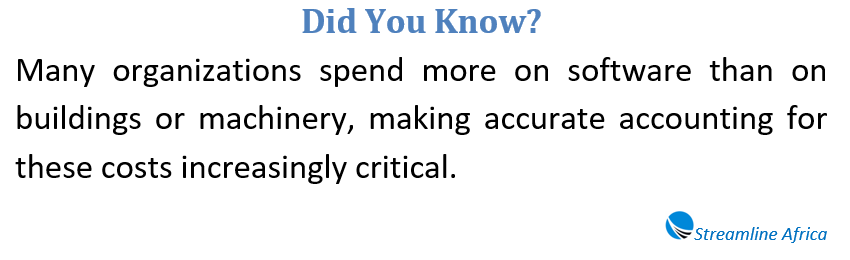
Accounting standards therefore require companies to exercise judgment when deciding whether software should be treated as a physical-type asset, a nonphysical asset, or an expense. These choices influence reported profits, asset values, and tax liabilities. For finance teams, auditors, and managers, understanding the logic behind these treatments is essential to avoid compliance risks and misleading financial results.
Distinguishing Between Tangible and Intangible Nature
Software does not exist in a physical sense, yet it may function as an essential component of hardware. This dual character makes classification difficult. In practice, companies look beyond the absence of physical substance and focus on how the software is used.
If a program is necessary for equipment to operate—such as firmware embedded in manufacturing machinery—it may be viewed as part of that equipment. In such cases, the cost can be grouped with tangible fixed assets. By contrast, standalone applications like accounting systems, enterprise resource planning platforms, or mobile apps are typically considered intangible assets because they deliver value independently of any specific device.
The distinction hinges on economic reality rather than technical form. Decision-makers ask whether the software has value on its own or merely enables another asset to function. This assessment drives the accounting policy applied by the entity.
Establishing an Accounting Policy When Standards Are Silent
Some accounting frameworks do not provide explicit instructions for software classification. When this occurs, organizations must create their own policy grounded in broader principles. Management typically consults related standards addressing similar issues, industry guidance, and the general rules for recognizing assets.
A sound policy should be applied consistently across reporting periods. It must also reflect the organization’s operations and the nature of the software involved. For example, a manufacturing company using embedded control systems may reach different conclusions than a technology firm developing commercial software products.
Consistency is critical because arbitrary switching between methods could distort financial performance. Auditors often examine whether the chosen approach aligns with the substance of transactions rather than merely producing favorable financial outcomes.
Conditions for Recognizing Internally Developed Software as an Asset
Not all software spending results in an asset. Research activities—such as exploring new ideas or experimenting with technology—are generally expensed immediately because future benefits are uncertain. Development costs, however, may qualify for capitalization once the project reaches a stage where success becomes reasonably assured.
To recognize internally generated software as an asset, several conditions must be met. The organization must demonstrate that completing the project is technically achievable and that management intends to finish and use or sell it. There must also be evidence that the software will generate economic benefits, either through external sales or improved internal efficiency.
In addition, sufficient resources—financial, technical, and operational—must be available to complete development. Finally, the company must be able to measure the project’s costs reliably. If any of these requirements cannot be satisfied, the expenditures are recorded as expenses rather than assets.
Initial Measurement and Subsequent Valuation
Once software qualifies for capitalization, its initial value usually equals the costs directly attributable to development or acquisition. This may include salaries of developers, payments to contractors, testing expenses, and necessary installation costs. Administrative overheads unrelated to the project are typically excluded.
After recognition, the asset must be allocated over its useful life. Because software often becomes obsolete quickly, this period is generally short compared to physical assets like buildings. The allocation—known as amortisation for intangible assets or depreciation for tangible assets—reflects the gradual consumption of economic benefits.
Entities may choose a valuation approach based on historical cost or, in limited circumstances, revaluation to reflect fair value. However, revaluation is uncommon for software because determining market value can be difficult when products are customized or unique.

Determining Useful Life and Amortisation Method
Estimating how long software will remain useful is a critical judgment. Factors include technological change, expected upgrades, legal protections, and organizational dependence on the system. If the consumption pattern of benefits can be predicted, an amortisation method that mirrors that pattern may be used.
In many cases, however, the pattern cannot be determined with precision. Companies then apply a straight-line method, spreading the cost evenly over the asset’s life. Some standards also impose an upper limit on useful life when reliable estimates are unavailable, preventing indefinite deferral of expenses.
Amortisation begins when the software is ready for use, not necessarily when development ends. It stops when the asset is removed from service or disposed of.
Monitoring for Impairment
Even after capitalization, software assets must be reviewed periodically to ensure their recorded value remains recoverable. Rapid technological innovation can render systems outdated long before their expected lifespan ends.
Indicators of impairment include declining usage, replacement by superior systems, loss of supporting vendors, or reduced economic benefits. When impairment is identified, the carrying value is reduced to the amount that can realistically be recovered through use or sale. The loss is recognized immediately in profit or loss.
This requirement prevents companies from overstating assets that no longer provide meaningful value.
Tax Implications of Classification Choices
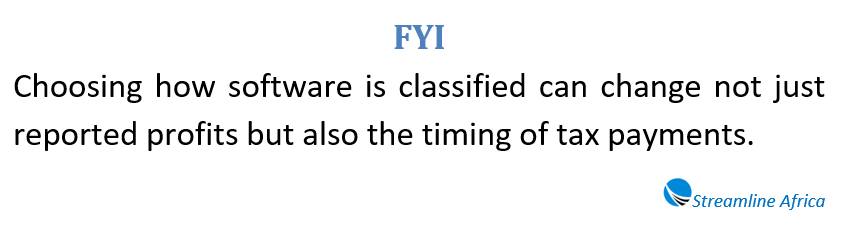
How software is classified for accounting purposes can significantly affect taxation. When software is treated as part of tangible fixed assets, tax relief may be obtained through capital allowance systems designed for physical equipment. Some jurisdictions allow businesses to deduct most or all of the cost in the year of purchase through investment incentives.
If the software is classified as an intangible asset, tax deductions often mirror the accounting treatment. Relief is spread over the asset’s useful life as amortisation is recorded. While this approach aligns tax with financial reporting, it delays the timing of deductions compared to immediate allowances.
Because timing differences influence cash flow, companies carefully evaluate which treatment is most advantageous while remaining compliant with regulations.
Alternative Tax Elections for Software Expenditure
Certain tax regimes provide flexibility by allowing businesses to elect a specific treatment for software costs. For instance, even when software appears as an intangible asset in financial statements, companies may be permitted to claim tax relief under rules normally reserved for tangible assets.
Such elections typically require formal written submission within a specified period after the expenditure occurs and may be irrevocable once made. The election must also clearly identify the relevant costs. If approved, depreciation-style allowances may be granted more quickly than amortisation-based deductions.
Any proceeds received from selling or licensing the software later may be taxed under different provisions, depending on whether those receipts were already accounted for under the capital allowance rules.
Software as a Long-Term Asset
From a broader perspective, purchased software is generally considered a long-term asset because it delivers benefits over several years. Like buildings or machinery, it supports ongoing operations rather than being consumed immediately.
However, unlike physical assets, software’s value often depends on intellectual content, user adoption, and compatibility with evolving technology. These characteristics make valuation less straightforward. Future benefits can be uncertain, especially for proprietary systems or specialized applications.
Nevertheless, capitalization allows companies to match expenses with the periods that benefit from the software’s use, producing a more accurate representation of profitability.
Circumstances Where Software Resembles Physical Assets
There are situations where software functions so closely with hardware that separating the two would be artificial. Examples include operating systems embedded in industrial equipment or control programs built into specialized devices. In such cases, the software may be treated as part of property, plant, and equipment.
To qualify, the asset typically must be used in operations, not intended for resale, and expected to provide service for multiple years. The absence of a physical form does not automatically exclude it from this category if it is inseparable from the equipment’s functioning.
Organizations often establish internal thresholds or guidelines to determine when software expenditures are large enough to justify capitalization.
Costs That Should Not Be Capitalized
Not all software-related spending creates an asset. Routine maintenance, minor updates, staff training, and support services are usually expensed because they maintain existing functionality rather than generate new benefits.
Similarly, costs incurred after a system becomes operational—unless they significantly enhance performance or extend useful life—are typically treated as operating expenses. This distinction prevents companies from inflating asset values by capitalizing ordinary running costs.
The Role of Testing and Implementation
Development projects typically pass through stages such as planning, coding, testing, and deployment. Capitalization usually continues until the software is ready for use, often marked by successful acceptance testing. After this point, subsequent expenditures are normally expensed unless they create substantial new functionality.
When software is deployed across multiple locations, capitalization may cease for each site once installation and testing are complete there. This approach reflects the fact that the asset begins delivering benefits at different times in different locations.
Managing Complexity in Practice
Accounting for software costs requires coordination between finance teams, IT departments, and management. Accurate cost tracking is essential to distinguish development expenses from general overheads. Documentation must demonstrate that capitalization criteria are satisfied and that estimates of useful life and benefits are reasonable.
Auditors often scrutinize software assets because of the judgment involved. Transparent policies and consistent application reduce the risk of disputes or restatements.
Concluding Perspective
Software has become one of the most significant investments for modern organizations, yet its accounting treatment remains nuanced. Decisions about classification, capitalization, amortisation, impairment, and tax treatment can materially influence financial statements and cash flows.
Ultimately, the guiding principle is substance over form. Whether software is embedded in equipment or operates independently, the chosen accounting approach should reflect how the asset generates value for the business. Careful analysis, supported by clear policies and compliance with relevant standards, ensures that financial reports present a fair and meaningful picture of the organization’s technological investments.
Frequently Asked Questions
What makes software accounting complicated for companies?
Software does not fit neatly into traditional accounting categories because it has no physical form yet can function like equipment. Its value depends on how it is used, whether it operates independently, and how long it will deliver benefits, making classification and measurement highly judgmental.
When is software treated as a tangible asset instead of an intangible one?
If the software is essential for hardware to function—such as embedded control systems—it may be recorded alongside physical equipment. When the program provides value on its own, like a payroll or ERP system, it is usually treated as an intangible asset.
Can internally developed software be recorded as an asset?
Yes, but only after the project reaches a stage where success is likely. The company must prove technical feasibility, intent to complete the project, availability of resources, measurable costs, and clear future economic benefits.
How are software costs recognized over time?
Once capitalized, the cost is spread across the period the software is expected to be useful. This allocation reflects how the business consumes the benefits, commonly using a straight-line method when no better pattern can be identified.
What happens if software becomes obsolete earlier than expected?
Companies must test for impairment. If the software no longer delivers the anticipated value—perhaps due to new technology or reduced usage—its recorded value must be reduced immediately to reflect reality.
How does classification affect tax treatment?
The tax impact can be significant. Software treated as tangible assets may qualify for faster tax relief through capital allowance systems, while intangible classification usually spreads deductions over several years in line with amortisation.
Are all software-related costs capitalized?
No. Routine maintenance, minor updates, staff training, and support services are typically expensed because they maintain existing capability rather than create new long-term value.