

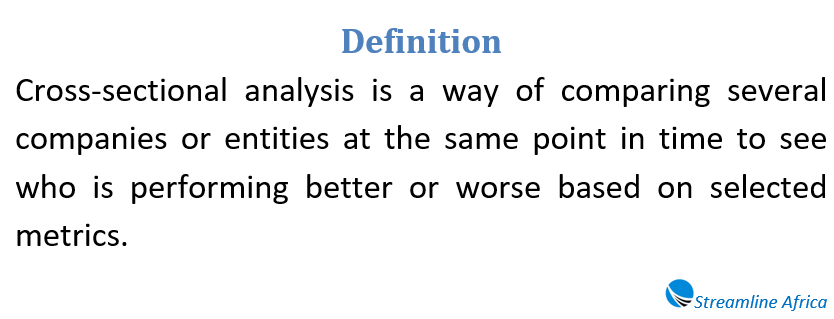
Investors constantly search for reliable ways to evaluate companies and identify promising opportunities. One powerful approach is cross-sectional analysis, a method that compares multiple companies at the same moment in time rather than tracking a single firm’s progress across years. By examining a group of similar organizations side by side, analysts can determine which businesses are outperforming, which are struggling, and why certain firms stand apart from the rest.
This type of evaluation is particularly valuable in competitive industries where companies operate under similar conditions. Because each firm faces comparable market forces, differences in performance often reveal strategic strengths, operational efficiency, or financial resilience. Cross-sectional analysis therefore provides a snapshot of relative positioning within a sector, helping investors allocate capital more intelligently.
How the Method Works in Practice
At its core, cross-sectional analysis relies on selecting comparable entities and measuring them using consistent indicators. These indicators might include profitability ratios, revenue growth, cost structures, market share, debt levels, or valuation multiples. The goal is not simply to gather numbers but to interpret how one company performs relative to others facing the same environment.
For example, an analyst studying telecommunications providers might compare customer acquisition costs, average revenue per user, infrastructure spending, and operating margins across several firms. If one company achieves higher margins despite similar pricing pressures, that difference could signal superior management, more efficient operations, or technological advantages.
This approach highlights contrasts rather than trends. It answers questions such as “Who is performing best right now?” and “Which company is most efficient compared with peers?” Instead of exploring historical patterns, it focuses on relative performance at a specific point in time.
Revealing Strengths and Weaknesses That Ratios Alone Miss
Traditional financial ratios offer insight into a company’s health, but they can be misleading without context. A debt-to-equity ratio, for instance, might appear high or low depending on industry norms. Cross-sectional analysis addresses this limitation by placing each company’s figures alongside those of competitors.
Through this comparative lens, analysts can uncover hidden advantages or vulnerabilities. A firm with moderate profits might actually be a top performer if the entire sector is facing declining demand. Conversely, a company showing impressive growth could still lag behind more dynamic rivals.
The method is especially useful for identifying unusual characteristics within a group. Some companies may hold large cash reserves, maintain exceptionally lean cost structures, or pursue aggressive expansion strategies. By isolating these differences, investors gain a deeper understanding of how each organization is positioned to handle future challenges.
Designing a Cross-Sectional Study
Conducting a meaningful comparison requires careful planning. Analysts typically begin by defining the objective of the study and selecting relevant performance indicators. The chosen metrics must reflect the aspects of business performance most important to the decision at hand.
Next comes the selection of the comparison group. Companies should operate in the same industry or share similar business models to ensure fairness. Comparing a technology startup with a mature manufacturing firm would yield little useful insight because the underlying economics differ dramatically.
Finally, the analyst determines the specific date or reporting period for the analysis. Using data from the same time frame ensures that external conditions—such as interest rates, economic cycles, or regulatory changes—affect all participants similarly. Once the data is assembled, statistical tools or qualitative assessment methods are applied to draw conclusions.
Cross-Sectional Analysis Versus Time-Based Evaluation
Cross-sectional analysis represents one of two major ways to assess corporate performance. The other widely used approach is time-series analysis, which tracks a single company’s metrics across multiple periods. While both methods are valuable, they answer different questions.
Time-series evaluation focuses on progress or decline over time. It helps determine whether a company is improving, stagnating, or deteriorating compared with its own past results. Metrics such as earnings per share, free cash flow, and revenue growth are often examined over several years to identify trends.
In contrast, cross-sectional analysis compares companies against one another at a single moment. It does not reveal whether a firm is improving historically but instead shows how it stands relative to competitors today. For investors, combining both approaches offers a more complete picture. A company might demonstrate steady improvement over time yet still underperform its peers, or vice versa.
Why Investors Rely on Both Perspectives
Using only one method can lead to incomplete conclusions. Suppose a firm’s earnings have doubled over five years. Time-series analysis would indicate strong growth. However, if rival companies have tripled their earnings during the same period, cross-sectional analysis would reveal that the firm is losing competitive ground.
Conversely, a company may appear weaker than competitors at present but could be rapidly improving due to strategic restructuring or new product launches. Time-series analysis would capture this positive trajectory even if cross-sectional comparisons show current disadvantages.
By integrating both methods, investors can identify businesses that are not only strong relative to peers but also improving over time—a combination often associated with long-term success.
Applications Beyond Individual Companies
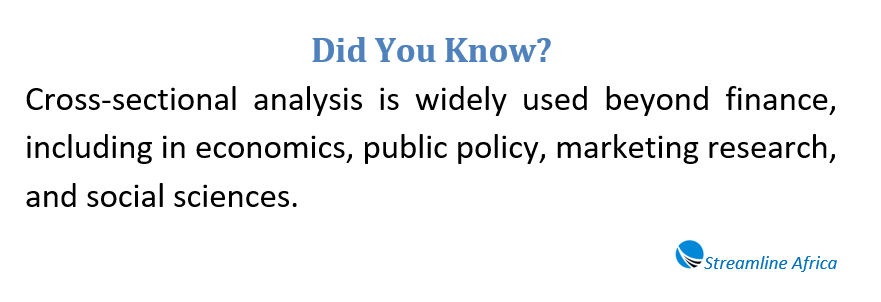
Although commonly associated with stock evaluation, cross-sectional analysis extends far beyond corporate comparisons. Researchers use it to study industries, markets, management performance, and even macroeconomic trends. Any situation involving multiple comparable entities at a single point in time can benefit from this approach.
For instance, analysts might compare different investment funds to determine which managers deliver superior returns under similar market conditions. Policymakers may examine economic indicators across regions to identify areas experiencing faster growth or higher unemployment. In each case, the objective is to understand variation across entities rather than changes over time.
Insights from Studies of Investment Managers
Academic research has applied cross-sectional methods to evaluate professional investors. Studies examining hedge fund performance, for example, have compared managers based on fund size, use of leverage, fee structures, and investment strategies.
Such analyses have revealed that certain characteristics correlate with stronger performance. Smaller funds may respond more quickly to market opportunities, while those employing leverage can amplify gains during favorable conditions. Incentive structures that reward performance may also encourage more active management.
These findings help investors choose among funds by highlighting which attributes are associated with success. Instead of relying solely on past returns, they can assess structural factors that influence future outcomes.

Contributions to Financial Theory
Cross-sectional techniques have also shaped major developments in asset pricing theory. Economists have used them to examine how characteristics such as company size, valuation ratios, and risk exposure relate to stock returns across large samples of firms.
By comparing many companies simultaneously, researchers have identified patterns that would be difficult to detect in single-company studies. These insights have contributed to models explaining why certain types of stocks—such as smaller firms or those with low valuation multiples—tend to generate higher long-term returns.
Such findings demonstrate the power of cross-sectional analysis not only as a practical investment tool but also as a method for advancing theoretical understanding of financial markets.
Limitations and Considerations
Despite its usefulness, cross-sectional analysis has constraints. Because it captures only one moment in time, it may overlook cyclical effects or temporary anomalies. A company might appear weak due to short-term disruptions even though its long-term prospects remain strong.
Additionally, selecting inappropriate comparison groups can produce misleading conclusions. Differences in accounting policies, geographic markets, or business strategies may distort results if not properly accounted for. Analysts must therefore ensure that the entities being compared are truly comparable.
Another challenge is determining which metrics matter most. Excessive reliance on a single indicator can oversimplify complex realities, while using too many variables may obscure clear insights. Careful judgment is required to balance comprehensiveness with clarity.
Practical Value for Decision-Making
When applied thoughtfully, cross-sectional analysis provides a powerful framework for investment decisions. It helps investors identify leaders and laggards within an industry, detect emerging competitors, and assess relative efficiency.
Portfolio managers often use it to construct diversified holdings by selecting companies that outperform peers on key measures. Corporate strategists may use it to benchmark performance against competitors and identify areas for improvement.
Ultimately, the technique transforms raw data into actionable insight by revealing how organizations stack up against one another under similar conditions.
Final Thoughts
Cross-sectional analysis offers a snapshot of comparative performance that complements other analytical tools. By examining multiple entities simultaneously, it uncovers differences that traditional evaluations might overlook. Whether assessing companies, funds, or economic regions, the method provides valuable perspective on relative strengths and weaknesses.
For investors seeking informed decisions, combining cross-sectional insights with historical analysis creates a more nuanced understanding of opportunities and risks. In an increasingly competitive financial landscape, the ability to interpret how one entity performs relative to others can make the difference between average outcomes and exceptional results.
FAQs about Cross-Sectional Analysis
Why do investors use cross-sectional analysis?
Investors use it to identify top performers within an industry, uncover competitive advantages, and make smarter decisions about where to invest their money.
How is it different from analyzing a company over time?
Cross-sectional analysis compares many companies at once, while time-based analysis examines how one company has changed across months or years.
What kind of data is typically compared?
Analysts often review profitability, growth rates, debt levels, efficiency measures, market share, and valuation indicators to understand relative performance.
Can this method be applied outside stock investing?
Yes. It can be used to compare investment funds, economic regions, business units, or even management strategies—any situation involving similar entities at one moment in time.
What is the main limitation of cross-sectional analysis?
Because it focuses on a single snapshot, it may overlook long-term trends or temporary disruptions that could change the interpretation of results.