

Imagine a distributor in Tamale that stocked thousands of bags of groundnuts expecting strong demand. Months later, heavy rains damaged part of the stock, transport costs rose, and market prices fell. On paper, the inventory still reflects the original purchase cost — but in reality, selling it today would bring far less cash. Accounting rules require businesses to reflect that reality. This is where net realizable value (NRV) comes in.
Net realizable value helps organizations determine what their inventory is actually worth in today’s market after considering all costs needed to sell it. It prevents businesses from overstating assets and presenting an overly optimistic financial position.
This guide explains the concept from a fresh perspective, using new examples, locations, and narrative flow while preserving the core principles.
What Net Realizable Value Really Means
Net realizable value is the amount a company expects to receive from selling inventory after subtracting any costs required to complete and sell the goods.
Those costs may include:
- Packaging
- Transportation
- Advertising
- Repairs or finishing
- Sales commissions
- Disposal or handling fees
In simple terms, NRV answers a practical question:
If we sold this inventory today, how much cash would we actually take home?
Accounting standards around the world — including GAAP and IFRS — rely on NRV to ensure assets are not valued higher than their realistic selling value.

Why Businesses Must Use NRV
Financial statements are used by investors, lenders, regulators, and managers. If inventory is overstated, profits may appear higher than they truly are, potentially leading to poor decisions or loss of trust.
NRV supports the accounting principle of conservatism — the idea that companies should avoid overstating assets or income when uncertainty exists.
Consider a textile wholesaler in Kumasi holding outdated fabric styles. Even if the fabric originally cost GHS 500 per roll, market demand might only support a price of GHS 300 — and selling expenses could reduce proceeds further. Reporting the inventory at GHS 500 would misrepresent the company’s true financial health.
The Basic NRV Formula
The calculation itself is straightforward:
Net Realizable Value = Expected Selling Price − Costs to Complete and Sell
This formula reflects the estimated net cash inflow from selling the asset.
Step-by-Step Calculation
- Estimate the selling price in the current market
- Identify costs required to make the item saleable
- Subtract those costs from the selling price
Although simple in structure, accurate estimation requires careful judgment.
Example: Fresh Produce Distributor
Let’s consider a mango exporter based in Cape Coast.
- Expected selling price per crate: GHS 120
- Packaging cost: GHS 10
- Transport to port: GHS 18
- Sales commission: GHS 7
Total selling costs = GHS 35
NRV per crate = GHS 120 − GHS 35 = GHS 85
If the crates originally cost GHS 95 each, the inventory must be written down to GHS 85.
This adjustment reflects the real economic value of the goods.
NRV and the “Lower of Cost or NRV” Rule
Inventory is typically recorded at historical cost — what the company paid to acquire or produce it. However, if market conditions change, accounting rules require reporting inventory at the lower of:
- Original cost
- Net realizable value
This approach ensures financial statements reflect the more cautious valuation.
Why This Matters
Without this rule, companies could carry unsellable or obsolete stock at inflated values for years, masking financial problems.
Situations That Trigger NRV Adjustments
NRV becomes particularly important when inventory loses value. Common triggers include:
Damage or Spoilage
Food, chemicals, and pharmaceuticals may deteriorate over time.
Technological Obsolescence
Electronics retailers often face rapid depreciation when new models are released.
Market Price Declines
Agricultural commodities, metals, and fuel products fluctuate based on global supply and demand.
Excess Inventory
Oversupply may force businesses to discount prices significantly.
Increased Selling Costs
Higher transport costs or regulatory requirements can reduce net proceeds.
Accounting standards explicitly state that inventory should be written down when selling prices fall or goods become obsolete or damaged.

Example: Electronics Retailer
A shop in Accra imports 500 units of a smartphone model at GHS 2,000 each. Shortly after arrival, a new version launches, pushing market prices down.
- New selling price: GHS 1,750
- Promotional discount: GHS 150
- Warranty servicing cost per unit: GHS 80
NRV = 1,750 − (150 + 80)
NRV = GHS 1,520
Since NRV is below the original cost, the inventory must be recorded at GHS 1,520 per unit.
NRV in Manufacturing Environments
For manufacturers, inventory may not yet be finished goods. Additional costs must be considered before sale.
Example: A furniture factory in Sunyani has unfinished dining tables.
- Expected selling price: GHS 1,400 per table
- Cost to complete finishing: GHS 120
- Delivery cost: GHS 90
- Sales commission: GHS 70
NRV = 1,400 − (120 + 90 + 70)
NRV = GHS 1,120
Even though the production cost may be higher, accounting rules require using NRV if it is lower.
How NRV Affects Profit
When inventory is written down to NRV, the difference between cost and NRV becomes an expense. This reduces reported profit in the current period.
For example:
- Original cost: GHS 200,000
- NRV after market decline: GHS 160,000
Write-down expense = GHS 40,000
This expense appears in the income statement, lowering net income.
If the inventory is later sold, profit is calculated based on the reduced carrying value.
NRV Compared to Profit
NRV is often misunderstood as profit. It is not.
Profit considers:
- Selling price
- Cost of purchase or production
- Operating expenses
NRV only considers the expected selling price minus selling-related costs. It estimates recoverable value, not profitability.
Challenges in Applying NRV
Although conceptually simple, NRV involves judgment and estimation.
Market Uncertainty
Future selling prices may be difficult to predict.
Variable Costs
Transportation, advertising, and commissions fluctuate.
Timing Issues
Seasonal goods may regain value later.
Managerial Bias
There may be pressure to avoid write-downs to preserve reported profits.
Because of these challenges, auditors often scrutinize NRV calculations closely.
Benefits of Using NRV
Despite estimation challenges, NRV provides significant advantages.
Realistic Financial Reporting
It prevents inflated asset values and misleading statements.
Better Decision-Making
Managers can assess whether holding or liquidating inventory is worthwhile.
Risk Awareness
NRV highlights potential losses early.
Compliance with Accounting Standards
Most major accounting frameworks require NRV-based valuation for inventory.
NRV Beyond Inventory
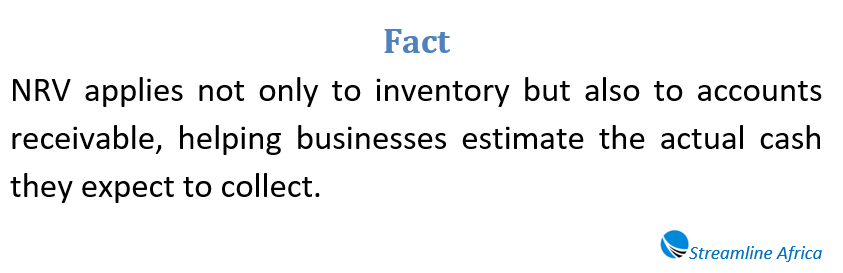
Although most commonly associated with inventory, NRV also applies to accounts receivable — estimating how much cash will actually be collected after bad debts.
For instance, a company expecting GHS 500,000 from customers may estimate that GHS 30,000 will be uncollectible, giving an NRV of GHS 470,000.
Real-World Scenario: Agricultural Trading Firm
Consider a maize aggregator operating across northern Ghana.
After harvest season:
- Purchase cost per ton: GHS 2,400
- Expected selling price: GHS 2,550
- Storage losses and drying cost: GHS 90
- Transport to buyers: GHS 140
- Handling and loading: GHS 35
NRV = 2,550 − (90 + 140 + 35)
NRV = GHS 2,285
Because NRV is below cost, the inventory must be written down.
This situation is common in commodity trading where price swings and logistics costs heavily influence profitability.
When NRV Increases Later
Accounting standards allow reversing previous write-downs if market conditions improve, but only up to the original cost.
This prevents companies from artificially boosting profits by revaluing inventory above what it originally cost.
Key Takeaways
Net realizable value ensures inventory is reported at a realistic recoverable amount rather than an outdated historical cost. It reflects current market conditions and selling realities.
At its core, NRV protects users of financial statements from misleading information and encourages prudent financial management.
Final Thoughts
In a dynamic business environment — whether dealing with electronics, textiles, agricultural products, or manufactured goods — inventory values rarely remain static. Prices shift, demand changes, goods deteriorate, and costs evolve.
Net realizable value acts as a financial reality check. It forces businesses to confront the true worth of their stock and prevents overly optimistic reporting.
For managers, NRV is more than an accounting rule. It is a strategic tool that can signal when to discount products, halt production, or clear excess inventory before losses deepen.
Understanding NRV equips business leaders, investors, and students alike with a clearer picture of how companies translate physical goods into actual cash — the ultimate measure of value in any enterprise.