
When we talk about economics, we’re referring to a vast field that helps us understand how resources are managed, distributed, and consumed. But this field is often divided into two key branches: microeconomics and macroeconomics. While both branches are concerned with economic activity and decision-making, they approach these questions from very different perspectives.
A Closer Look at Microeconomics
Microeconomics focuses on the small picture. It explores how individual people, households, and businesses make choices about their resources. This branch studies the behavior of entities that operate in specific markets—how consumers decide what to buy, how companies set prices, and how workers negotiate wages.
At its heart, microeconomics is all about the dynamics of supply and demand in individual markets. It helps us understand why the price of tomatoes might rise in one season or why one brand of phone outperforms another in sales. From consumer preferences and labor markets to production decisions and pricing strategies, microeconomics provides the tools to understand how smaller-scale economic units interact.
For instance, when a bakery decides whether to raise prices on its bread because the cost of flour has gone up, that decision falls under microeconomics. Similarly, when a person chooses between buying a new laptop or fixing the old one, economists look at that trade-off to understand individual decision-making processes.
Zooming Out to Macroeconomics
In contrast, macroeconomics takes a broader view. Instead of focusing on one business or one household, it studies economies as a whole. This includes national economies and even the global economic system. Macroeconomists are interested in big-picture trends like inflation, unemployment, gross domestic product (GDP), and government fiscal policies.
Macroeconomics is concerned with how governments manage the economy through spending and taxation, how central banks influence interest rates, and what impacts trade balances have on national well-being. These studies help answer questions like why recessions occur, what causes long-term economic growth, and how countries respond to economic crises.
For example, the monthly unemployment rate or national inflation rate are macroeconomic indicators. They tell us about the health of the entire economy rather than what’s happening in a single market or industry.
Why the Distinction Matters
The distinction between micro and macro isn’t just academic—it shapes the way economic problems are addressed. A policymaker trying to reduce inflation will focus on macroeconomic strategies, such as adjusting interest rates or altering government spending. On the other hand, a business owner planning next quarter’s product prices will draw on microeconomic principles.
This division also matters for researchers, who use different models and tools depending on the level of analysis. Microeconomic studies might rely heavily on game theory or behavioral analysis, while macroeconomic studies could involve complex models that simulate entire national economies.
How Macroeconomics Emerged as Its Own Field
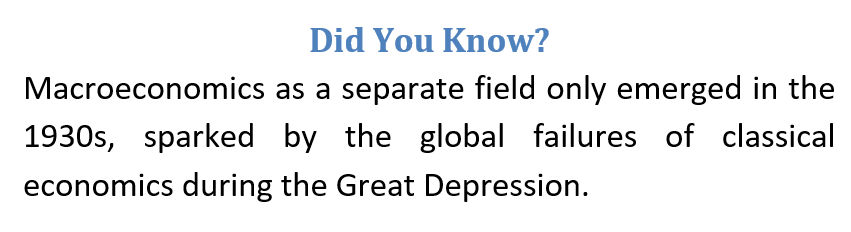
Interestingly, macroeconomics didn’t always exist as a separate discipline. It emerged out of necessity in the 1930s, during a period of severe economic downturn known as the Great Depression. At the time, the tools of microeconomics couldn’t fully explain the widespread unemployment and lack of economic output.
The economist John Maynard Keynes stepped in with a new approach. In his landmark work The General Theory of Employment, Interest and Money, Keynes argued that economies could remain in a depressed state unless governments intervened. He demonstrated how large-scale issues like inadequate demand could keep entire nations from reaching full employment, even if individual markets were working as expected.
This shift in thinking marked the birth of modern macroeconomics. It led to a new understanding of how monetary and fiscal policies could be used to guide national economies, prevent recessions, and encourage growth.
How They Interact
Even though microeconomics and macroeconomics are separate fields, they influence each other constantly. You can’t fully understand one without considering the other.
Take inflation, for example. Macroeconomists might study inflation to determine how rising prices affect a country’s economy. But those rising prices also directly impact individual households and businesses, which is the domain of microeconomics. A family may cut back on groceries because prices have gone up, and a business may reduce staff hours to save money on wages. These micro-level decisions, when replicated across millions of actors, influence broader macroeconomic trends.
Similarly, macroeconomic policies—like raising interest rates—can affect individual behaviors. If borrowing becomes more expensive, fewer people may take out loans to buy homes or invest in new businesses. These individual responses, in turn, affect the overall economy.

Micro vs. Macro: Practical Examples
Let’s take a look at real-world examples to ground these concepts.
In the world of microeconomics, think of a college student planning her monthly expenses. She needs to allocate money for food, rent, transportation, and maybe a few fun nights out. Her decision on how to divide her budget is a microeconomic issue—one that reflects trade-offs, priorities, and resource limitations.
Now consider macroeconomics. Imagine the national unemployment rate rises to 10%. That data point suggests major changes in the labor market. Economists will use this figure to predict consumer spending trends, gauge business confidence, and recommend policy responses. The unemployment rate isn’t about one person or business—it’s about an entire workforce.
Micro and Macro Environments in Business
Businesses also experience the difference between micro and macro factors. The “micro environment” refers to conditions that directly affect a specific company—its suppliers, customers, competitors, and internal operations. For example, if a business loses a key supplier or sees a sudden drop in customer demand, those are micro-level challenges.
On the other hand, the “macro environment” includes larger forces that influence all businesses, like economic cycles, government regulations, and international trade dynamics. A countrywide recession or changes in tax policy would fall under this category and can affect every business regardless of size or sector.
Understanding Both Is Essential
To fully grasp economic trends and make informed decisions, it’s important to understand both micro and macro perspectives. Policymakers, business leaders, and even everyday consumers benefit from recognizing how the economy works at both individual and collective levels.
By seeing the connection between local decisions and broader outcomes, we become more capable of navigating the complexities of modern economies. Whether you’re setting prices for your small business or analyzing a nation’s inflation data, both micro and macro insights are vital.
Final Thoughts
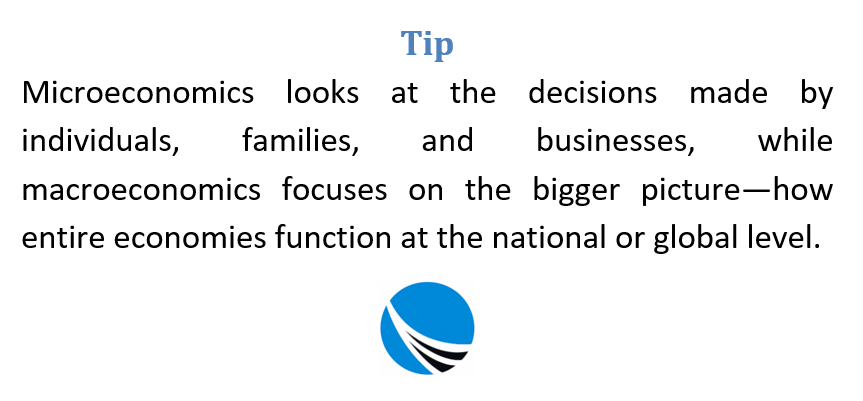
Economics is a tool for understanding how people and societies manage resources. Microeconomics zeroes in on individuals and businesses. Macroeconomics looks at the bigger picture—how economies function on a national or global scale.
Though distinct in their focus, these two branches are deeply intertwined. What happens in one household or company can ripple outward to affect an entire economy. And changes in national policy or global trade can, in turn, shape the decisions of families and firms. Understanding both sides offers a clearer, more complete picture of the economic world we all live in.
Frequently Asked Questions
Why does microeconomics matter in everyday life?
Microeconomics helps us understand personal choices, like how to budget for groceries or why a business decides to raise its prices. It’s all about how we use limited resources to meet daily needs.
How does macroeconomics impact regular people?
Macroeconomics affects job availability, inflation, interest rates, and the cost of living. When the economy slows down or inflation spikes, it touches everyone’s pocket in one way or another.
Can one field exist without the other?
Not really. They’re deeply connected. Micro-level decisions from individuals and businesses influence macro trends, and vice versa—national policies affect what people and companies do on the ground.
How did macroeconomics come about?
It developed during the Great Depression when existing economic theories couldn’t explain widespread unemployment. Economists like John Maynard Keynes introduced new ideas to understand large-scale economic challenges.
What’s an example of a microeconomic decision?
Choosing between eating out or saving money for rent is a microeconomic decision. It’s about how individuals allocate resources based on needs and priorities.
What’s a typical macroeconomic indicator?
The unemployment rate is a classic macroeconomic indicator. It tells us how well the labor market is functioning and gives hints about broader economic health.
How do businesses feel the impact of both micro and macro environments?
A business might deal with customer behavior (micro) while also navigating interest rate changes or new tax laws (macro). Both play a role in its success or struggles.
Why should we care about understanding both?
Knowing how micro and macroeconomics work helps us make smarter personal, business, and policy decisions. It’s about seeing how the little things we do tie into the big picture.