

Why Traditional Accounting Becomes Unreliable During Inflation
Financial statements are designed to help investors, managers, lenders, regulators and other stakeholders understand how a business is performing. However, when inflation rises sharply, conventional accounting records may no longer provide an accurate picture of a company’s financial health. Historical figures can remain unchanged even though the purchasing power of money, the cost of replacing assets and the expenses required to operate the business have increased significantly.
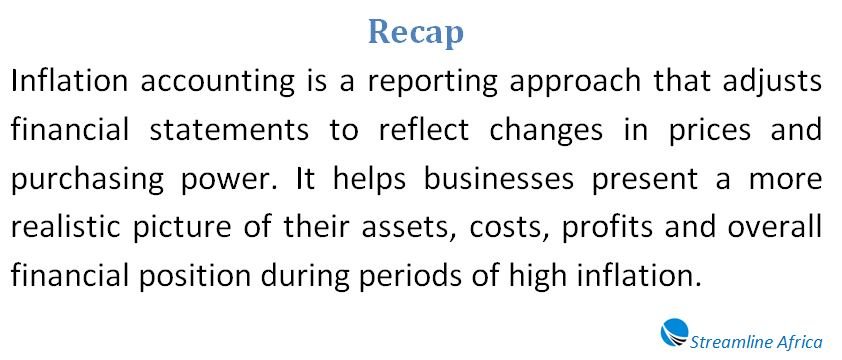
Inflation accounting addresses this problem by adjusting financial information to reflect changing price levels. Instead of treating money from different periods as though it has the same value, the approach updates selected figures using price indexes, current asset values or replacement costs. The objective is not simply to increase reported numbers. It is to ensure that income, expenses, assets and liabilities are presented in values that are economically comparable.
Without these adjustments, a business may appear more profitable than it truly is. Revenue earned at today’s higher prices may be compared with inventory, equipment or property recorded at much older and lower costs. The resulting profit may therefore contain an inflationary element rather than representing a genuine improvement in performance.
How Inflation Accounting Improves Financial Reporting
Inflation accounting restates financial statements so that amounts recorded at different points in time can be evaluated using a more consistent measurement basis. A suitable price index, such as the Consumer Price Index, may be applied to certain balances to reflect the decline in the currency’s purchasing power.
This process is especially important in economies where prices rise so quickly that historical financial statements lose relevance within a relatively short period. A factory purchased several years earlier, for example, may still be carried in the accounts at its original cost even though replacing that facility would now require several times the recorded amount. Similarly, depreciation based on the original purchase price may be too low to represent the real cost of using the asset.
By adjusting these amounts, inflation accounting enables management to assess whether the business is earning enough to maintain its productive capacity. It also reduces the risk of distributing apparent profits that may actually be needed to replace inventory, machinery or other operating resources.
Read Also: Why Inflation Belongs In Every Business Financial Plan
Recognizing Hyperinflationary Conditions
Inflation accounting becomes particularly important when an economy enters a period of hyperinflation. Under International Financial Reporting Standards, IAS 29 governs financial reporting for businesses whose functional currency belongs to a hyperinflationary economy.
Hyperinflation is not determined by one rigid indicator alone. Accountants examine several economic conditions, including whether consumers prefer to store wealth in foreign currencies or physical assets, whether prices are commonly quoted in a more stable currency and whether credit transactions include compensation for the expected loss of purchasing power.
A cumulative inflation rate approaching or exceeding 100% over three years is widely treated as a major warning sign. When such conditions exist, financial statements prepared under IFRS generally must be restated using a general price index before they are presented or translated into another reporting currency.
These requirements help prevent financial reports from combining figures expressed in units of money with substantially different purchasing power.
The Current Purchasing Power Method
The current purchasing power method, commonly called CPP, adjusts financial statement items according to changes in a general price index. Its main purpose is to express accounting information in units of comparable purchasing power.
Under CPP, accounts are divided into monetary and nonmonetary categories. Monetary items include cash, receivables, loans and payables because they are settled in fixed or determinable amounts of currency. These balances are not normally restated in the same manner as physical assets because they already represent current monetary amounts.
However, holding monetary assets during inflation can create a purchasing-power loss. Cash that could purchase a certain quantity of goods at the beginning of the year may buy considerably less by the end of the year. Conversely, a company with fixed monetary liabilities may experience a purchasing-power gain because it repays the obligation using money that has become less valuable.
Nonmonetary items, including inventories, buildings, machinery and shareholders’ equity, may be adjusted using a conversion factor derived from an appropriate price index. For example, an asset acquired when the index stood at 150 could be restated when the index reaches 225 by multiplying its historical cost by 225 divided by 150.
CPP therefore concentrates on changes in the general purchasing power of money rather than the individual market value of each asset.
The Current Cost Accounting Method
Current cost accounting, or CCA, takes a different approach. Rather than relying primarily on a general inflation index, it focuses on the amount a business would currently need to pay to replace the assets and resources used in its operations.
Under this method, assets may be reported at their current replacement cost, market value or another relevant modern valuation. Inventory consumed during the accounting period may also be charged against revenue at its current cost rather than its original purchase price.
This distinction is important because the cost of a particular asset may increase at a rate that differs from general inflation. Construction equipment, imported machinery or specialized technology may become much more expensive even when the general consumer price index rises moderately.
CCA aims to determine whether the company has generated sufficient income to preserve its operating capability. Profit is recognized only after considering the amount required to replace the resources used to earn that profit. The method can therefore give managers a practical view of whether the business can continue operating at its present scale.
Calculating Changes in Price Levels
A price index provides a reference point for measuring how prices have changed over a selected period. The percentage change can be calculated by subtracting the opening index from the closing index, dividing the result by the opening index and multiplying by 100.
Suppose a price index rises from 200 to 280. The increase is 80 points. Dividing 80 by 200 and multiplying by 100 gives an inflation rate of 40%.
A restatement factor may also be calculated by dividing the closing index by the index that applied when a transaction occurred. In this example, the factor would be 280 divided by 200, producing 1.40. A nonmonetary asset originally recorded at $50,000 could therefore be expressed as $70,000 in closing purchasing-power units.
The index selected must be reliable, relevant to the economy and applied consistently. Poor index selection may produce adjustments that appear precise but fail to reflect the company’s actual economic circumstances.
Differences Between IFRS and U.S. GAAP
International and American accounting frameworks do not always respond to high inflation in the same way. IFRS generally requires businesses using the currency of a hyperinflationary economy to restate their financial statements under IAS 29. After restatement, the figures may be translated into the reporting currency of a parent company.
U.S. Generally Accepted Accounting Principles often require a different treatment for foreign operations considered highly inflationary. In some cases, the reporting entity’s currency, frequently the U.S. dollar, is treated as the subsidiary’s functional currency. Local-currency transactions and balances are then remeasured into dollars.
This difference can produce significant foreign exchange gains or losses, particularly when a local currency depreciates rapidly. Multinational businesses operating in countries with persistent inflation must therefore understand which reporting framework applies and how the chosen treatment may affect earnings, assets and financial ratios.
Benefits of Adjusting Financial Statements for Inflation
One of the strongest advantages of inflation accounting is that it compares current revenue with more realistic current costs. This improves profit measurement and reduces the possibility that inflation-generated gains will be mistaken for operational success.
Adjusted statements may also strengthen business planning. Management can estimate replacement funding more accurately, assess capital requirements, review pricing decisions and determine whether the company is maintaining its productive capacity.
Investors and lenders may benefit from improved comparisons between businesses operating in different economic environments. Inflation-adjusted figures can also support more meaningful analysis of return on assets, inventory performance, depreciation and capital maintenance.
Additionally, the method may protect organizations from paying excessive dividends or taxes based on profits that exist largely because of outdated asset values.
Drawbacks and Practical Limitations
Despite its benefits, inflation accounting introduces considerable complexity. Businesses must select appropriate indexes, classify accounts correctly, update valuations regularly and explain the adjustments to stakeholders who may be unfamiliar with the process.
Different methods may also produce different results. CPP reflects changes in general purchasing power, while CCA considers specific replacement costs. Neither method can eliminate every form of estimation or professional judgment.
Frequent restatements may make financial statements difficult to compare across reporting periods. Investors may struggle to distinguish between actual business growth and changes caused by inflation adjustments. Valuations may also create opportunities for manipulation when management has discretion over assumptions, market estimates or replacement values.
The process can be expensive, particularly for organizations with large asset portfolios, multiple foreign subsidiaries or limited access to reliable economic data.
Presenting a More Realistic View of Performance
Inflation accounting helps businesses maintain the usefulness of financial statements when rapidly changing prices weaken the meaning of historical costs. Through current purchasing power adjustments or current cost valuations, companies can present assets, expenses and profits in values that more closely reflect current economic reality.
CPP emphasizes the changing value of money, while CCA focuses on the cost of replacing business resources. Both methods seek to prevent organizations from overstating profit and understating the cost of sustaining operations.
Although the approach may increase reporting costs and create interpretation challenges, it remains an important financial tool in inflationary and hyperinflationary economies. When applied transparently and consistently, inflation accounting gives decision-makers a clearer understanding of whether a company is genuinely growing, merely benefiting from rising prices or gradually losing its ability to replace the resources required for future operations.
Frequently Asked Questions about Inflation Accounting
Why can historical cost accounting become misleading?
Historical cost accounting records assets and expenses at their original values. During inflation, those figures may become outdated, causing assets to appear undervalued and profits to look higher than they truly are.
What are the two main inflation accounting methods?
The two main methods are current purchasing power and current cost accounting. Current purchasing power adjusts figures using a general price index, while current cost accounting values assets and expenses according to present replacement costs.
How does the current purchasing power method work?
The current purchasing power method separates monetary and nonmonetary items. Nonmonetary items are adjusted using a price index, while gains or losses on monetary balances are recognized based on changes in purchasing power.
What does current cost accounting measure?
Current cost accounting measures what it would cost a business to replace its assets and resources today. It helps determine whether current profits are sufficient to maintain the company’s operating capacity.
When is an economy considered hyperinflationary?
An economy may be treated as hyperinflationary when cumulative inflation reaches or exceeds approximately 100% over three years, alongside signs such as widespread indexation, rapid currency depreciation and preference for stable foreign currencies.
How does inflation accounting improve profit analysis?
It matches current revenue with more realistic current costs. This reduces the risk of treating inflation-related price increases as genuine business growth or operational improvement.
What are the main benefits of inflation accounting?
Inflation accounting improves financial planning, asset valuation, profit measurement and replacement-cost analysis. It can also help businesses avoid paying dividends or taxes based on profits that mainly result from outdated accounting values.
What are the main disadvantages of inflation accounting?
The process can be complex, costly and difficult for investors to interpret. It also relies on price indexes, market estimates and professional judgment, which may create inconsistency or opportunities for manipulation.