
Cameroon is a market with substantial long-term commercial potential, supported by its natural resources, geographic position, and relatively diversified economy. The country offers exposure to agriculture, hydrocarbons, mining, forestry, consumer goods, infrastructure, and regional trade. However, investors must approach the market with a disciplined understanding of its political, regulatory, financial, and security risks.
Our assessment is that Cameroon can offer attractive opportunities for well-prepared investors, but market entry should be supported by detailed due diligence, strong compliance controls, and carefully selected local partnerships.
Political Environment and Governance Risk
From an investment perspective, Cameroon’s political structure remains highly centralized. Long-standing presidential leadership has limited institutional renewal and contributed to concerns about transparency, accountability, and the equitable distribution of national wealth.
Political tensions are particularly pronounced in the English-speaking regions, where demands for greater political representation and autonomy have led to prolonged unrest. These conditions may affect business continuity, logistics, workforce safety, and access to certain areas.
We advise investors to conduct location-specific security assessments before committing capital. Companies should also prepare contingency plans for transport disruption, political demonstrations, communication interruptions, and changes in local operating conditions.
Economic Fundamentals and Strategic Advantages
Cameroon remains one of the most economically significant markets in Central Africa. Its economy benefits from petroleum reserves, mineral deposits, productive agricultural land, forests, and a sizeable population.
The country’s location also strengthens its commercial value. Cameroon can serve as a gateway to neighbouring landlocked markets and offers access to wider regional trade networks. For businesses seeking a Central African operational base, this geographic advantage can support distribution, logistics, and market expansion.
However, the benefits of regional access depend heavily on transport infrastructure, customs efficiency, and the ability to manage cross-border administrative requirements.
Diversification Beyond Oil
Our team considers economic diversification to be one of Cameroon’s most important investment themes. Oil has historically supported government revenue and foreign exchange earnings, but the sector cannot provide a permanent foundation for growth.
Declining reserves increase the urgency of developing non-oil industries. Investors should therefore examine sectors that can generate employment, increase exports, and reduce dependence on imported goods.
Agriculture and agro-processing offer particularly strong potential. Opportunities exist across cocoa, coffee, cotton, palm oil, livestock, fruit, cereals, and food manufacturing. Investment in storage, irrigation, packaging, cold-chain systems, and transportation could improve productivity and reduce post-harvest losses.
Local processing also creates value by converting raw materials into finished or semi-finished products for domestic and export markets.
Renewable Energy and Power Infrastructure
Energy shortages remain a major obstacle to industrial activity, but they also create opportunities for private investment. Cameroon aims to increase the contribution of renewable energy to 25 percent of its electricity supply by 2035.
Reaching this target will require significant capital, technical expertise, and cooperation between public institutions and private investors. Potential areas include hydropower, solar energy, biomass, rural electrification, transmission networks, battery storage, and captive power systems for industrial users.
We recommend that investors assess tariff structures, contract enforceability, payment risks, and regulatory clarity before entering the sector. The financial reliability of public-sector counterparties should also be examined carefully.

Financial Sector Constraints
Cameroon’s financial system remains underdeveloped relative to the needs of a growing private sector. Access to credit can be difficult, especially for small and medium-sized businesses. Long-term financing is limited, and borrowing costs may be high.
For international investors, this may create a need to secure funding outside the domestic banking system. It may also affect the financial stability of suppliers, distributors, and local partners.
Our advisory approach includes reviewing the financial strength of counterparties, testing cash-flow assumptions, and preparing for possible delays in payments or access to working capital.
Corruption and Compliance Exposure
Corruption remains one of the most significant risks facing investors in Cameroon. Administrative processes may be influenced by informal payments, political connections, or inconsistent application of regulations.
Companies should establish clear anti-bribery policies, approval procedures, reporting channels, and recordkeeping systems. Enhanced due diligence is especially important when dealing with intermediaries, agents, public officials, or politically exposed individuals.
We strongly advise investors to avoid arrangements that depend excessively on political influence. Commercial relationships should be based on transparent contracts, documented services, and verifiable business capability.
Establishing a Local Company
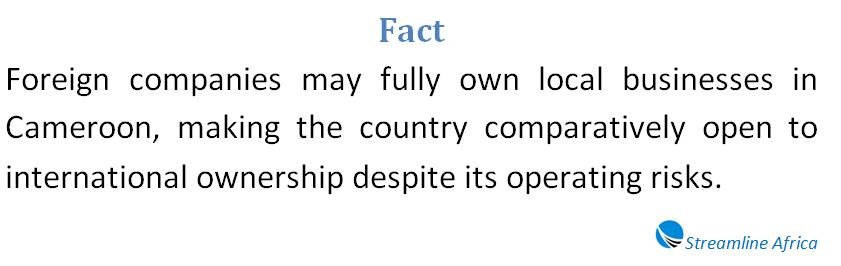
Foreign investors are generally permitted to own 100 percent of a company in Cameroon, provided they meet relevant immigration and work-permit requirements.
Business registration through the appropriate enterprise creation centre may be completed within a few days, although practical timelines can extend to approximately two weeks. Incorporation expenses may reach around US$3,500, depending on the company structure, legal support, and documentation required.
Certain professions and regulated industries require additional licences or approvals. Investors should confirm all sector-specific requirements before making financial commitments or signing operational agreements.
Market Entry and Distribution
Retail, consumer goods, and fast-moving consumer products may offer relatively accessible entry points for foreign companies. However, identifying qualified distributors can be challenging.
Our team recommends conducting independent checks on potential distributors, including their ownership structure, financial position, warehouse capacity, sales network, reputation, and political exposure.
A gradual entry strategy may be preferable. Pilot programmes, limited territorial agreements, and performance-based distribution contracts can help investors test demand before expanding their commitment.
Business Culture and Decision-Making
Cameroon’s business environment is generally formal and hierarchical. Seniority, status, and protocol are important, and decisions are often made by top management rather than through broad consultation.
Investors should identify the true decision-makers early in the negotiation process. Respectful communication, formal introductions, and regular face-to-face engagement can help build trust.
Relationship development may take time, and patience is often necessary. Companies that understand local etiquette and demonstrate long-term commitment may find it easier to establish productive partnerships.
Our Investment Outlook
Our overall view is that Cameroon offers meaningful opportunities in agriculture, renewable energy, manufacturing, infrastructure, consumer goods, logistics, and regional trade.
Nevertheless, the market requires a cautious and informed strategy. Political uncertainty, insecurity, corruption, limited access to finance, and regulatory inconsistency can affect returns.
Investors that combine reliable local intelligence, rigorous due diligence, disciplined compliance, and phased market entry will be better placed to manage risk and capture Cameroon’s long-term commercial potential.
Important Questions and Answers about Cameroon’s Business Opportunities
Why is Cameroon attractive to foreign investors?
Cameroon offers valuable opportunities through its natural resources, agricultural potential, growing consumer market, and strategic location within Central Africa.
Which sectors present the strongest investment opportunities?
Agriculture, agro-processing, renewable energy, manufacturing, infrastructure, logistics, consumer goods, mining, and regional trade offer some of the most promising prospects.

What is Cameroon’s main political risk?
The country’s highly centralized political system creates concerns about limited institutional reform, weak accountability, regulatory uncertainty, and unequal access to economic opportunities.
How does insecurity affect businesses?
Political unrest, particularly in English-speaking regions, can disrupt transportation, workforce safety, supply chains, communication systems, and access to local markets.
Why must Cameroon diversify beyond oil?
Oil reserves are declining, making it necessary to develop industries that can create jobs, increase exports, strengthen public revenue, and reduce dependence on hydrocarbons.
What opportunities exist in agriculture?
Investors can explore cocoa, coffee, cotton, palm oil, livestock, fruit, cereals, food processing, irrigation, packaging, storage, cold-chain systems, and agricultural transportation.
Is renewable energy a viable investment area?
Yes. Cameroon aims to obtain 25 percent of its energy from renewable sources by 2035, creating opportunities in solar power, hydropower, biomass, storage, and rural electrification.
Can foreigners fully own companies in Cameroon?
Foreign investors can generally hold full ownership of local businesses, provided they meet the country’s immigration, licensing, registration, and work-permit requirements.
What should investors consider when choosing local partners?
Investors should examine a partner’s ownership, finances, reputation, distribution capacity, political connections, operational experience, and compliance history before signing agreements.
What is the best approach to entering the Cameroonian market?
A phased strategy involving pilot projects, limited distribution agreements, strong due diligence, local market research, and performance-based contracts can reduce exposure.