

Senior management may believe employee relations are stable when meetings remain orderly, operational reports appear positive and formal complaints are rare. However, employees may still be increasingly reluctant to challenge decisions, report emerging risks or question the conduct of managers. Teams may privately discuss unsafe practices, unrealistic targets, process failures or difficult leadership decisions without raising them through formal channels.
The underlying issue is not always an absence of problems. It may be a lack of confidence that raising them will produce a fair, constructive and proportionate response.
Employee silence usually develops gradually. Participation becomes more limited, language grows more cautious and concerns migrate from formal forums into private conversations. Before turnover, reputational damage or operational failure emerges, warning signs may have been visible for months.
Leadership should therefore treat employee voice as a governance, risk and performance mechanism. The following indicators can help organisations identify when employees no longer feel sufficiently safe to question assumptions, report misconduct or escalate emerging concerns.
Open Communication Declines Noticeably
A reduction in candid communication is often one of the earliest indicators of declining psychological safety. Employees who previously contributed freely may begin providing minimal updates, avoiding sensitive topics or seeking to conclude meetings quickly.
Leadership should compare current participation patterns with established team behaviour. Confidential channels, one-to-one discussions and informal check-ins provide credible routes for raising concerns before silence becomes embedded in the organisational culture.
Concerns Surface Through External Channels
When employees approach regulators, journalists, legal advisers or public platforms before using internal mechanisms, trust in organisational processes may already be significantly weakened. External escalation often suggests that employees regard internal channels as ineffective, biased or personally risky.
Organisations should establish independent options, including an ombuds function, ethics hotline or third-party reporting platform. The effectiveness of these mechanisms depends on clarity regarding confidentiality, investigation procedures, reporting ownership and protection from retaliation.
Agreement Becomes Automatic
Consistent agreement should not automatically be interpreted as strategic alignment. Rapid consensus and limited alternative views may mean employees are managing leadership reactions rather than objectively assessing decisions.
Leaders can counter this by explicitly requesting dissent, inviting alternative scenarios and publicly recognising employees who identify material weaknesses. This reinforces the principle that constructive disagreement is a professional contribution rather than an act of disloyalty.

Constructive Challenge Disappears
High-performing teams typically test assumptions, question priorities and debate execution risks. When that behaviour disappears, management may mistakenly conclude that collaboration has improved.
Senior leaders should acknowledge uncertainty and invite scrutiny of their proposals. Employees are more likely to challenge decisions where leaders demonstrate that ideas can be examined without damaging professional relationships, career prospects or personal credibility.
Reporting Becomes Exclusively Positive
A good-news-only environment is risky because operational difficulties do not disappear when reporting stops. Project updates may become increasingly polished while delivery constraints, customer dissatisfaction and compliance concerns remain unresolved.
Executives should request balanced reporting by asking what is underperforming, what assumptions may be incorrect and which risks could materially affect outcomes. Their response to difficult information will determine whether employees continue to provide it.
Recurring Problems Remain Unresolved
Persistent issues often indicate that employees no longer believe escalation will lead to meaningful action. A service team may repeatedly report system failures while management continues to approve temporary workarounds. An operational unit may raise staffing constraints, yet resource decisions remain unchanged.
Follow-through is essential. Leaders should clarify the action being taken, assign accountability and communicate progress. Where a full solution is not immediately possible, a transparent explanation can still preserve trust and encourage continued reporting.
Informal Gossip Replaces Direct Dialogue
When concerns move from formal meetings into private messages, corridor conversations and social groups, employees may feel safer communicating laterally than upward. The resulting frustration can intensify because individuals are able to describe the problem but do not expect leadership to address it.
Management should avoid treating gossip solely as a conduct issue. It can indicate blocked communication. Facilitated discussions, listening sessions and non-defensive leadership responses can help convert informal dissatisfaction into structured organisational insight.
Employees Routinely Bypass Their Managers
Skip-level discussions should primarily provide strategic context, development support and broader organisational visibility. When employees use them to secure routine approvals, resolve basic conflicts or raise matters they cannot discuss with their direct manager, the immediate reporting relationship may be impaired.
The response should be diagnostic rather than punitive. Leaders should identify the source of the breakdown and provide targeted support through coaching, clarified responsibilities and structured conversations between the parties.
Proactive Questions and Ideas Decline
Employees who previously suggested improvements may begin waiting for instructions. This frequently occurs where repeated correction, dismissal or micromanagement has taught them that independent judgement creates unnecessary personal exposure.
Leaders should create defined opportunities for employees to test ideas, discuss alternatives and develop imperfect proposals. Controlled autonomy and constructive responses can restore initiative, ownership and confidence.
Concerns Become Excessively Formalised
In a healthy organisation, employees can raise incomplete observations, including concerns that are not yet fully evidenced. When every issue arrives as a highly documented and carefully worded case, employees may be preparing to defend themselves against denial, blame or retaliation.
Management should encourage early reporting and value preliminary concerns. Incomplete observations often provide the first indication of potential fraud, misconduct, customer harm or operational weakness.
Minor Issues Are No Longer Reported
The disappearance of small complaints should not be viewed as proof that conditions have improved. Employees observe how colleagues are treated when they report scheduling inconsistencies, disrespectful conduct or minor policy breaches. If those matters are ignored or minimised, employees may withhold more serious concerns.
An effective speak-up framework should protect employees from retaliation and demonstrate that minor reports are useful. Small issues frequently provide an opportunity to address patterns before they develop into material legal, financial or reputational exposure.
Disengagement Becomes More Evident
Lower initiative, reduced collaboration, weaker performance and limited social interaction may indicate more than fatigue. Employees who no longer expect their views to matter often withdraw into basic task completion and avoid discretionary contribution.
Managers should address such changes through respectful, evidence-based conversations. The objective should be to understand whether the underlying cause relates to workload, conflict, trust, leadership behaviour or career progression rather than assuming poor motivation.
Requests for Feedback Produce Silence
Some organisations regularly request employee input but receive little meaningful response. The issue may not be the frequency of the request. Employees may believe decisions have already been made or that disagreement will carry future consequences.
Leaders should replace broad questions such as “Does everyone agree?” with more specific prompts, including “What risks have we not considered?” or “Which assumptions require further testing?” Targeted questions make dissent easier and demonstrate that challenge is expected.
Employees Follow Flawed Instructions Literally
Malicious compliance occurs when employees implement a questionable directive exactly as issued, despite understanding that it may damage customers, colleagues or commercial outcomes. They may prefer to observe failure rather than risk challenging authority.
Leadership should distinguish between unreasonable insubordination and responsible professional judgement. An employee who pauses or modifies a harmful instruction may be acting in the organisation’s long-term interest and should be assessed accordingly.
Near-Miss Reporting Falls
In safety-sensitive sectors, a decline in near-miss reporting may appear to indicate stronger performance. It can instead suggest that employees no longer believe reporting will lead to improvement or that they fear personal blame.
Near-miss data should be regarded as preventative operational intelligence. Leaders should thank the reporter, investigate system conditions rather than defaulting to individual fault and communicate the corrective measures adopted.
Turnover Is Concentrated in One Area
General turnover may reflect wider labour-market conditions, but repeated departures from one department often indicate a localised leadership, workload or trust issue. Exit interviews may not reveal the full position because departing employees can remain concerned about references and professional relationships.
Organisations should combine anonymous surveys, third-party interviews and workforce analytics. Comparing turnover, absence, grievances, promotion rates and engagement across teams can help distinguish isolated departures from a structural problem.
Rebuilding Confidence Through Consistent Leadership Practice
A credible speak-up culture cannot be restored through slogans, annual surveys or open-door policies alone. Employees assess safety through repeated leadership behaviour. They observe whether managers become defensive, whether messengers suffer consequences, whether investigations are impartial and whether action follows.
The most effective leadership response is consistent: listen carefully, protect the individual raising the issue, investigate objectively, explain decisions and demonstrate visible follow-through. Where management cannot adopt a recommendation, it should explain the commercial, legal or operational reasons.
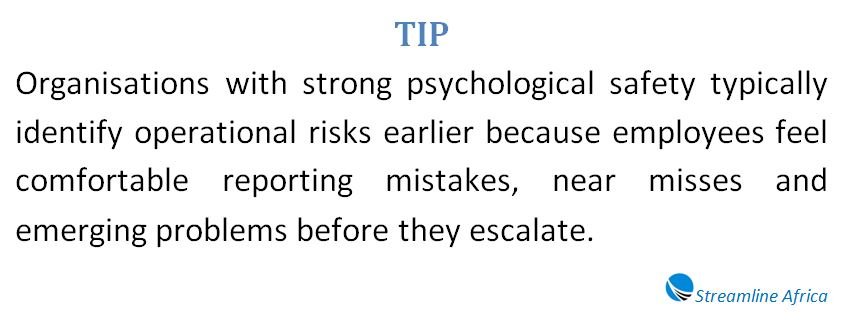
When employees believe that candour is protected and useful, concerns emerge earlier, decision quality improves and risks become easier to manage. Silence may create the appearance of stability, but it often increases organisational exposure. The objective is not to eliminate disagreement. It is to ensure that material concerns reach the appropriate decision-makers while corrective action remains possible.
Frequently Asked Questions
Why is psychological safety important in the workplace?
Psychological safety encourages employees to speak openly about risks, mistakes and new ideas without fearing punishment, leading to stronger decision-making and better business performance.
What is the earliest sign that employees no longer feel safe speaking up?
One of the first indicators is a noticeable decline in open communication, where employees become quieter, less engaged and reluctant to challenge decisions.
Why is constant agreement during meetings a warning sign?
When everyone agrees without discussion, it may indicate fear of disagreeing rather than genuine alignment, causing important issues to remain hidden.
How does unresolved feedback affect employee trust?
When employees repeatedly see their concerns ignored or left unresolved, they lose confidence that speaking up will make any meaningful difference.
What role do managers play in building a speak-up culture?
Managers set the tone by listening respectfully, responding fairly, protecting employees from retaliation and acting on legitimate concerns.
Why should organisations encourage reporting of small issues?
Addressing minor concerns early helps prevent larger operational, legal and reputational problems while reinforcing confidence in the reporting process.
How can leaders encourage honest feedback?
Leaders should ask thoughtful questions, welcome opposing viewpoints, acknowledge constructive criticism and demonstrate visible follow-through on employee feedback.
Why is employee disengagement linked to psychological safety?
Employees who feel ignored or undervalued often reduce their participation, avoid taking initiative and limit their contributions to only what is required.
What does concentrated employee turnover reveal?
High turnover within a specific department may point to leadership, communication or workplace culture challenges that require immediate attention.
What is the most effective way to rebuild trust after employee silence?
Trust is rebuilt through consistent leadership behaviour, transparent communication, fair investigations and visible action that demonstrates employee concerns are taken seriously.