

Insourcing is increasingly being viewed not simply as an operational choice, but as a strategic decision about which capabilities an organization should directly own, manage and develop.
At its core, insourcing involves assigning a business activity, project or function to internal employees and resources rather than engaging an external provider. In some cases, this means retaining work that might otherwise have been outsourced. In others, it involves bringing previously outsourced activities back under internal management.
The significance of this decision extends beyond organizational structure. Insourcing can influence cost efficiency, service quality, workforce capability, risk exposure, knowledge retention and competitive positioning.
For business leaders, the central question is therefore not whether internal delivery is inherently better than outsourcing. Rather, the focus should be on determining which activities are sufficiently important to warrant direct organizational ownership.
Functions that involve sensitive information, proprietary knowledge, customer experience, operational quality or business-critical decision-making may provide stronger long-term value when managed internally. By contrast, highly specialized or non-core activities may still be more efficiently handled by external providers.
An effective insourcing strategy requires management to evaluate these trade-offs systematically.
How Insourcing Supports Greater Operational Control
One of the strongest arguments for insourcing is the level of control it provides over business processes.
When a function is performed internally, management has direct oversight of employees, workflows, performance standards and operating procedures. Changes can be introduced more quickly without depending on contract amendments, vendor negotiations or third-party approval processes.
This level of control can be particularly important where quality standards are tightly connected to customer expectations or regulatory requirements.
An internal team can adapt processes immediately when performance gaps emerge. Managers are also better positioned to identify bottlenecks, resolve operational issues and establish accountability.
In outsourced arrangements, responsibility is often divided between the company and the service provider. While formal service-level agreements can establish expectations, they do not always provide the same degree of flexibility or day-to-day visibility.
For organizations operating in fast-changing markets, internal control can therefore support greater agility and responsiveness.
Strengthening Quality and Service Consistency
Insourcing can also improve consistency in how products, services and internal processes are managed.
Employees working directly within an organization are more likely to understand its operational standards, customer expectations and strategic priorities. This familiarity can reduce inconsistencies that sometimes arise when work is transferred to external parties.
Quality management becomes more integrated because performance expectations can be embedded directly into internal systems, training programmes and management processes.
For example, an organization that relies heavily on customer experience as a source of differentiation may choose to retain customer support internally. Doing so gives management greater control over recruitment, training, performance measurement and service standards.
Similarly, companies operating complex production environments may prefer to manage critical manufacturing or quality control processes internally to ensure that product standards remain consistent.
Insourcing can therefore be particularly valuable when service quality is closely linked to reputation or competitive advantage.
Improving Communication and Cross-Functional Collaboration
Operational efficiency is often affected not only by the quality of individual functions, but also by how effectively teams collaborate.
Insourcing can strengthen coordination by keeping related activities within the same organizational structure.
Internal teams typically share common communication channels, management systems and strategic objectives. This makes it easier to exchange information, resolve issues and coordinate decisions across functions.
External service providers may require additional communication structures, reporting requirements and formal approvals. These arrangements can work effectively, but they may also introduce delays when decisions need to move quickly.
An internal marketing team, for example, can work closely with sales, product development and customer service teams during a product launch. Information can be shared immediately, and campaign adjustments can be made without passing through multiple organizational boundaries.
This closer collaboration can improve execution and help ensure that different departments remain aligned with broader business priorities.
Developing Organizational Knowledge and Internal Expertise
A major strategic benefit of insourcing is the opportunity to develop capabilities that remain within the organization.
External providers deliver expertise, but the knowledge generated through their work may not always remain fully embedded within the client organization once an engagement ends.
Internal employees, by contrast, accumulate experience over time.
They develop deeper familiarity with company systems, customers, technologies and operating models. Lessons learned from one project can be applied to future challenges, strengthening organizational capability.
This is particularly important in knowledge-intensive functions such as data analytics, technology development, research and development, finance and strategic planning.
A business that consistently depends on external specialists for these capabilities may become highly reliant on its vendors. Developing internal expertise can reduce this dependence and give the organization greater strategic flexibility.
Over time, insourcing can therefore serve as an investment in institutional knowledge rather than simply a method of completing operational work.
Protecting Intellectual Property and Sensitive Information
Data protection and information security are increasingly influencing sourcing decisions.
Many business functions require access to commercially sensitive information, including financial records, customer data, proprietary technologies, strategic plans and intellectual property.
Working with external providers can create additional points of exposure because individuals outside the organization may require access to internal systems.
Strong cybersecurity controls, confidentiality agreements and vendor management procedures can reduce this risk. However, they cannot eliminate it completely.
Insourcing may offer greater control over who accesses sensitive information and how that information is managed.
This consideration is particularly relevant for functions involving software development, research, financial reporting, legal matters or strategic analytics.
However, internal delivery should not automatically be assumed to be secure. Organizations still require strong governance, access controls, employee training and appropriate technology infrastructure.
The strategic advantage lies in reducing unnecessary external exposure while maintaining disciplined internal security practices.
Insourcing as a Workforce Development Strategy
Bringing business activities internally can also support broader talent development objectives.
Organizations may create new positions, expand existing roles or develop specialist teams to manage insourced functions.
This provides employees with opportunities to acquire new skills and assume greater responsibility.
For example, an organization that establishes an internal data analytics function can train employees in advanced reporting, forecasting and business intelligence. The resulting capability can support multiple departments rather than serving only one project.
Insourcing can also contribute to employee engagement by creating clearer development pathways and opportunities for internal mobility.
From a workforce planning perspective, this can help organizations build capabilities that are expected to remain strategically important over the long term.
However, management should also consider capacity constraints. Assigning additional responsibilities to employees without providing sufficient resources can reduce productivity and increase pressure on teams.
Successful insourcing therefore requires deliberate workforce planning rather than simply reallocating existing workloads.
Assessing the Financial Case for Insourcing
Cost is an important factor in sourcing decisions, but it should not be evaluated in isolation.
Insourcing may initially appear more expensive because organizations may need to recruit employees, purchase equipment, implement systems and provide training.
Employee-related costs such as salaries, benefits and management overhead must also be considered.
Outsourcing, by comparison, may provide immediate access to established expertise and infrastructure without requiring significant upfront investment.
However, long-term economics can change when a business repeatedly pays external providers for activities that could eventually be delivered more efficiently internally.
A comprehensive financial assessment should therefore compare the total cost of both models.
This includes direct expenditure, management costs, technology requirements, quality risks, transition expenses and the potential impact on productivity.
Opportunity cost is equally important.
Employees who are capable of performing an insourced activity may generate more value elsewhere. Management must determine whether deploying those employees to the function represents the most productive use of available resources.
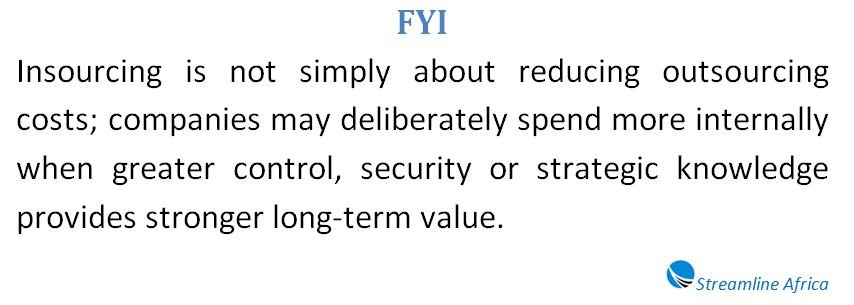
In some cases, organizations may knowingly accept higher internal costs because the strategic benefits of control, confidentiality or knowledge retention justify the additional investment.
Read Also: Opportunity Cost in Economics and Business: How Every Choice Has a Price
Insourcing Versus Outsourcing: A Strategic Comparison
Outsourcing remains an important management tool, particularly where specialist capabilities are required.
External providers can offer expertise, scale and flexibility that may be difficult or expensive to develop internally.
Organizations may also outsource temporary or highly specialized work where maintaining permanent internal resources would not be economically justified.
Historically, businesses have also used outsourcing to access lower-cost labor markets and improve operational efficiency.
Digital communication and global connectivity have made this model increasingly accessible across industries.
Insourcing offers a different value proposition.
It emphasizes organizational ownership, closer control and long-term capability development.
The appropriate model therefore depends on the strategic importance of the activity.
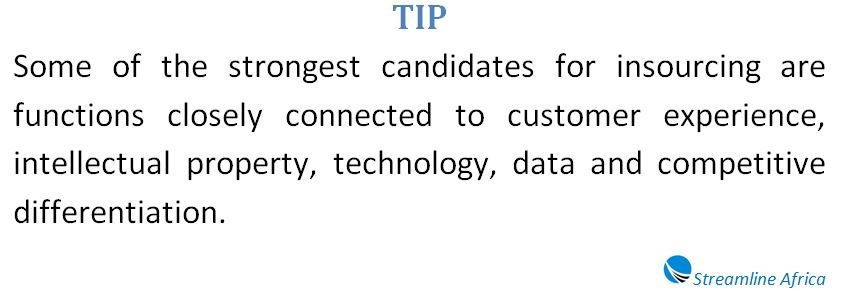
Core activities that influence competitive differentiation, intellectual property or customer experience may justify internal ownership. More standardized or transactional activities may remain suitable for external delivery.
For many organizations, the most effective operating model will involve a combination of both approaches.
Functions Frequently Considered for Insourcing
A wide range of business activities may be suitable for internal delivery depending on organizational priorities.
Technology services are often insourced where digital systems are central to operations. Internal teams can manage software development, infrastructure, cybersecurity and systems integration while maintaining direct knowledge of the business.
Customer support may be retained internally where service quality and customer relationships are strategically important.
Manufacturing can be insourced to provide greater control over production schedules, product standards and supply chain coordination.
Human resources functions such as recruitment, payroll, employee relations and workforce planning may also benefit from internal management because they require close alignment with organizational culture and leadership priorities.
Research and development is another critical area. Organizations competing through innovation may prefer to maintain direct control over intellectual property and product development.
Finance, legal services, marketing, quality assurance and data analytics can similarly be insourced where confidentiality, responsiveness or strategic integration are considered important.
The suitability of each function depends on organizational scale, capability and strategic relevance.
Applying a Hybrid Sourcing Model
In practice, businesses do not need to choose exclusively between insourcing and outsourcing.
A hybrid sourcing model can provide greater flexibility.
Consider a company preparing to launch a new consumer product.
Its internal marketing team may have excellent brand knowledge and strong customer insight. However, the team may lack capacity during the launch period.
Management could engage an external agency to support campaign execution while retaining strategy, brand governance and customer insight internally.
Once the launch phase is completed, responsibility for ongoing campaign management may transition back to the internal team.
This approach allows the organization to access external expertise without surrendering long-term ownership of a strategically important capability.
Hybrid models can therefore provide an effective balance between flexibility and control.
Key Risks Associated With Insourcing
Insourcing creates its own operational challenges.
Recruiting specialist employees may be difficult, particularly in areas where skills are scarce.
Organizations may also need to invest substantially in training, technology and management infrastructure before internal teams reach the required level of performance.
Capacity risk should also be carefully managed.
Existing employees may already be fully committed to current responsibilities. Adding new activities without increasing resources may result in slower delivery or reduced quality.
Insourcing can also increase fixed costs because the organization assumes responsibility for salaries, infrastructure and ongoing management.
External providers may offer greater scalability where workloads fluctuate significantly.
Another risk is reduced external perspective. Specialist firms often work across multiple organizations and industries, exposing them to emerging practices and new technologies.
Internal teams may need deliberate mechanisms for benchmarking and external learning to avoid becoming isolated from broader market developments.

Building a Balanced Insourcing Strategy
An effective insourcing strategy should begin with a clear assessment of strategic importance.
Management should identify which activities directly influence competitive advantage, customer experience, intellectual property or business continuity.
The organization should then evaluate whether it possesses the talent, infrastructure and management capability required to deliver those activities successfully.
Financial analysis should consider total cost rather than short-term expenditure alone.
Risk, quality, flexibility and knowledge retention should also form part of the decision.
Sourcing arrangements should be reviewed periodically because organizational conditions change.
A function that was outsourced when a company was smaller may become suitable for insourcing as the organization expands. Conversely, a previously internal activity may become more efficiently delivered by an external specialist as technology and market conditions evolve.
Conclusion
Insourcing should be approached as a strategic capability decision rather than simply an alternative to outsourcing.
When applied selectively, it can strengthen operational control, protect sensitive information, improve collaboration and build valuable institutional knowledge.
It can also support workforce development and enable organizations to respond more quickly to changing business requirements.
However, insourcing requires investment, management capacity and careful resource allocation.
The most effective organizations will not attempt to bring every activity in-house. Instead, they will distinguish between capabilities that should be owned internally and those that can be accessed more efficiently through external partners.
Ultimately, the objective is to create an operating model that balances control, cost, capability and flexibility while supporting long-term business performance.
Key Takeaways
Insourcing Strengthens Operational Control
Keeping important functions within the organization gives management greater visibility over performance, quality standards and decision-making. This can make it easier to respond quickly when business priorities change.
Internal Capability Can Become a Competitive Advantage
Insourcing allows organizations to build expertise that remains within the business. Over time, this accumulated knowledge can improve problem-solving, innovation and organizational resilience.
Not Every Function Should Be Brought In-House
The value of insourcing depends on the strategic importance of the activity. Highly specialized, temporary or non-core functions may still be better handled by external providers.
Insourcing Can Improve Collaboration
Internal teams generally communicate through shared systems, processes and objectives. This can reduce delays and improve coordination across departments, particularly during complex projects.
Sensitive Information May Be Better Protected
Functions involving proprietary data, financial information, intellectual property or strategic plans may benefit from tighter internal control, although strong cybersecurity practices are still essential.
Cost Should Be Evaluated Over the Long Term
Insourcing can require significant upfront investment in recruitment, technology, training and infrastructure. However, it may become financially attractive when organizations repeatedly pay external providers for work that can be performed efficiently internally.
Workforce Development Is a Major Strategic Benefit
Bringing activities in-house can create new career opportunities and help employees develop specialist capabilities. This can strengthen succession planning, internal mobility and long-term talent capacity.
Hybrid Sourcing Often Delivers the Best Balance
Organizations do not have to choose entirely between insourcing and outsourcing. Combining internal ownership of strategic capabilities with selective use of external specialists can provide greater flexibility, expertise and control.