
Fiscal policy has become one of the most important variables shaping business conditions across African markets. Decisions on taxation, public expenditure, subsidies, infrastructure, and government borrowing can quickly influence consumer demand, financing costs, investment confidence, and operating margins.
For companies, the practical question is no longer whether fiscal policy matters. It is how quickly changes in government policy can affect revenue, costs, capital allocation, and market strategy.
A reduction in fuel subsidies can alter transport and logistics costs. Higher import duties can raise manufacturing expenses. New infrastructure spending can create opportunities for construction, engineering, agriculture, and logistics firms. Tax reforms can reshape household purchasing power and corporate cash flow.
This makes fiscal policy a core business intelligence issue, not simply a matter for economists and public-sector institutions.
How Fiscal Policy Works
Fiscal policy refers to the use of government revenue and expenditure to influence economic activity.
Governments can stimulate an economy by increasing public spending, reducing selected taxes, expanding transfers, or supporting strategic sectors. These measures are generally described as expansionary fiscal policy.
They can also move in the opposite direction by reducing expenditure, increasing taxes, withdrawing subsidies, or tightening public-sector budgets. This is generally referred to as contractionary fiscal policy.
The objective depends on prevailing economic conditions. During weak growth and high unemployment, governments may try to support demand. During periods of high inflation, rising debt, or widening fiscal deficits, the focus may shift toward restoring stability.
Why Fiscal Policy Matters More in African Markets
In many African economies, government expenditure plays a particularly visible role in economic activity.
Public investment can influence road networks, ports, energy infrastructure, healthcare systems, education, housing, agriculture, water supply, and digital connectivity. Government procurement can also be an important source of revenue for private companies.
As a result, changes in fiscal priorities can create significant sector-level effects.
A road construction program can strengthen demand for cement, transport services, engineering, equipment, and labour. Investment in irrigation and storage can improve agricultural productivity and reduce post-harvest losses. Spending on power infrastructure can improve reliability for manufacturers and service providers.
At the same time, delayed government payments, lower capital expenditure, or abrupt tax changes can create pressure across supply chains.
For business leaders, fiscal policy therefore deserves the same level of attention as exchange rates, interest rates, and consumer demand.

Expansionary Fiscal Policy and Business Growth
Expansionary fiscal policy is generally used when authorities want to strengthen economic activity.
Governments may increase spending on infrastructure, social programs, public employment, agriculture, healthcare, or targeted industry support. They may also reduce selected taxes to increase disposable income or improve business cash flow.
Consider a government that expands road investment connecting farming communities to major commercial centres. The immediate effect may include more construction activity and employment.
The broader effects can be more important.
Improved roads can reduce transport times, lower vehicle maintenance costs, reduce spoilage, expand access to markets, and increase the commercial viability of agricultural production.
This illustrates why the quality of fiscal spending matters as much as the amount spent.
Productive expenditure can strengthen both short-term demand and long-term economic capacity.
Tax Policy and Corporate Decision-Making
Tax policy has a direct impact on business performance.
Changes in corporate taxes can affect retained earnings and investment capacity. VAT adjustments can influence consumer prices and demand. Import duties can alter production costs, while excise taxes may affect specific industries such as beverages, telecommunications, energy, and transport.
Businesses should therefore look beyond headline tax rates.
The overall tax environment includes compliance requirements, exemptions, customs procedures, withholding taxes, sector levies, and the predictability of tax administration.
For many investors, certainty can be as important as the tax burden itself.
A company may be able to plan around a relatively high but stable tax regime. Repeated or unexpected policy changes, however, can make investment decisions more difficult.
Fiscal Consolidation and Its Trade-Offs
Governments facing high debt, weak revenues, or large budget deficits may introduce fiscal consolidation measures.
These can include expenditure cuts, new taxes, subsidy reforms, public-sector wage restraint, or reductions in capital spending.
Such policies may improve fiscal sustainability, but they can also weaken demand.
For example, a reduction in government infrastructure spending can affect contractors, transporters, equipment suppliers, consultants, and workers. Higher consumption taxes can reduce household spending. Fuel subsidy removal can increase transport and production costs.
The central issue is therefore how consolidation is structured.
Well-designed fiscal adjustment should improve public finances while protecting productive investment and avoiding unnecessary damage to economic activity.
Debt and the Quality of Government Spending
Public borrowing is not inherently negative.
Governments may need to borrow during recessions, emergencies, or periods of major infrastructure development. The more important question is how the borrowed funds are used.
Debt used to finance productive assets can support future growth. Infrastructure that improves transport efficiency, energy reliability, agricultural productivity, or digital access can expand the economy’s productive capacity.
The risk becomes greater when borrowing finances recurring expenditure without improving future revenue or growth.
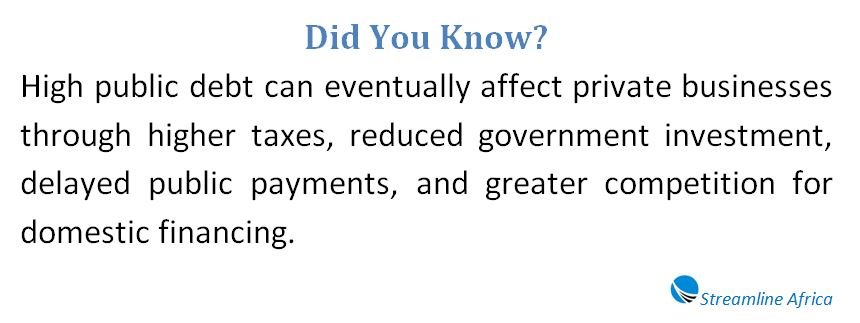
High debt-service costs can eventually reduce the amount governments have available for development priorities.
This creates a direct business implication.
When a large share of government revenue is absorbed by debt servicing, companies may face weaker public investment, higher taxes, delayed payments, or increased domestic borrowing by government.
Fiscal Policy and Inflation
Fiscal policy can contribute to both inflation and inflation control.
If government spending expands rapidly while productive capacity remains constrained, additional demand can contribute to price pressures.
This becomes especially important when economies are already dealing with high food prices, currency depreciation, fuel cost increases, or supply shortages.
Governments may respond by reducing expenditure, increasing taxes, or withdrawing selected support measures.
However, not all inflation is caused by excessive demand.
If prices are rising because of poor harvests, imported fuel costs, exchange-rate weakness, or supply-chain disruption, fiscal tightening may have only limited impact.
Businesses should therefore distinguish between demand-driven and supply-driven inflation when assessing the likely effect of policy changes.
Fiscal Policy Versus Monetary Policy
Fiscal and monetary policy influence the economy through different mechanisms.
Fiscal policy operates through government taxation, spending, borrowing, and transfers.
Monetary policy operates mainly through interest rates, liquidity, and credit conditions and is generally managed by central banks.
The two can reinforce each other.
If a government cuts spending while a central bank raises interest rates, businesses may experience weaker demand alongside higher borrowing costs.
If government investment increases while interest rates decline, the operating environment may become more supportive of expansion.
Executives should therefore evaluate fiscal and monetary policy together rather than in isolation.
What This Means for Business
For African businesses, fiscal policy should be incorporated into strategic planning, budgeting, investment analysis, and risk management.
Companies should monitor annual national budgets, tax reforms, public debt trends, subsidy changes, infrastructure priorities, government procurement, and fiscal deficit targets.
They should also distinguish between announcements and execution.
A government may announce a significant infrastructure program, but implementation can be delayed by financing constraints, procurement processes, or administrative bottlenecks.
Management teams should therefore build alternative scenarios.
What happens to margins if fuel taxes rise? How would a VAT increase affect consumer demand? Which revenue streams are vulnerable to lower government spending? Which sectors could benefit from infrastructure or agricultural investment?
These questions should be part of routine planning.
Key Takeaways for African Business Leaders
Fiscal policy can materially affect demand, operating costs, financing conditions, and investment returns.
Infrastructure spending can create broader economic benefits when it improves productivity rather than simply increasing short-term expenditure.
Tax predictability matters because frequent policy changes can undermine business planning even when headline tax rates remain manageable.
Debt sustainability should be monitored because rising debt-service costs can eventually affect taxes, public investment, and domestic financing conditions.
Subsidy reforms can have wide-ranging effects, particularly in fuel, transport, agriculture, and energy-intensive industries.
Fiscal tightening may improve government finances while simultaneously reducing consumer demand and private-sector activity.
The interaction between fiscal policy, interest rates, inflation, and exchange-rate conditions should be assessed collectively.
Businesses that build fiscal scenarios into strategic planning are better positioned to respond to policy shifts before they materially affect performance.
Strategic Outlook
Fiscal policy will remain a central driver of the African business environment.
Governments across the continent continue to face difficult choices involving infrastructure needs, employment, social spending, inflation, public debt, domestic revenue mobilisation, and economic growth.
For business leaders, the implication is straightforward.
Fiscal developments should not be treated as background policy news. They should form part of commercial forecasting, investment strategy, pricing decisions, and risk assessment.
The strongest companies will be those that understand not only what governments announce, but how fiscal decisions move through the economy and ultimately affect customers, suppliers, competitors, and capital.
For policymakers, the objective should be equally clear: fiscal policy should strengthen productive capacity, improve resilience, and create conditions that encourage sustainable private-sector growth.
That is where effective public policy and sound business strategy intersect.
Important Questions and Answers
Why does fiscal policy matter to African businesses?
Government decisions can quickly change operating conditions. Tax increases, subsidy reforms, infrastructure spending, or public-sector cuts can influence costs, demand, investment opportunities, and profitability across different industries.
How can expansionary fiscal policy support economic growth?
Governments can stimulate activity by increasing public spending or reducing selected taxes. This can raise demand, create jobs, improve business cash flow, and support investment, particularly during periods of weak economic growth.
Why is infrastructure spending especially important in Africa?
Infrastructure investment can improve productivity by reducing transport delays, strengthening energy reliability, improving market access, and supporting agriculture, manufacturing, logistics, and digital services.
How do tax changes affect companies?
Tax changes can influence pricing, cash flow, investment decisions, and competitiveness. Businesses are affected not only by corporate taxes but also by VAT, import duties, excise taxes, withholding taxes, and sector-specific levies.
What is fiscal consolidation?
Fiscal consolidation refers to efforts to reduce budget deficits and improve public finances. Governments may cut spending, raise taxes, remove subsidies, or reduce public-sector costs, although these measures can also weaken economic activity.
Why should businesses pay attention to public debt?
High public debt can increase government interest costs and reduce the funds available for infrastructure and development. It may also contribute to higher taxes, delayed government payments, and tighter domestic financing conditions.
Can fiscal policy help control inflation?
Yes, particularly when inflation is caused by excessive demand. Governments can reduce spending or increase taxes to cool economic activity. However, fiscal tightening may be less effective when inflation is driven mainly by supply shortages, currency weakness, or imported costs.
How is fiscal policy different from monetary policy?
Fiscal policy is managed by government through taxation, spending, and borrowing. Monetary policy is generally managed by central banks through interest rates, liquidity, and credit conditions. Both can significantly influence business conditions.
What should African business leaders monitor?
Businesses should track national budgets, tax reforms, subsidy changes, government borrowing, infrastructure priorities, public procurement, and deficit targets. Scenario planning can help companies prepare for how these developments might affect costs, demand, and investment decisions.