
Kenya’s minimum wage framework remains an important consideration for organisations managing employees, establishing operations or assessing workforce costs in the country. Unlike jurisdictions that apply a single national minimum wage, Kenya operates a differentiated structure under which statutory wage requirements vary according to an employee’s occupation, sector and geographical location.
For 2026, the wage rates introduced under the Regulation of Wages (General) (Amendment) Order, 2024 remain an important reference point. The framework incorporated the 6% minimum wage adjustment announced in 2024 and established different wage thresholds across occupational and geographical categories.
From an employer perspective, minimum wage compliance should therefore not be approached as a simple payroll benchmark. Organisations need to determine the appropriate wage order, correctly classify employees, assess the location in which work is performed and account for additional requirements such as housing allowances and overtime.
This article provides a practical overview of Kenya’s minimum wage environment and highlights the principal considerations that employers, investors, HR professionals and employees should understand when evaluating compensation compliance in 2026.
Understanding Kenya’s Geographical Wage Structure
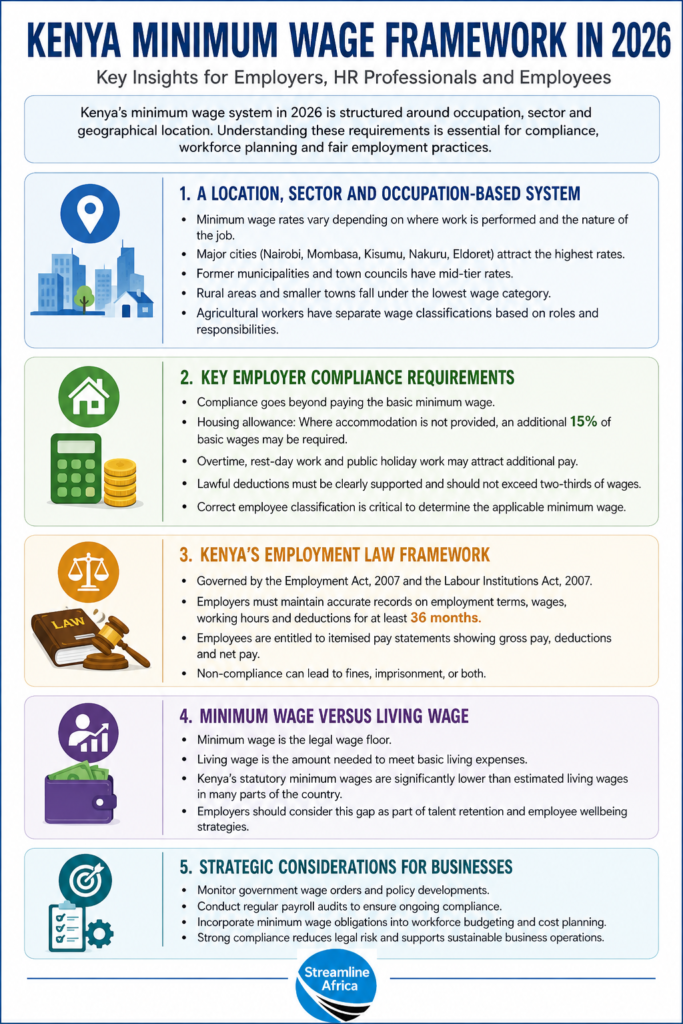
A defining characteristic of Kenya’s minimum wage framework is the differentiation of wage levels according to geographical location. The system recognises that employment and living costs vary considerably between major commercial centres, secondary urban areas and rural communities.
The highest statutory rates generally apply in Nairobi, Mombasa, Kisumu, Nakuru and Eldoret. These cities represent major economic and employment centres where workers typically face comparatively higher accommodation, transportation and household expenses.
A second category covers specified former municipalities and town councils, including areas such as Ruiru, Mavoko and Limuru. Wage thresholds in these locations generally fall below those applicable in the major cities while remaining above rates applicable in many rural locations.
Other areas, including smaller towns and rural communities, constitute the third geographical category.
For organisations operating across several counties, this distinction has direct payroll implications. A company employing workers in Nairobi and a rural operational location cannot necessarily apply the same statutory wage benchmark to employees performing equivalent functions.
Occupational Classification Is Equally Important
Geography alone does not determine the applicable minimum wage. Kenya’s framework also differentiates compensation according to occupation, responsibility and skill requirements.
For workers in major cities, the statutory schedule covers categories ranging from general labourers and domestic employees to cooks, machine attendants, clerks, receptionists, storekeepers, artisans and commercial drivers.
Under the applicable reference rates, a general labourer in a major city has a monthly minimum of KES 16,113.75. Higher occupational classifications attract progressively higher minimum rates, with certain skilled drivers and other specialised positions exceeding KES 30,000 per month.
Consider an organisation operating a distribution centre in Eldoret. The facility may employ cleaners, clerks, storekeepers and heavy commercial vehicle drivers. Although all employees work from the same location, the applicable statutory minimum may differ significantly depending on their occupational classifications.
We therefore recommend that employers map job titles against the relevant statutory classifications rather than establishing a single company-wide minimum salary without reference to employee responsibilities.
Agricultural Employers Face a Distinct Wage Framework
Agricultural employment is subject to separate minimum wage considerations, reflecting the structure and economic characteristics of Kenya’s farming sector.
The applicable schedule distinguishes between unskilled agricultural workers and employees performing more specialised responsibilities. The referenced minimum monthly rate for an unskilled agricultural worker is KES 7,997.33. Higher thresholds apply to positions including stockmen, farm artisans, tractor drivers, combined harvester drivers, vehicle drivers, farm foremen and clerks.
This distinction is particularly relevant for commercial farms and agribusinesses employing workers across multiple operational functions.
For example, an agricultural enterprise operating near Nanyuki could employ field labourers, tractor operators, drivers and administrative clerks. Classifying the entire workforce as general agricultural labour could expose the business to underpayment claims where particular employees perform duties falling within higher wage categories.
Employers in the agricultural sector should consequently review both job descriptions and employees’ actual responsibilities when assessing compliance.
Housing Allowance Should Be Incorporated Into Compensation Reviews
Housing represents another significant component of minimum wage compliance in Kenya.
Where an employer does not provide appropriate accommodation, the employee may be entitled to a housing allowance in addition to the applicable basic wage. The referenced framework identifies an additional housing component equivalent to 15% of basic wages.
This requirement means the published minimum basic wage should not always be interpreted as the employer’s total minimum compensation obligation.
For example, an employee in Nairobi earning a basic minimum of KES 16,113.75 could require an additional housing component of approximately KES 2,417.06 where accommodation is not provided. This would increase the combined minimum compensation to approximately KES 18,530.81.
From a payroll governance perspective, organisations should clearly distinguish basic salary from housing-related payments and determine whether employment contracts and payroll records adequately demonstrate compliance with the applicable requirement.
Regulatory Framework Supporting Minimum Wage Compliance
Kenya’s minimum wage regime operates within a wider body of employment legislation.
The Employment Act, 2007 establishes several fundamental obligations concerning the payment of wages, timing of salary payments, permissible deductions, itemised pay statements and employer record-keeping. The Labour Institutions Act, 2007 supports the wage-setting framework through wage councils responsible for considering remuneration and employment conditions.
Wage recommendations take account of multiple economic and social considerations. These may include workers’ needs, prevailing wage levels, living costs, social protection arrangements, productivity, employer sustainability, poverty reduction considerations and potential employment effects.
For employers and investors, this broader framework is important because wage regulation should be assessed as part of overall employment-law compliance rather than as an isolated payroll obligation.

Working Hours and Overtime Require Separate Assessment
Salary compliance does not necessarily mean that all working-time obligations have been satisfied.
Kenyan employment arrangements may provide for monthly, daily or hourly compensation. The referenced framework provides calculation principles for different payment arrangements, including an hourly rate calculated at 1/225th of the monthly basic wage for monthly paid employees.
Overtime can create additional financial obligations. Work performed beyond applicable normal hours may attract enhanced compensation, while work undertaken on rest days and public holidays may be compensated at higher rates.
Businesses should therefore avoid evaluating compliance solely by comparing an employee’s monthly salary against the relevant minimum wage.
A comprehensive review should consider basic salary, actual working hours, overtime, rest-day work, public-holiday work and any other applicable compensation elements.
Payroll Documentation Should Form Part of the Compliance Framework
Effective payroll governance requires organisations to demonstrate how employee compensation has been calculated.
Employers are expected to maintain records covering employee particulars, employment terms, work locations, wages, working hours and other relevant employment information. The referenced framework indicates a minimum record-retention period of 36 months for inspection purposes.
Itemised pay statements also play an important role by providing transparency regarding gross compensation, deductions and the resulting amount payable to the employee.
From a risk-management perspective, reliable documentation can significantly strengthen an employer’s position during labour inspections, employee grievances, payroll audits or litigation.
Organisations with decentralised operations should pay particular attention to consistency between employment contracts, HR information systems, attendance records and payroll data.
Statutory and Other Wage Deductions Require Careful Management
Minimum wage compliance also requires consideration of deductions applied after gross compensation has been determined.
Certain deductions may be permitted, including applicable statutory contributions, authorised pension arrangements, recovery of qualifying overpayments and deductions supported by appropriate employee consent or collective arrangements.
However, the referenced framework provides that total deductions should not exceed two-thirds of wages at any one time.
This means payroll reviews should examine both the employee’s contractual gross compensation and deductions appearing on the payslip.
Employers should maintain adequate supporting documentation for non-statutory deductions and ensure employees can clearly identify the purpose of amounts deducted from their earnings.

Employee Rights and Mechanisms for Addressing Underpayment
Minimum wage requirements establish statutory employment standards that generally cannot be displaced simply through contractual agreement.
Employees who believe they are receiving less than their applicable statutory entitlement may initially raise the matter internally with their employer or HR department. Where the issue remains unresolved, the source framework outlines escalation through a Labour Officer and potentially the Employment and Labour Relations Court.
For organisations, an effective internal grievance mechanism can provide an opportunity to identify payroll errors before they develop into formal regulatory or legal disputes.
Employees should similarly retain employment contracts, payslips, attendance information and evidence of salary payments. These records may become important where there is disagreement over remuneration, overtime or deductions.
Financial and Legal Consequences of Non-Compliance
Minimum wage underpayment can result in significant legal, financial and reputational exposure.
The source identifies potential criminal sanctions for failure to pay the statutory minimum wage, including a fine of up to KES 100,000, imprisonment of up to two years, or both. Maintaining false employment records may also result in penalties.
In addition to regulatory sanctions, employers may be required to compensate workers for the difference between the statutory wage entitlement and the amount actually paid.
The financial consequences can become particularly material where underpayment affects a large workforce or continues over an extended period.
Minimum wage compliance should therefore be incorporated into broader employment risk assessments, particularly during acquisitions, workforce restructuring, outsourcing arrangements and expansion into new locations.
Historical Wage Adjustments Highlight the Need for Forward Planning
Kenya’s statutory wage levels have increased significantly over time.
The historical figures referenced in the source show monthly minimum wage benchmarks progressing from KES 1,700 in 1994 to KES 12,926 in 2017. The benchmark increased to KES 15,120 following the 2022 adjustment and subsequently to KES 16,113.75 for applicable urban workers following the 2024 increase.
For employers, this trend reinforces the importance of incorporating wage escalation scenarios into financial planning.
Businesses considering multi-year contracts, labour-intensive investments or major recruitment programmes should model the potential effect of future statutory wage increases rather than assuming existing employment costs will remain unchanged.
Minimum Wage Should Not Be Confused With a Living Wage
An important distinction exists between statutory minimum wages and living-wage benchmarks.
A minimum wage represents the legally established wage floor. A living wage, by contrast, generally seeks to estimate the income required for an employee or household to meet reasonable living expenses.
The source compares the applicable urban statutory minimum of KES 16,113.75 with living-wage estimates exceeding KES 30,000 per month in certain locations.
This difference creates broader workforce considerations for employers.
An organisation may be legally compliant while still experiencing challenges relating to employee financial wellbeing, retention, absenteeism or competition for talent. Companies should therefore consider statutory compliance alongside market salary data, internal equity, productivity objectives and their broader employee value proposition.
Kenya’s Position Within the Regional Labour Market
Kenya operates a comparatively detailed wage framework within East Africa, with statutory rates differentiated across occupations, industries and geographical areas.
Regional comparisons should nevertheless be interpreted carefully because neighbouring countries use different wage-setting mechanisms and sector classifications. The referenced source indicates substantial variation across Tanzania, Uganda, Rwanda and Ethiopia.
For investors evaluating regional operations, headline wage rates alone are therefore insufficient for comparing labour costs.
Total employment cost assessments should incorporate statutory contributions, housing obligations, overtime, employee benefits, payroll administration and the regulatory environment in each jurisdiction.
Strategic Considerations for Employers in 2026
Kenya’s wage environment is likely to remain responsive to inflation, living costs, labour-market conditions, productivity and government policy.
At the time covered by the source, no new general 2026 minimum wage notice had been published, while discussions concerning future wage improvements and sector-specific interventions remained relevant.
We recommend that employers maintain a structured compliance approach rather than waiting for wage changes to create an immediate payroll requirement.
Periodic compensation audits should verify employee classifications, duty locations, basic wages, housing arrangements, overtime payments and deductions. Organisations should also monitor official wage orders and assess the financial impact of potential adjustments before implementation deadlines arise.
Ultimately, the principal compliance question is not simply whether employees are being paid “the minimum wage.” Employers need to establish whether each employee receives the correct statutory compensation based on their occupation, sector, location and employment conditions.
For organisations operating in Kenya, integrating this assessment into payroll governance, workforce budgeting and broader HR compliance can reduce legal exposure while supporting more sustainable employment practices.
Key Questions and Answers about Kenya’s Minimum Wage Structure
Why do minimum wages differ across Kenya?
Kenya uses geographical wage categories to reflect differences in living costs. Major cities generally attract higher statutory rates than smaller towns and rural areas.
Does an employee’s job title affect the minimum wage?
Yes. Different occupations attract different statutory minimums. Cleaners, clerks, receptionists, storekeepers, drivers and artisans may all fall under different wage classifications.
Are agricultural workers covered by different wage rates?
Yes. Kenya applies separate minimum wage categories within the agricultural sector, ranging from unskilled workers to tractor drivers, farm artisans, clerks and farm foremen.
Is housing allowance included in the minimum wage?
Not necessarily. Where suitable accommodation is not provided, an employer may be required to add a housing allowance equivalent to 15% of the employee’s basic wage.
Can employers simply pay the same minimum salary to everyone?
This approach can create compliance risks. Employers should assess each employee’s actual role, sector and location before determining the applicable statutory minimum.
How should employers handle overtime?
Overtime should be assessed separately from basic salary. Additional compensation may apply when employees work beyond applicable normal hours, on rest days or on public holidays.
What payroll records should employers maintain?
Employers should retain information covering employment terms, work locations, wages, working hours and other relevant employee records. The referenced framework indicates a minimum retention period of 36 months.
Are employers allowed to make deductions from minimum-wage earnings?
Certain statutory and properly authorised deductions are permitted. However, deductions must comply with employment law, and the referenced framework states that total deductions should not exceed two-thirds of wages.
What can an employee do if they are underpaid?
An employee may first raise the matter internally with the employer or HR team. Unresolved matters may be escalated to a Labour Officer and potentially the Employment and Labour Relations Court.
What are the risks of paying below the statutory minimum?
Non-compliance can result in wage arrears, penalties and legal proceedings. The source notes possible fines of up to KES 100,000, imprisonment of up to two years, or both for failure to pay the statutory minimum wage.
Is the minimum wage the same as a living wage?
No. A minimum wage is the legally required wage floor, while a living wage estimates the income needed to meet reasonable living expenses. The article highlights a substantial gap between Kenya’s statutory wage levels and some living-wage estimates.