
Overview of Egypt’s Minimum Wage Environment
Egypt’s employment landscape has undergone significant regulatory and wage-related changes in recent years. For organisations operating in the country, or considering establishing a workforce there, understanding the statutory minimum wage is an important starting point. However, effective employment cost planning requires a broader assessment of social insurance, mandatory salary adjustments, taxation, overtime, leave entitlements and other statutory obligations.
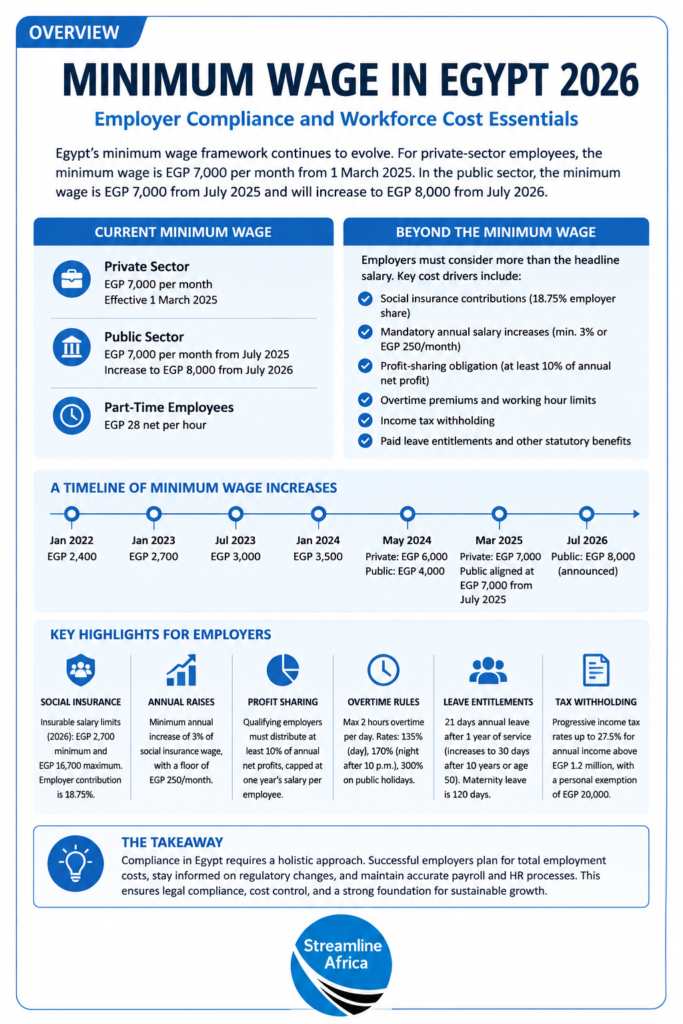
The private-sector minimum wage was increased to EGP 7,000 per month with effect from 1 March 2025. For public-sector employees, the minimum wage reached EGP 7,000 from July 2025, with a further increase to EGP 8,000 per month announced to take effect from July 2026.
These developments should be considered alongside Egypt’s Labour Law No. 14 of 2025, which took effect on 1 September 2025 and introduced important requirements affecting employment administration and workforce costs.
From an employer perspective, the key consideration is therefore not simply the prevailing minimum wage. Organisations should evaluate the total cost of employment and establish systems capable of responding efficiently to future statutory changes.
Current Minimum Wage Considerations
The statutory minimum wage applicable to most private-sector employees was established at EGP 7,000 per month from 1 March 2025.
The framework referenced also provides an exemption for small-scale businesses employing fewer than ten workers. Organisations considering reliance on this exemption should assess its applicability to their specific circumstances before determining compensation arrangements.
For public-sector employees, the minimum wage became EGP 7,000 from July 2025. A subsequent increase to EGP 8,000 per month was announced for implementation from July 2026.
The announced public-sector compensation measures extend beyond the minimum wage. Employees covered by the Civil Service Law are expected to receive a 12% annual salary increase, while employees outside the Civil Service Law are expected to receive a 15% increase. An additional monthly incentive of EGP 750 was also announced.
Part-time employment is subject to a separate minimum of EGP 28 net per hour.
For employers, these distinctions highlight the importance of classifying employees correctly and aligning payroll structures with the statutory requirements applicable to each employment category.
Historical Wage Developments and Budgeting Implications
Egypt’s recent minimum wage history demonstrates a relatively rapid pace of adjustment.
In January 2022, the minimum wage for both private and public sector employees stood at EGP 2,400 per month. This increased to EGP 2,700 in January 2023 and EGP 3,000 in July 2023.
The minimum increased again to EGP 3,500 in January 2024. By May 2024, the private-sector minimum had risen to EGP 6,000, while the public-sector minimum stood at EGP 4,000.
A further adjustment increased the private-sector minimum to EGP 7,000 from March 2025. The public-sector minimum subsequently reached EGP 7,000 from July 2025.
For July 2026, an EGP 8,000 minimum was announced for public-sector employees. A corresponding private-sector minimum for that period had not been separately confirmed in the source framework.
From a workforce planning perspective, this progression is significant. Organisations developing multi-year budgets should avoid assuming that prevailing statutory wage levels will remain unchanged throughout the planning period.
Salary forecasts should therefore incorporate appropriate contingencies for future regulatory adjustments, particularly where organisations intend to expand headcount significantly.
Mandatory Annual Salary Adjustments
Minimum wage compliance represents only one element of compensation management.
Under Labour Law No. 14 of 2025, private-sector employers are required to provide an annual salary increase equivalent to at least 3% of the employee’s social insurance wage, subject to a minimum increase of EGP 250 per month.
The requirement should be treated separately from performance-related salary adjustments, discretionary bonuses or merit increases. Employers should therefore ensure that their compensation policies distinguish statutory adjustments from internal reward programmes.
The calculation is based on the social insurance wage rather than automatically applying to an employee’s entire compensation package.
For 2026, the maximum insurable salary is EGP 16,700 per month. Three percent of this amount is approximately EGP 501 per month. For employees at lower salary levels, the statutory EGP 250 floor helps ensure that the annual increase does not fall below the prescribed minimum.
For budgeting purposes, organisations should incorporate these recurring adjustments into medium- and long-term employment cost projections rather than treating them as unexpected payroll increases.
Social Insurance and Total Employment Cost
Social insurance represents a material component of employer cost in Egypt and should be considered when assessing the financial implications of recruitment.
From January 2026, the minimum insurable salary is EGP 2,700 per month, while the maximum insurable salary is EGP 16,700.
Employers contribute 18.75% of the applicable insurable salary, while employees contribute 11% through payroll deductions.
The framework also identifies Universal Health Insurance contributions of 3.25% for employers and 1% for employees as implementation of the system progresses across different governorates.
As an illustration, consider an employee with an insurable monthly salary of EGP 7,000. The employer’s 18.75% social insurance contribution would amount to approximately EGP 1,313 per month. The corresponding employee contribution at 11% would be EGP 770.
Consequently, organisations should avoid assessing employment affordability solely by reference to gross salary.
The social insurance ceiling is another important forecasting consideration. The framework provides for insurable salary limits to increase by 15% annually until 2027, followed by inflation-linked adjustments from 2028.
Employers with employees earning above the current insurance ceiling may therefore experience higher contribution costs as the ceiling increases, even where contractual salaries remain unchanged.
Profit-Sharing Obligations
Employee profit sharing is another potential employment-related liability that organisations should incorporate into their annual financial planning.
Under the applicable framework, qualifying employers are required to distribute at least 10% of annual net profits among employees, subject to a maximum allocation equivalent to one year’s salary for each employee.
The obligation should be distinguished from a discretionary bonus arrangement. Where the statutory conditions are satisfied and the organisation generates qualifying net profits, profit participation becomes part of the employer’s broader financial obligations toward employees.
Where an organisation does not generate net profit during the relevant financial year, the obligation does not arise in the same manner.
This issue also requires attention from international organisations engaging workers through an Employer of Record. As the legal employer, the EOR generally assumes responsibility for statutory employment obligations. However, the resulting commercial cost may ultimately be passed to the client organisation.
Companies should therefore establish whether potential profit-sharing costs are incorporated into recurring EOR charges or invoiced separately following year-end calculations.
Working Hours and Overtime Compliance
The general statutory working framework in Egypt provides for eight working hours per day and 48 hours per week, typically distributed across six working days.
Some organisations operate shorter five-day schedules, particularly in professional and corporate environments. Nevertheless, internal working arrangements should remain within the applicable statutory limits.
Overtime is generally limited to two additional hours per day. The framework also establishes advance notice requirements and controls relating to extended working periods.
Total workplace time, including overtime, should not exceed 12 hours in a single day.
Overtime compensation varies according to the timing and circumstances of the additional work. Daytime overtime is compensated at 135% of the employee’s normal hourly wage, while nighttime overtime performed after 10 p.m. attracts 170%.
Employees required to work on a weekly rest day are entitled to an additional day’s wage together with a compensatory day off. Work undertaken on public holidays attracts compensation equivalent to 300% of the employee’s daily wage.
From a compliance perspective, employers should maintain reliable attendance and overtime records and establish clear approval procedures for additional working hours.
Working-Time Protections During Pregnancy
Egypt’s employment framework also establishes additional protections for pregnant employees.
From the sixth month of pregnancy, qualifying employees are entitled to a reduction in working time of at least one hour per day.
Pregnant employees cannot be required to undertake overtime during pregnancy. This restriction continues for six months following childbirth.
For organisations operating shift-based, manufacturing or other overtime-intensive environments, these requirements should be incorporated into workforce scheduling and resource planning.
Personal Income Tax and Employer Withholding Responsibilities
Employers are responsible for withholding applicable personal income tax from employee compensation through payroll.
Egypt operates a progressive personal income tax system. Under the referenced 2025/2026 framework, annual income up to EGP 40,000 falls within a 0% tax band.
Subsequent income bands are subject to rates of 10%, 15%, 20%, 22.5% and 25%, while annual taxable income exceeding EGP 1.2 million is subject to a 27.5% rate.
Resident taxpayers also benefit from a personal annual exemption of EGP 20,000.
Employers should ensure that payroll systems apply the relevant tax bands correctly and reflect applicable exemptions when calculating employee deductions.
Statutory Leave and Workforce Capacity Planning
Leave entitlements represent both an employee benefit and an important workforce planning consideration.
Employees generally become entitled to 21 days of paid annual leave after completing one year of service. Employees who have completed at least six months of employment may receive a proportional entitlement.
Annual leave increases to 30 days after ten consecutive years of service or when an employee reaches 50 years of age. Employees working in remote or hazardous environments are entitled to an additional seven days.
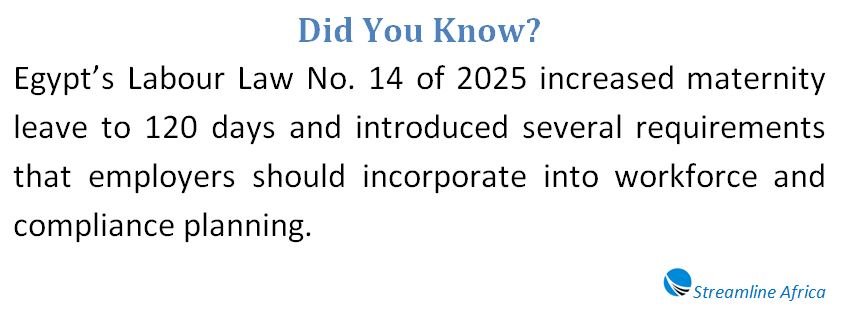
Under Labour Law No. 14 of 2025, maternity leave was increased to 120 days and may be used up to three times during an employee’s career.
The framework also provides one paid day of paternity leave per child, subject to a maximum of three children.
Sick leave compensation is stated at 100% for the first three months, 85% for the following six months and 75% for the subsequent three months.
Employers should therefore consider statutory leave not only from a compliance perspective but also when evaluating workforce capacity, temporary replacement requirements and operational continuity.
Egypt’s Position Within the Regional Labour Market
Egypt continues to offer comparatively competitive employment costs within the Middle East and North Africa region.
However, minimum wage comparisons alone provide an incomplete basis for investment or workforce location decisions. Organisations should consider total employer contributions, personal taxation, statutory leave, working-hour requirements, overtime obligations and other employment-related costs.
Egypt’s combination of a sizeable labour market and comparatively competitive wage levels can make the country attractive for technology, customer support, shared services, administrative operations and other labour-intensive activities.
The commercial opportunity should nevertheless be assessed alongside the organisation’s ability to maintain effective payroll and employment compliance.
Considerations for International Employers and EOR Arrangements
International organisations may use an Employer of Record to recruit employees in Egypt without establishing their own local employing entity.
Under this arrangement, the EOR generally assumes the legal employer responsibilities associated with employment contracts, payroll administration, minimum wage compliance, social insurance registration, statutory salary increases, income tax withholding, overtime administration and leave management.
However, outsourcing the legal employer function does not eliminate the underlying employment costs.
Companies considering an EOR arrangement should review how statutory wage increases are passed through, how social insurance is calculated, how profit-sharing liabilities are addressed and how regulatory changes affect pricing.
Contractual arrangements should also establish how quickly payroll structures will be updated following statutory changes.
Strategic Outlook for Employers
Egypt’s wage developments demonstrate the importance of treating employment compliance as an ongoing management responsibility rather than a one-time payroll exercise.
The private-sector minimum wage increased from EGP 2,400 in January 2022 to EGP 7,000 from March 2025. The public-sector minimum reached EGP 7,000 from July 2025, with an increase to EGP 8,000 announced for July 2026.
For employers, the broader implication extends beyond these individual figures.
Organisations should establish compensation models that account for statutory wage movements, annual salary adjustments, social insurance, taxation, overtime, leave and other employment-related obligations.
A structured approach to workforce cost modelling can help businesses reduce compliance exposure, improve budget accuracy and make better-informed recruitment and investment decisions.
For organisations entering or expanding within Egypt, the most sustainable approach is therefore to evaluate total employment cost rather than minimum salary alone. Regular regulatory review, disciplined payroll administration and forward-looking workforce budgeting should remain central components of the organisation’s employment strategy.
FAQs
What is the minimum wage for private-sector employees in Egypt?
The private-sector minimum wage is EGP 7,000 per month, effective from 1 March 2025. Employers should remember that the minimum wage is only one component of the overall employment cost.
What is the minimum wage for public-sector employees?
The public-sector minimum wage reached EGP 7,000 per month from July 2025, with an increase to EGP 8,000 announced to take effect from July 2026.
Are part-time workers covered by a minimum wage?
Yes. Part-time employees are subject to a separate minimum rate of EGP 28 net per hour under the framework referenced in the article.
Do employers have to provide annual salary increases?
Yes. Private-sector employers are required to provide an annual increase of at least 3% of the employee’s social insurance wage, subject to a minimum increase of EGP 250 per month.
How much do employers contribute to social insurance?
Employers contribute 18.75% of an employee’s applicable insurable salary. Employees contribute 11% through payroll deductions.
What are the social insurance salary limits for 2026?
From January 2026, the minimum insurable salary is EGP 2,700 per month, while the maximum insurable salary is EGP 16,700 per month.
Are companies required to share profits with employees?
Qualifying employers are required to distribute at least 10% of annual net profits among employees, subject to a maximum equivalent to one year’s salary for each employee.
What are the standard working hours in Egypt?
The general statutory framework provides for eight working hours per day and 48 hours per week, usually spread across six working days.
How is overtime compensated?
Daytime overtime is paid at 135% of the normal hourly wage, while nighttime overtime after 10 p.m. attracts 170%. Work on public holidays attracts 300% of the daily wage.
How much annual leave are employees entitled to?
Employees generally receive 21 days of paid annual leave after one year of service. This can increase to 30 days after ten consecutive years of service or when the employee reaches age 50.
What maternity leave is available in Egypt?
Under Labour Law No. 14 of 2025, maternity leave is 120 days and may be taken up to three times during an employee’s career.
What should international employers consider before hiring in Egypt?
Businesses should assess total employment cost rather than salary alone. Minimum wage, social insurance, statutory raises, tax withholding, overtime, leave, profit sharing and EOR fees can all affect the final cost of employing staff.