

Operating Working Capital (OWC) is a financial management metric used to determine the amount of short-term capital committed to an organisation’s recurring business activities. It provides analysts with a more operationally focused assessment of working capital by concentrating on current assets and current liabilities that arise directly from normal commercial activities.
For finance and accounting students, OWC is particularly important because it connects three major areas of financial analysis: the balance sheet, operating cash flow, and business efficiency. Understanding the metric helps explain why a profitable company may still experience cash constraints and why rapid revenue growth can sometimes increase rather than reduce financing requirements.
What Is Operating Working Capital?
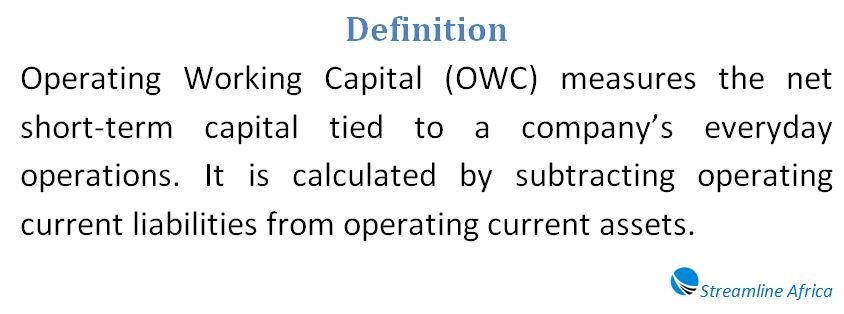
Operating Working Capital represents the difference between operating current assets and operating current liabilities.
Operating current assets are short-term resources created or consumed through normal business activities. Typical examples include trade receivables, inventory, and prepaid operating expenses. Operating current liabilities are short-term obligations generated through those same activities, including trade payables, accrued expenses, and deferred revenue.
Consider a hypothetical pharmaceutical distributor operating in Accra. The company purchases medicines from manufacturers, stores products before distribution, supplies pharmacies on credit, and pays certain suppliers several weeks after receiving inventory.
Inventory and trade receivables represent capital committed to operations. Trade payables, meanwhile, provide temporary financing because the distributor receives goods before paying suppliers.
OWC measures the net effect of these operating balances.
Operating Working Capital Versus Traditional Working Capital
Students should distinguish OWC from conventional working capital.
Traditional working capital is calculated as:
Working Capital = Current Assets – Current Liabilities
The calculation includes virtually all balance sheet accounts classified as current, regardless of whether those accounts originate from operations, financing, or treasury management.
OWC applies a more selective approach:
Operating Working Capital = Operating Current Assets – Operating Current Liabilities
Suppose Company A and Company B have identical receivables, inventories, payables, and accrued expenses. However, Company A recently received GH¢15 million from a bank facility and currently holds the proceeds as cash.
Traditional working capital could make Company A appear substantially different from Company B. From an operating perspective, however, their working capital structures remain largely identical.
OWC removes much of this financing-related distortion.
Why Cash Is Excluded from OWC
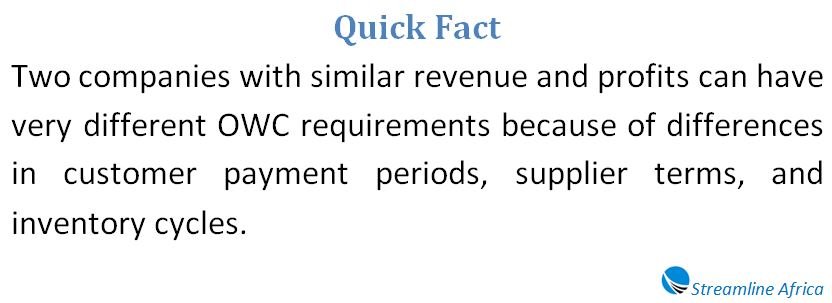
Cash and cash equivalents are normally excluded because their balances can be influenced by decisions unrelated to the company’s underlying operating cycle.
A business may hold additional cash after raising equity, disposing of an asset, obtaining financing, or accumulating funds for a future investment. Management may also place surplus liquidity in short-term investments or government securities.
These activities affect the company’s financial position but do not necessarily reveal how efficiently it manages customers, suppliers, inventories, and other operational resources.
For analytical purposes, excluding cash allows OWC to concentrate more directly on capital generated or consumed through recurring commercial transactions.
This does not imply that cash is unimportant. Cash remains fundamental to liquidity analysis. Rather, OWC has a different analytical objective.
Why Short-Term Debt Is Excluded
Short-term loans and other interest-bearing obligations are also generally excluded.
The distinction arises because debt represents a financing source rather than an operating liability.
For example, accounts payable arise when a supplier allows a company to purchase materials without making immediate payment. The liability develops naturally from procurement activity.
A bank overdraft or short-term loan is different. Management deliberately raises external capital to finance the organisation.
Consequently, trade payables normally form part of OWC, while short-term borrowings do not.
Understanding the economic substance of an account is therefore more important than simply observing whether the balance sheet classifies it as current.
Operating Working Capital Formula
The core formula is:
Operating Working Capital = Operating Current Assets – Operating Current Liabilities
Common operating current assets include:
Trade Receivables + Inventory + Prepaid Operating Expenses
Common operating current liabilities include:
Trade Payables + Accrued Operating Expenses + Deferred Revenue
Therefore, an expanded version can be expressed as:
OWC = (Trade Receivables + Inventory + Prepaid Expenses) – (Trade Payables + Accrued Expenses + Deferred Revenue)
The appropriate components can differ across industries.
A manufacturing company may maintain substantial raw-material and finished-goods inventories. A professional advisory firm may carry almost no inventory but have significant receivables. A subscription business may receive customer payments in advance and consequently report substantial deferred revenue.
Analysts must therefore adapt the calculation to the economics of the organisation being examined.
Practical OWC Calculation Example
Consider Coastal Manufacturing Ltd., a hypothetical producer of household cleaning products located in Tema.
At year-end, the company reports the following operating current assets:
Trade receivables = GH¢22 million
Inventory = GH¢31 million
Prepaid operating expenses = GH¢2 million
Total operating current assets are therefore:
GH¢22 million + GH¢31 million + GH¢2 million = GH¢55 million.
The company also reports the following operating current liabilities:
Trade payables = GH¢17 million
Accrued operating expenses = GH¢8 million
Deferred customer revenue = GH¢3 million
Total operating current liabilities are:
GH¢17 million + GH¢8 million + GH¢3 million = GH¢28 million.
The calculation becomes:
OWC = GH¢55 million – GH¢28 million
OWC = GH¢27 million
Coastal Manufacturing therefore has GH¢27 million of net capital committed to its short-term operating cycle.
The figure alone, however, provides limited information. Analysts should examine it relative to revenue and historical performance.
OWC-to-Sales Ratio
The OWC-to-sales ratio measures the amount of operating working capital required relative to the company’s revenue base.
The formula is:
OWC-to-Sales Ratio = Operating Working Capital ÷ Revenue
Assume Coastal Manufacturing generates annual revenue of GH¢180 million.
Its ratio would be:
GH¢27 million ÷ GH¢180 million = 15%
This indicates that operating working capital at the measurement date represents approximately 15% of annual revenue.
Analysts can compare the percentage across several years to determine whether the company’s capital requirements are increasing or decreasing relative to sales.
For example, if the ratio increases from 10% to 15% while revenue growth remains moderate, analysts should investigate the underlying causes.
Interpreting a High OWC-to-Sales Ratio
A relatively high ratio generally indicates that substantial capital is committed to supporting operations.
Several factors could produce this outcome.
Customers might be taking longer to settle invoices, causing trade receivables to increase. Inventory could be accumulating because production exceeds sales. Alternatively, the company may be paying suppliers faster, reducing the financing benefit obtained through accounts payable.
Each situation can increase the amount of cash tied up in the operating cycle.
However, a high ratio should not automatically be interpreted as evidence of poor management. Businesses with long production cycles or substantial inventory requirements may naturally require greater working capital.
Industry context remains essential.
Interpreting a Low OWC-to-Sales Ratio
A lower OWC-to-sales ratio generally indicates that relatively little capital is required to support revenue.
This can result from efficient customer collections, rapid inventory turnover, favourable supplier credit arrangements, or significant advance payments from customers.
Such characteristics can strengthen cash generation.
Nevertheless, an unusually low ratio can also warrant investigation. Inventory may be insufficient to satisfy customer demand, suppliers may be experiencing delayed payments, or the organisation may be operating with an unsustainably narrow liquidity buffer.
Financial analysis therefore requires interpretation rather than mechanically concluding that lower OWC is always preferable.
Relationship Between OWC and Cash Flow
One of the most important concepts for students is the relationship between changes in OWC and cash flow.
An increase in operating working capital generally represents a use of cash.
Suppose receivables increase by GH¢5 million because customers have not yet paid for sales already recognised as revenue. Accounting profit may increase, but the corresponding cash has not yet been collected.
Similarly, purchasing additional inventory requires cash even though the inventory may remain unsold at the reporting date.
Conversely, reductions in OWC can release cash.
Faster collections, lower inventory requirements, higher supplier balances, or increased customer advances can improve operating cash flow.
This relationship explains why revenue growth and profitability do not automatically translate into stronger liquidity.
Why OWC Matters During Business Growth
Rapidly expanding businesses often require substantial additional operating working capital.
Imagine a distributor increasing annual revenue from GH¢50 million to GH¢90 million. To support the additional sales, the business may need more inventory and may extend additional credit to customers.
If suppliers do not provide equivalent increases in payment terms, the organisation must finance the resulting working capital gap.
This creates an important principle in corporate finance: growth can consume cash.
Companies experiencing rapid expansion should therefore forecast working capital requirements alongside revenue and profitability. Failure to do so can create liquidity pressure despite apparently strong financial performance.
Applying OWC in Financial Modelling
OWC is widely incorporated into budgeting, valuation and financial forecasting.
Analysts commonly project individual operating accounts using operational drivers. Receivables may be forecast using Days Sales Outstanding, inventory through Days Inventory Outstanding, and payables through Days Payable Outstanding.
These assumptions allow analysts to estimate future working capital requirements as revenue changes.
For example, if projected sales increase substantially while customer collection periods remain unchanged, receivables will normally rise. That increase represents additional capital that must be funded.
OWC forecasting therefore connects operating assumptions directly to cash-flow projections.
Using OWC for Comparative Financial Analysis
OWC becomes particularly informative when examined over several reporting periods or compared with similar organisations.
A single figure provides only a snapshot. Trend analysis can reveal whether receivables are increasing faster than revenue, inventory efficiency is deteriorating, supplier credit is changing, or the company’s overall operating cycle is becoming more capital intensive.
Peer comparisons can also provide useful context, although students should exercise caution.
Different business models, accounting policies, payment arrangements, seasonal patterns, and supply-chain structures can produce significant differences even among companies operating within the same broad industry.
Comparability should therefore be assessed before conclusions are drawn.
Key Considerations for Students and Financial Analysts
Operating Working Capital should be viewed as a measure of operational capital efficiency rather than simply another liquidity ratio.
The central analytical question is not whether the company possesses sufficient total current assets to cover total current liabilities. Instead, OWC asks how much net short-term capital is committed specifically to running the underlying business.
Students conducting financial statement analysis should therefore identify each balance sheet account according to its economic function before calculating OWC.
Cash and financing-related debt are generally excluded, while receivables, inventory, payables, accrued expenses, prepaid operating costs, and deferred revenue are included where relevant.
Most importantly, OWC should rarely be interpreted in isolation. Combining the metric with revenue growth, cash-flow analysis, turnover ratios, profitability measures, and industry benchmarks provides a more comprehensive assessment.
When applied correctly, Operating Working Capital can reveal whether business expansion is generating cash efficiently or creating increasing funding requirements. For investors, managers, lenders, and finance students, this makes OWC a valuable tool for understanding the connection between operational performance, liquidity, and sustainable growth.
Commonly Asked Questions and Answers about Operating Working Capital
How is Operating Working Capital calculated?
The basic formula is: Operating Working Capital = Operating Current Assets – Operating Current Liabilities. Typical components include receivables, inventory, prepaid expenses, payables, accrued expenses, and deferred revenue.
Why is cash excluded from OWC?
Cash is excluded because its balance can reflect financing, investing, or treasury decisions rather than normal operating activity. Removing it provides a clearer picture of capital committed directly to business operations.
Why is short-term debt excluded from OWC?
Short-term debt represents a financing decision rather than an operating obligation. OWC focuses instead on liabilities generated naturally through operations, such as supplier payables and accrued expenses.
What does a high OWC-to-sales ratio indicate?
A high ratio can indicate that a significant amount of cash is tied up in receivables, inventory, or other operating assets. However, what counts as “high” depends heavily on the company’s industry and business model.
Is a low Operating Working Capital ratio always good?
Not necessarily. A lower ratio can indicate strong working capital efficiency, but an unusually low figure might also signal inadequate inventory, delayed supplier payments, or other operational pressures.
How does OWC affect cash flow?
An increase in OWC generally consumes cash because more money becomes committed to receivables, inventory, or other operating assets. A decrease can release cash back into the business.
Why should students understand Operating Working Capital?
OWC helps students connect balance sheet movements with cash flow and operational efficiency. It also provides a practical foundation for financial modelling, valuation, forecasting, and corporate financial analysis.