

Building Stronger Controls Through Shared Responsibility
As organisations grow, financial transactions become more complex, responsibilities expand, and employees gain access to increasingly valuable information and assets. Without appropriate controls, these developments can expose a business to financial errors, fraud, unauthorised transactions and operational losses.
Segregation of duties is therefore an important component of a well-designed internal control system. The principle is straightforward: responsibility for a critical business process should not rest entirely with one individual.
Where practical, the authority to initiate, approve, execute, record and review a transaction should be distributed among different employees. This creates independent checks within everyday operations and reduces the likelihood that errors or irregularities can occur without detection.
Segregation of Duties as Part of the Control Environment
An effective internal control framework extends beyond financial approvals. It combines governance, risk management, operating procedures, information flows and continuous oversight.
The widely recognised COSO framework reflects this broader approach through five interconnected areas: the control environment, risk assessment, control activities, information and communication, and monitoring.
Within this structure, segregation of duties operates primarily as a control activity. However, its effectiveness depends heavily on the wider control environment. Clear reporting lines, ethical leadership, documented responsibilities and appropriate supervision all influence whether controls work in practice.
Businesses should therefore avoid treating segregation of duties as an isolated accounting requirement. It should form part of the organisation’s broader approach to risk management and accountability.
Designing an Effective Segregation Structure
A practical starting point is to map the organisation’s major transaction cycles and determine who performs each activity.
Management should pay particular attention to procurement, supplier management, payments, cash handling, payroll, inventory, revenue collection, banking, financial reporting and information technology. For each process, responsibilities for initiation, approval, execution, custody, recording and review should be clearly identified.
Documented standard operating procedures can provide employees with clarity on their responsibilities and approval limits. A segregation-of-duties matrix can provide management with an additional layer of visibility by highlighting potentially incompatible responsibilities.
For example, an employee who can create a new supplier, approve the supplier’s invoice and initiate payment presents a significant control risk. Similarly, an employee responsible for maintaining inventory records should not have unrestricted responsibility for conducting and approving physical stock counts.
Applying the Principle to Key Business Processes
Cash and banking activities require particularly strong separation because of their direct exposure to financial loss. An employee receiving cash should generally not be solely responsible for depositing it, recording the receipt and completing the bank reconciliation. Independent reconciliation and review provide an important check on both errors and irregularities.
Procurement requires similar safeguards. Purchase requests, purchase approvals, receipt of goods, invoice processing and payment authorisation should be separated where resources permit. This structure can help businesses identify unauthorised purchases, duplicate payments, fictitious suppliers and conflicts of interest before significant losses arise.
System access should also reflect employees’ actual responsibilities. Finance, payroll, procurement and enterprise management systems should use role-based permissions. Administrator privileges should be restricted, and access rights should be reviewed whenever employees change positions, assume temporary responsibilities or leave the organisation.

Maintaining Controls as the Business Changes
A segregation structure that works today may become ineffective as the organisation evolves. Staff turnover, restructuring, technology changes and new business activities can create control gaps that were not present when procedures were originally designed.
Management should therefore conduct periodic reviews of approval authorities, system permissions, reconciliations and role assignments. Internal control exceptions should also be investigated to understand their underlying causes rather than simply correcting individual transactions.
Where weaknesses are identified, corrective action may involve redesigning workflows, adjusting access rights, introducing additional reviews or clarifying accountability.
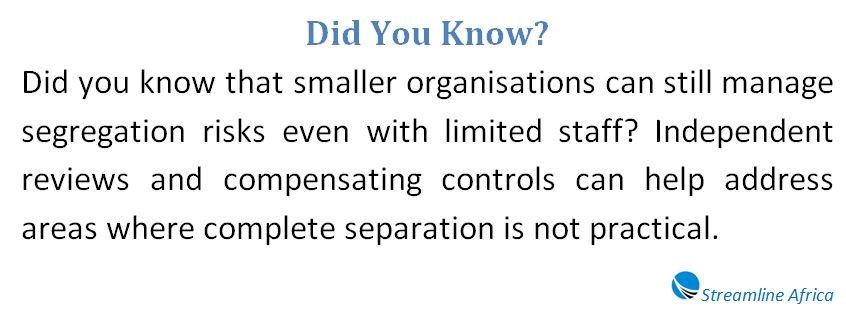
Smaller organisations may not always have enough employees to achieve complete segregation. In these circumstances, management should introduce compensating controls, such as independent management reviews, regular bank reconciliation reviews, exception reporting or periodic external checks.
Making Segregation of Duties a Management Priority
Effective segregation of duties is ultimately about protecting the organisation while improving the reliability of its operations. It reduces excessive dependence on individuals and establishes clear accountability at critical stages of business processes.
Management should prioritise areas involving transaction authorisation, custody of assets, financial recording, reconciliations, payment processing and privileged system access.
Segregation of duties will not eliminate every operational or fraud risk. However, when responsibilities are deliberately separated and controls are consistently monitored, irregularities become more difficult to conceal and errors are more likely to be identified before they become costly.
For organisations seeking sustainable growth, strong internal controls should develop alongside the business. A well-designed segregation-of-duties framework provides a practical foundation for protecting assets, strengthening financial reporting and maintaining stakeholder confidence.
Significant Takeaways
Shared Responsibility Reduces Risk
No single employee should control every stage of a sensitive transaction. Dividing responsibilities creates stronger checks and makes mistakes or misconduct harder to conceal.
Internal Controls Need More Than Policies
Written procedures are useful, but they only work when responsibilities, approvals and monitoring are clearly built into daily operations.
Segregation of Duties Supports Accountability
When different employees are responsible for initiating, approving, recording and reviewing transactions, accountability becomes much clearer across the organisation.
Cash Handling Requires Strong Safeguards
Cash collection, banking, recording and reconciliation should ideally be handled by different people because cash-related processes carry a high risk of loss or misuse.
Procurement Controls Should Be Deliberate
Purchase requests, approvals, goods receipt, invoice processing and payment authorisation should be separated wherever possible to reduce fraud and unauthorised spending.
System Access Should Match Job Responsibilities
Employees should only have the level of system access required to perform their roles. Excessive access can create unnecessary operational and fraud risks.
Control Reviews Should Be Ongoing
Internal controls should not remain unchanged for years. Staff changes, restructuring and new systems can create weaknesses that require regular review.
Segregation of Duties Works Best Within a Broader Framework
Strong internal control also depends on good governance, risk assessment, communication, ethical leadership and continuous monitoring.
Smaller Businesses Can Use Compensating Controls
Where staffing levels make full segregation difficult, management reviews, exception reports, independent reconciliations and periodic external checks can provide additional protection.
Role Changes Can Create Hidden Control Gaps
Temporary assignments, promotions and staff exits can unintentionally give employees conflicting responsibilities or unnecessary system permissions.
Control Failures Should Be Investigated Properly
Businesses should look beyond correcting individual errors and identify the underlying cause, whether it involves poor supervision, unclear procedures or excessive access.
Strong Controls Support Sustainable Growth
As organisations expand, internal controls should develop with them. Effective segregation of duties helps protect assets, improve financial reliability and strengthen stakeholder confidence.