
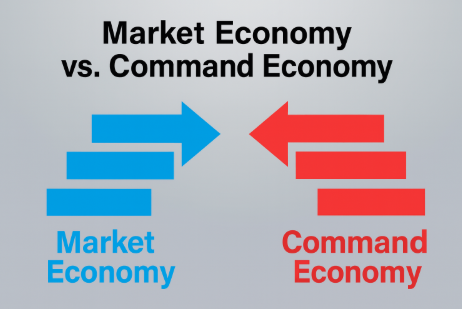
Market and command economies represent two contrasting approaches to organizing economic activity. The key distinction lies in who holds control over resources and who determines the prices of goods and services.
In a command economy, the state manages the factors of production—land, labor, and capital—and makes the decisions on what is produced, in what quantities, and at what price. In contrast, a market economy is driven by private ownership, where businesses and individuals decide production based on profitability, with prices shaped by the interaction of supply and demand.
While these systems are often presented as opposites, in reality, most modern nations incorporate aspects of both, creating hybrid economic structures.
How a Market Economy Works
In a market economy, production decisions emerge from the decentralized actions of individuals and businesses rather than from a central authority. Consumer preferences, available resources, and production costs guide what is produced and in what amounts.
This concept was famously described by Adam Smith in The Wealth of Nations through the metaphor of the “invisible hand,” where self-interest and competition lead to an efficient allocation of resources without central planning. Prices in such a system function as signals—rising prices can encourage producers to make more, while falling prices may lead them to scale back.
Governments in market economies generally take a limited role, focusing on setting legal frameworks, enforcing contracts, collecting taxes, and ensuring fair competition. However, they rarely withdraw completely; regulations, consumer protections, and oversight of monopolies remain essential.
Market economies are closely linked to capitalist principles, emphasizing private property, voluntary exchange, and the pursuit of profit. However, critics such as Karl Marx have argued that such systems inherently concentrate wealth and power in the hands of those who own capital, leaving many without fair access to resources or opportunities.
Economist John Maynard Keynes later highlighted a limitation of pure market systems: they often fail to respond effectively to deep recessions. He advocated for targeted government intervention to stabilize economic cycles, a principle that still underpins policies like the U.S. Federal Reserve’s management of money supply and interest rates.
How a Command Economy Works
A command economy centralizes economic decision-making within the government. Here, the state owns most or all means of production and dictates which goods and services will be produced, how much will be made, and what prices will be charged.
Production targets are usually set according to political and social objectives rather than market demand. This system often aims to guarantee access to essential goods, promote equality, and direct resources toward national priorities.
However, economists such as Ludwig von Mises have argued that without competition and private ownership, command economies struggle to set rational prices or allocate resources efficiently. Milton Friedman also pointed out that these systems tend to restrict individual economic freedom, as centralized control leaves little room for independent decision-making.
Despite these criticisms, command economies can be effective in mobilizing resources during emergencies, rapidly scaling up production for large-scale infrastructure, defense, or health initiatives.
Mixed Approaches in Practice
Few countries operate as purely market- or purely command-based systems. Instead, most adopt a blended or mixed economy, incorporating policies from both models to suit their needs.
For example, Cuba has historically functioned as a command economy but has introduced significant market-oriented reforms in recent years, including the privatization of many small and medium-sized enterprises.
The United States, often viewed as a market economy, has temporarily shifted toward command-style planning during times of national crisis. During World War II, the government directed industrial production to meet military needs while also ensuring civilian goods remained available. More recently, during the COVID-19 pandemic, it compelled pharmaceutical companies to accelerate production of vaccines and testing kits—an approach unlikely in a purely market-driven environment.
Even in peacetime, the U.S. government provides subsidies, maintains welfare programs, and regulates essential industries, all features borrowed from command-style governance.
Strengths of a Market Economy
One of the core advantages of a market system is its ability to encourage efficiency and innovation. Competition drives producers to improve quality, reduce costs, and offer better prices, benefiting consumers directly.
The profit motive inspires businesses to respond to consumer needs quickly, while flexible pricing allows for efficient allocation of resources. This adaptability often enables market economies to adjust to technological advances and shifting consumer preferences more effectively than rigidly planned systems.
However, market economies can also produce inequalities and fail to address basic needs for all citizens without targeted government intervention.
Strengths of a Command Economy
Command economies can direct national resources toward specific goals, such as infrastructure, defense, or universal healthcare. They can respond quickly to large-scale challenges, especially where collective action is essential.
In times of war, natural disasters, or public health crises, centralized planning can ensure that production is redirected toward urgent needs without waiting for market signals to catch up. Price controls, rationing, and coordinated distribution can prevent shortages and stabilize society during turbulent periods.
Yet, without the feedback mechanism of competitive pricing, command economies risk inefficiency, waste, and shortages in some areas, while overproducing in others.
The Role of Politics in Economic Systems
A country’s political structure often influences its economic organization. Political freedoms and economic freedoms are closely linked, and some economists argue that heavy central control over economic life can pave the way for authoritarian governance.
In market-oriented democracies, citizens have more say over how the economy operates through voting and advocacy. In contrast, tightly controlled command economies may prioritize state goals over individual choice, sometimes at the expense of personal liberties.
What Is a Mixed Economy?
A mixed economy blends the decentralization and efficiency of market systems with the oversight and direction of command structures. Governments in mixed economies may regulate industries, provide social safety nets, and intervene in markets to address issues like unemployment, inflation, or inequality.
Most modern economies—whether in Europe, Asia, or the Americas—fall into this category, varying in how much control the state exerts versus how much freedom is left to the market.
Final Comparison
The most fundamental difference between market and command economies lies in who controls the resources and makes key decisions.
In a market economy, ownership is predominantly private, and supply-and-demand dynamics determine both prices and production. In a command economy, the government owns and controls resources, setting output levels and prices to meet policy objectives rather than market demand.
While pure forms of each system are rare, understanding their contrasts helps explain why most nations choose a balanced approach. By blending competition and innovation with targeted government intervention, mixed economies aim to capture the strengths of both systems while minimizing their weaknesses.
Frequently Asked Questions
What Is a Market Economy?
It’s a system where businesses and individuals make production decisions based on profit, with prices determined by supply and demand.
What Is a Command Economy?
It’s an economic model where the government owns resources, controls production, and sets prices according to national plans.
Who Controls Resources in Each System?
In a market economy, resources are privately owned. In a command economy, they are owned or directed by the state.
How Are Prices Determined?
Market economies let competition and demand set prices, while command economies have prices fixed by government decision.
Are Pure Forms of These Systems Common?
No. Most countries mix elements of both, creating hybrid or mixed economies.
What Are the Strengths of a Market Economy?
It promotes innovation, efficiency, and consumer choice through competition and the profit motive.
What Are the Strengths of a Command Economy?
It can direct resources toward national goals and respond quickly in crises or large-scale projects.
How Does Politics Influence the Economy?
Political systems often shape economic structures, with central control linked to less economic freedom and markets tied to more individual choice.
What Is a Mixed Economy?
It blends market flexibility with government oversight, aiming to balance efficiency with social stability.