

Tunisia’s personal taxable income generally represents the amount remaining after allowable expenses incurred to generate or maintain earnings have been deducted. Different income categories are assessed under specific rules before being combined to establish an individual’s overall tax liability.
Income Sources Subject to Taxation
Tunisia’s tax framework covers employment earnings, business profits, professional services, agricultural activities, fishing operations, property income, investments, and certain foreign earnings. Salaries, pensions, allowances, and noncash employment benefits may also contribute to taxable income.
Individuals classified as Tunisian tax residents are generally assessed on worldwide earnings, although qualifying foreign income already taxed overseas may receive special treatment. Nonresidents are ordinarily liable only for income originating in Tunisia, often through withholding arrangements.
Employment Income and Allowable Deductions
Employees calculate taxable salaries after subtracting compulsory contributions paid to Tunisian social security institutions. An additional professional expense allowance of 10% applies to earnings remaining after these contributions, subject to a maximum deduction of TND 2,000.
Employment benefits, including accommodation, transportation, meals, vehicles, healthcare, and educational support, are generally valued according to their actual cost.
Employers typically deduct income tax monthly, using one-twelfth of the employee’s estimated annual liability.
Special Tax Treatment for Foreign Employees
Certain foreign workers may qualify for a simplified 20% tax applied directly to gross remuneration without deductions.
This arrangement can cover nonresident employees working in Tunisia for no more than six months during a fiscal year. Eligible foreign managers and trainers working in export businesses, designated energy companies, free trade zones, and qualifying financial institutions may also benefit.
Applicable international tax treaties can influence withholding obligations and final liabilities.
Progressive Personal Income Tax Rates
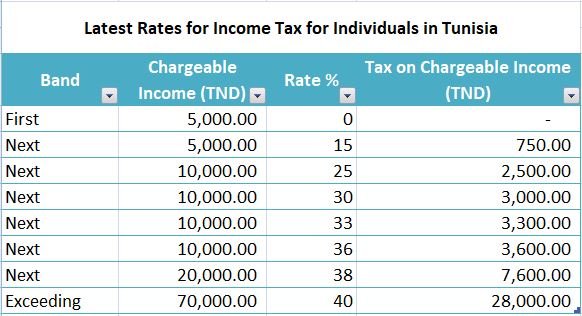
Tunisia introduced revised progressive income tax bands in January 2025. Annual taxable earnings up to TND 5,000 remain exempt from ordinary personal income tax.
Higher income portions attract progressively increasing rates of 15%, 25%, 30%, 33%, 36%, 38%, and 40%. The highest marginal rate applies to taxable earnings exceeding TND 70,000.
Qualifying income from activities benefiting from the reduced 10% corporate tax regime may receive a two-thirds deduction when determining personal taxable income.
Social Solidarity Contributions
Tunisia additionally imposes a social solidarity contribution on income assessed through the progressive personal income tax schedule.
The contribution stands at 0.5% through the 2026 fiscal year, with the general rate scheduled to return to 1% in 2027.
Individuals earning exclusively salaries, pensions, wages, or life annuities with annual net income not exceeding TND 5,000 remain exempt.
Income taxed under separate arrangements, including certain dividends, capital gains, and qualifying remuneration subject to the 20% flat rate, generally falls outside this contribution.
Understanding these distinctions helps taxpayers evaluate obligations and maintain appropriate compliance.
Key Takeaways
Tax Residency Determines Income Tax Obligations
Individuals residing in Tunisia are generally taxed on their worldwide income, while nonresidents are taxed primarily on income earned within the country. Applicable tax treaties may provide relief.
Tunisia Applies Progressive Personal Income Tax Rates
Personal income tax rates range from 0% to 40%, depending on annual taxable earnings. Higher rates apply progressively as income increases, rather than to an individual’s entire income.
Low-Income Earners Benefit From Tax Exemptions
Annual taxable income of up to TND 5,000 is exempt from ordinary personal income tax, reducing the financial burden on individuals with lower earnings.
Employment Income Includes Salaries and Additional Benefits
Taxable employment income extends beyond basic salaries to include allowances and benefits such as accommodation, transportation, company vehicles, meals, and educational support.
Employees Can Reduce Taxable Income Through Deductions
Mandatory Tunisian social security contributions are deductible from employment earnings. Employees may also claim a 10% professional expense deduction, limited to TND 2,000 annually.
Certain Foreign Employees Qualify for Special Tax Treatment
Eligible foreign workers, including qualifying short-term nonresident employees, may benefit from a flat 20% income tax rate on gross remuneration instead of progressive taxation.
Social Solidarity Contributions Increase Certain Tax Liabilities
Tunisia applies an additional social solidarity contribution to income subject to progressive taxation. The reduced 0.5% rate remains applicable through 2026, with a return to 1% scheduled for 2027.
Employers Play a Central Role in Income Tax Compliance
Employers generally calculate and withhold personal income tax from monthly salaries. Accurate payroll calculations and proper treatment of employee benefits help ensure compliance with Tunisian tax regulations.