

In Namibia, a company’s financial year determines when it must make provisional income tax payments, file its annual return and settle any remaining balance. The same timetable applies to close corporations. Withholding tax runs on a separate schedule, and the deadline depends on the type of payment and the event that triggers it.
Corporate Income Tax Returns and Provisional Payments
The first provisional payment is due within six months of the start of the financial year. By then, the company must pay at least 40% of its estimated annual income tax. The second payment is due by the last day of the financial year and must bring total provisional payments to at least 80% of the estimated liability.
The company ordinarily has seven months after year-end to file its annual income tax return and pay any remaining tax. A filing extension of up to five additional months may be available if the company has submitted all prior-year income tax returns. The Namibia Revenue Agency (NamRA) does not accept cheques for tax payments.
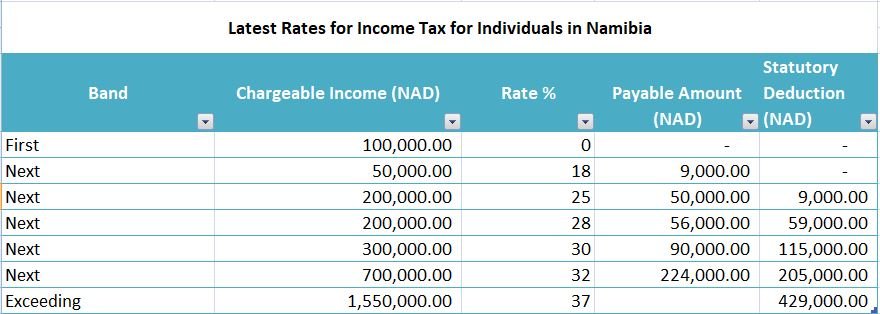
Read Also: Personal Income Tax Rates in Namibia
Worked Tax Calendar for a 31 December Year-End
Suppose a company estimates that it will owe NAD 100,000 in corporate income tax. The table shows how its payments would fall if the estimate stays the same and the final liability matches it.
| Obligation | Ordinary deadline | Amount in this example |
|---|---|---|
| First provisional payment | 30 June | NAD 40,000 |
| Second provisional payment | 31 December | NAD 40,000 more, bringing the total paid to NAD 80,000 |
| Annual return and final payment | 31 July of the following year | NAD 20,000 |
If the estimate rises to NAD 120,000 before the second payment, the company would need to bring its cumulative payments to NAD 96,000. After a first payment of NAD 40,000, that leaves NAD 56,000 due at year-end.
Namibia Withholding Tax Deadlines
For dividends, the 20-day period starts on the declaration date. For royalties, services and interest, the deadline is calculated from the end of the relevant month.
| Payment type | Event that determines the deadline | When payment is due to NamRA |
|---|---|---|
| Dividends | The company declares the dividend | Within 20 days of declaration |
| Royalties and similar payments | The liability to pay arises | Within 20 days after the end of that month |
| Services | The payer deducts or withholds the tax | Within 20 days after the end of that month |
| Interest | The earlier of actual payment and the date interest becomes due and payable | Within 20 days after the end of that month |
If a double taxation agreement reduces withholding tax to zero on a payment to a non-resident, the recommended practice is to submit a nil return showing the amount of treaty relief claimed.
Late Filing, Underpayments and Penalties
A late provisional return can attract a penalty of NAD 100 per day. An underestimate can also trigger a penalty of up to 100% of the resulting shortfall. Late payment of provisional or withholding tax can attract a monthly penalty of 10% and annual interest of 20%, subject to the applicable caps tied to the outstanding tax.
Late annual filing combined with late payment can trigger a one-off penalty of 10%, while late payment can carry annual interest of 20%. Omissions or incorrect statements can attract a penalty of up to 200% and annual interest of 20%.
NamRA’s published deadline for the tax amnesty programme was 31 October 2026. The programme offered eligible taxpayers a full waiver of interest and penalties if they registered, filed outstanding returns electronically and settled the underlying tax within the programme period.
NamRA Audits, Refunds and Objections
NamRA decides which returns to audit, and larger refund claims often receive closer scrutiny. Auditors may verify invoices and check whether the expenses claimed qualify for a deduction. The agency communicates proposed changes in writing. A taxpayer who disputes the outcome may lodge an objection within 90 days.
There is no statutory time limit for claiming a refund of overpaid income tax. Debts owed to the state generally prescribe after 30 years. Other areas of NamRA scrutiny include import VAT, transfer pricing, employee taxes, subsistence and travel allowances, and general compliance.
How Namibia’s Anti-Avoidance Rule Works
Section 95 of the Income Tax Act, 1981 allows NamRA to disregard the tax effects of certain arrangements. The agency must establish that the arrangement avoided or postponed a liability under the Act and that this was its sole or main purpose. It must also show that the parties used an unusual method or created rights or obligations that independent parties would not ordinarily agree to under comparable circumstances.
Board minutes, pricing analyses and negotiation records can help a company explain the commercial reasons behind an unusual transaction and how the parties agreed on its terms.
Frequently Asked Questions
What is the difference between provisional tax and the annual return?
Provisional payments are based on an estimate of the year’s income tax. The annual return reports the final figures and accounts for the provisional payments already made.
How do I calculate the second provisional payment if my estimate changes?
Multiply the revised annual tax estimate by 80% and subtract the amount already paid for the first instalment. The difference is the minimum additional payment needed to reach the year-end threshold.
Can I get a filing extension if earlier returns are outstanding?
The extension is conditional on bringing prior-year income tax returns up to date. Once those returns are filed, the company may qualify for up to five additional months.
What if interest becomes due in one month and is paid in the next?
Use the earlier month, when the interest became due and payable. The withholding tax must reach NamRA within 20 days after the end of that month.
How can a company challenge a NamRA assessment after an audit?
The company may lodge an objection within 90 days. It can use NamRA’s written findings to identify the disputed adjustments and gather records that support its position.