
In finance, risk often comes from the unexpected, but sometimes it can be traced back to something very clear: putting too much in one place. Concentration risk refers to the danger that arises when a bank, financial institution, or investor relies too heavily on a single borrower, industry, geographic region, or even a specific product. The less diversified a portfolio is, the greater the chance that a negative event tied to that concentration will cause significant losses.
This concept matters greatly in banking because lending decisions often cluster around sectors or counterparties. A bank that extends too much credit to one energy company, or focuses a large share of its portfolio in the real estate sector of a single country, could face serious consequences if that borrower defaults or that sector experiences a downturn.
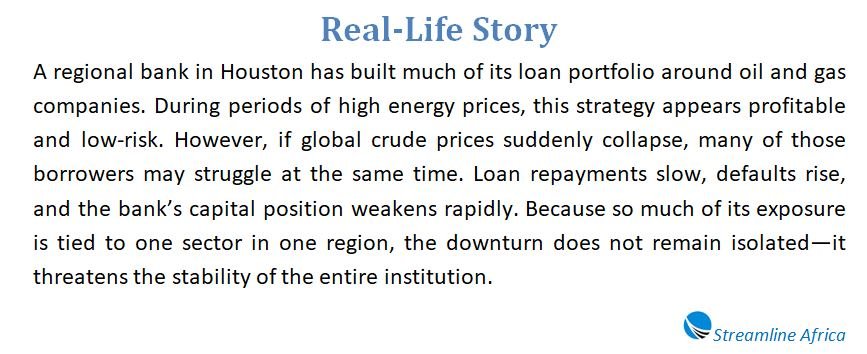
Why Concentration Risk Matters
The key issue with concentration risk is correlation. When many assets or loans are tied to the same factor, their outcomes tend to move in the same direction. If one borrower struggles, chances are others in the same industry or region will face difficulties too. This creates a domino effect that magnifies losses.
Regulators and risk managers pay close attention to this type of exposure because concentrated portfolios undermine the very principle of diversification. A well-diversified portfolio spreads risks across different areas so that one failure does not endanger the entire balance sheet. But concentration risk erodes that safety net, leaving financial institutions more vulnerable to shocks.
Types of Concentration Risk
Concentration risk usually appears in two primary forms:
Name concentration risk arises when a large portion of lending or investment is tied to one specific counterparty. For example, if a bank lends a disproportionate amount of money to a single corporation, that company’s financial health becomes critical to the bank’s stability.
Sectoral concentration risk occurs when exposures are clustered within a particular sector, product, region, or industry. A portfolio heavily invested in housing loans, or loans in one country, becomes exposed to downturns affecting that sector or geography.
Both types carry dangers, but sectoral concentration often catches institutions by surprise, especially during economic cycles when certain industries—such as real estate, technology, or energy—suddenly face unexpected downturns.
Measuring Concentration Risk
Banks and investors rely on specific tools to calculate concentration and assess whether portfolios are overly exposed.
For individual loans, the calculation is straightforward: it is simply the percentage of the portfolio represented by that loan. If one loan makes up 10 percent of a portfolio, it has a concentration ratio of 0.1.
For entire portfolios, more sophisticated measures are used, such as the Herfindahl-Hirschman Index (HHI). This tool considers the distribution of all exposures and indicates whether the portfolio is balanced or skewed toward certain borrowers, industries, or regions.
To illustrate, consider two portfolios each with ten loans. In the first case, all ten loans are of equal size, giving each a 10 percent share of the portfolio. In the second case, one loan represents half of the total portfolio, while the rest make up the other half. The second portfolio is much more concentrated, with a significantly higher concentration ratio.
These calculations are not just mathematical exercises. They help decision-makers recognize when a downturn in a single sector or country could threaten a large portion of their capital.

Managing Concentration Risk
Financial institutions set policies and thresholds to control this risk. These thresholds define how much exposure is acceptable to a particular borrower, industry, or region. Monitoring is done regularly through detailed reporting and risk assessment processes.
Key management practices include:
- Diversifying loans and investments across different sectors and regions.
- Establishing limits on exposure to single counterparties.
- Conducting stress tests to simulate how downturns in specific industries or countries would impact the overall portfolio.
- Ensuring strong oversight by risk committees and regulatory bodies.
When risks are identified, actions such as reducing exposure, requiring additional collateral, or reallocating investments are taken to rebalance portfolios.
Beyond Banking: Other Uses of Concentration Risk
Although the term originates in banking, concentration risk as a concept appears in other fields. In investment management, it helps explain why diversified portfolios often outperform highly concentrated ones over the long run.
Economists use similar measures, such as the Herfindahl-Hirschman Index, to evaluate market concentration and detect monopolistic tendencies in industries. By measuring how much power a few firms hold, regulators can identify whether competition is being undermined.
Interestingly, the concept also crosses into non-financial fields. In epidemiology, for example, economists’ tools like the Lorenz curve are used to analyze how health risks or diseases are concentrated within certain populations. This shows how the principle of concentration—whether in finance or public health—can signal vulnerabilities that require close attention.

Final Thoughts
Concentration risk is a reminder of the old saying, “Don’t put all your eggs in one basket.” In finance, too much reliance on a single borrower, sector, or region can jeopardize stability. Regulators, risk managers, and investors use a combination of calculation tools, thresholds, and diversification strategies to guard against it.
As global markets become more interconnected, managing concentration risk grows even more important. Whether in banking, economics, or even healthcare, the lesson is clear: spreading exposure is often the best defense against unexpected shocks.

FAQs about Concentration Risk
Why is concentration risk a problem for banks?
It reduces diversification, meaning if one borrower defaults or a sector struggles, the impact on the bank’s overall portfolio can be severe.
What are the main types of concentration risk?
There are two main types: name concentration risk, tied to a single borrower, and sectoral concentration risk, linked to industries, regions, or products.
How is concentration risk measured?
It can be measured by a simple ratio for single loans or by indices like the Herfindahl-Hirschman Index to gauge portfolio-wide concentration.
Can you give an example of concentration risk?
A bank heavily invested in real estate loans within one country would face big losses if the housing market there collapsed.

How do banks manage concentration risk?
They set exposure limits, diversify across sectors and regions, use stress tests, and monitor risks through regular reporting and oversight.
Is concentration risk only relevant in banking?
No. It’s also used in investment management, economics to assess monopolies, and even in fields like epidemiology to study health risks.
What is the simplest way to reduce concentration risk?
Diversification—spreading exposure across different borrowers, industries, and regions—remains the most effective strategy.