Operational risk is one of the most significant yet often misunderstood aspects of financial and organizational management. Unlike market or credit risk, which are tied to deliberate investment decisions, operational risk arises from the simple fact that people, processes, and systems are not perfect. From human error and fraud to technological breakdowns and natural disasters, operational risk represents the vulnerabilities embedded within the day-to-day functioning of a business.
What Makes Operational Risk Unique?
Operational risk refers to the possibility of financial loss or disruption caused by inadequate processes, system failures, employee mistakes, or unexpected external events. It is not pursued intentionally, nor does it directly generate profit. Instead, it is a consequence of how organizations operate.
Unlike market or credit risk, which can be managed through hedging or diversification, operational risk cannot be fully eliminated. Every company relies on human decisions, technology, and procedures—all of which are susceptible to flaws. The best an organization can do is to identify, monitor, and minimize these vulnerabilities while staying within its tolerance for risk.

The Evolution of Operational Risk in Financial Regulation
For many years, operational risk was seen as a catch-all category—essentially, any type of risk that wasn’t directly tied to credit or market fluctuations. Under the early Basel I framework, operational risk was defined by exclusion. It wasn’t until Basel II reforms in the early 2000s that operational risk was formally recognized as a category requiring specific oversight and capital requirements.
This shift reflected the growing recognition that operational failures could be just as damaging as poor investments or defaults. From rogue trading scandals to technology-driven market disruptions, operational breakdowns have repeatedly demonstrated their potential to destabilize firms and entire markets. Basel III later refined these requirements, introducing standardized approaches to help banks and regulators calculate the capital needed to withstand such risks.
Real-World Examples of Operational Risk
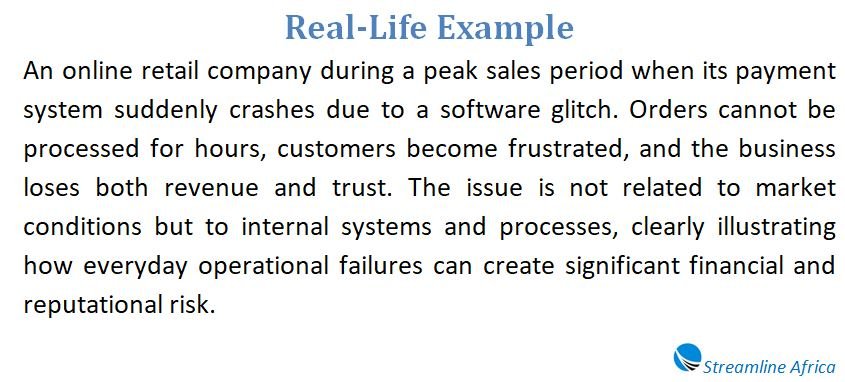
Operational risk manifests in countless ways, some minor and others catastrophic.
- Internal fraud: Employees manipulating financial statements or misusing company resources.
- External fraud: Cyberattacks, data theft, or counterfeit transactions.
- Workplace risks: Lawsuits arising from unsafe working conditions or discriminatory practices.
- Product and client risks: Selling defective products, misrepresenting services, or breaching fiduciary duties.
- Physical damage: Natural disasters, terrorist attacks, or vandalism disrupting business activities.
- System failures: Power outages, server breakdowns, or software glitches halting operations.
- Process errors: Mistakes in data entry, late reporting, or incorrect transaction handling.
Each of these examples illustrates how operational risks do not simply affect the balance sheet—they also shape reputation, customer trust, and overall stability.
Why Operational Risk Cannot Be Ignored
Organizations often underestimate operational risk because it lacks the immediate visibility of market losses. Yet history proves otherwise. The collapse of Barings Bank in 1995 due to unauthorized trading, the massive losses suffered by Société Générale in 2008 from rogue trading, or the ripple effects of the September 11 attacks all show how operational risks can overwhelm even large institutions.
Beyond financial impact, operational failures can erode customer confidence and tarnish a company’s reputation for years. In today’s environment, where globalization and digitalization dominate, the scale and speed of such risks are even greater.
Operational Risk Management as a Discipline
Operational risk management (ORM) is the structured process of identifying, assessing, and mitigating operational risks. It is not about eliminating risk altogether—a near-impossible task—but about reducing the likelihood and severity of losses to acceptable levels.
The process typically involves:
- Risk identification – Mapping out processes and pinpointing vulnerabilities.
- Measurement – Estimating the potential impact of different types of failures.
- Monitoring – Tracking risk indicators and early warning signs.
- Control and mitigation – Putting safeguards in place, such as stronger internal controls or backup systems.
- Reporting – Communicating risk levels to management and regulators.
Unlike some forms of risk management, ORM overlaps with areas such as quality assurance and internal audit, but it has its own specialized focus on operational resilience.
Defining the Boundaries of Operational Risk
The Basel Committee defines operational risk as the risk of loss from inadequate or failed internal processes, people, systems, or external events. Importantly, this definition includes legal risk but excludes strategic and reputational risk.
Strategic risk—losses from poor business decisions—is seen as a separate category. Reputational risk, though often linked to operational failures, is considered a consequence rather than a direct component of operational risk. This distinction helps companies avoid confusing operational breakdowns with broader business strategy issues.
The Role of Vendor Risk
Modern companies often rely heavily on third-party vendors for services, software, or infrastructure. This reliance introduces vendor risk, which is the potential disruption or loss caused by a supplier’s failure.
Examples include a critical supplier going bankrupt, a software provider ending support for a system, or sudden price hikes that make contracts unsustainable. Because businesses rarely operate in isolation, vendor risk has become a central concern in operational risk management.
Why Measuring Operational Risk Is So Challenging
Unlike credit risk, where mathematical models can predict default probabilities, operational risk is more difficult to quantify. It arises from unpredictable human behavior, unique processes, or rare but devastating external events.
Historically, companies treated operational risk as the unavoidable cost of doing business. But with technological tools and regulatory requirements, organizations now attempt to gather data on operational failures—such as fraud or system outages—and use these records to estimate future risks and build financial buffers.
Still, models are imperfect. The 2008 financial crisis underscored the danger of relying on inaccurate assumptions, as valuations built on flawed models collapsed under stress. Operational risk requires not just models, but judgment and adaptability.
Methods for Calculating Operational Risk Capital
Regulators recognize that banks and insurers must hold capital reserves to absorb losses from operational failures. Several approaches exist:
- Basic Indicator Approach (BIA): Capital requirements are calculated as a fixed percentage of annual revenue.
- Standardized Approach (SA): Different percentages are applied to revenue from specific business lines, reflecting varying risk profiles.
- Advanced Measurement Approaches (AMA): Institutions develop their own models based on internal data, scenario analysis, and external benchmarks, subject to regulatory approval.
Each method balances complexity with accuracy, and institutions often choose based on their size, resources, and regulatory expectations.
The New Standardized Measurement Approach
In 2014, the Basel Committee proposed simplifying the calculation of operational risk capital by introducing the Standardized Measurement Approach (SMA). This framework, effective in 2022, replaces earlier models and emphasizes comparability across institutions.
The SMA requires banks to consider their internal loss history over the previous decade. It uses revenue figures and past operational losses to determine the capital requirement, ensuring that larger and riskier firms carry a proportionately higher buffer.
This shift reflects lessons from past crises: the best predictor of future operational risk exposure often lies in analyzing historical failures.
Broader Implications for Organizations
Operational risk extends far beyond banking and insurance. Any organization, from a multinational corporation to a local business, faces similar vulnerabilities. A poorly written contract, a supplier default, or a cybersecurity breach can inflict significant harm.
Moreover, societal changes such as globalization, the rise of social media, and increasing demands for corporate accountability magnify these risks. Negative news spreads faster than ever, and stakeholders demand higher standards of transparency and resilience.
For this reason, operational risk management is not just about regulatory compliance—it is about building trust with customers, investors, and the public.
Conclusion
Operational risk is an unavoidable reality of modern business. It emerges whenever people make decisions, systems are used, or processes guide activity. While it cannot be completely eradicated, it can be understood, managed, and mitigated.
From fraud and system breakdowns to natural disasters and vendor failures, the scope of operational risk is vast. Yet with disciplined management, organizations can minimize surprises, preserve stability, and safeguard their reputation. In an interconnected world where failures can spread quickly, mastering operational risk management has become one of the most essential pillars of organizational resilience.
Frequently Asked Questions
How is operational risk different from credit or market risk?
Credit and market risks are tied to financial decisions and can often be diversified or hedged. Operational risk, however, comes from day-to-day operations and cannot be fully eliminated.
Why is operational risk important for businesses?
Because even strong companies can collapse from operational failures. These risks affect finances, reputation, customer trust, and long-term stability.
What are common examples of operational risk?
Examples include employee fraud, IT system breakdowns, workplace safety violations, product defects, vendor failures, and natural disasters disrupting operations.
How did Basel regulations change the treatment of operational risk?
Basel II and Basel III required banks to formally recognize operational risk, measure it, and hold capital reserves to cover potential losses.
Can operational risk be completely avoided?
No. As long as people, systems, and processes exist, errors and disruptions will happen. The goal is to reduce and control risks, not eliminate them entirely.
What is operational risk management (ORM)?
ORM is the structured process of identifying, assessing, monitoring, and mitigating operational risks to keep losses within acceptable limits.
What role does vendor risk play in operational risk?
Since businesses depend heavily on third-party suppliers, failures or price hikes from vendors can directly disrupt operations and increase exposure.
Why is operational risk hard to measure?
Unlike credit or market risks, which rely on models, operational risk often comes from unpredictable human errors or rare but severe external events.
How do banks calculate capital for operational risk?
They use methods such as the Basic Indicator Approach, Standardized Approach, or Advanced Measurement Approaches. Basel III introduced the Standardized Measurement Approach (SMA) to simplify and standardize calculations.