For many Africans, investing often sounds complicated, risky, or reserved for people with large sums of money. Stocks, real estate, and cryptocurrencies dominate most conversations about wealth building, but there’s a quiet, safe, and accessible investment option that millions overlook—Treasury Bills, also known as T-Bills. These government-backed securities have been around for decades, yet only a fraction of people in Africa actively invest in them.
T-Bills are not flashy, and they won’t turn you into a millionaire overnight. What they can do, however, is protect your money, generate steady returns, and help you build a disciplined saving and investing habit. This guide breaks down what T-Bills are, why they are safe, how much you need to start, and the exact process to follow if you want to purchase them in your country.
What Exactly Are Treasury Bills?
Treasury Bills are short-term loans that individuals, companies, and institutions provide to their government. Think of it as you lending money to your state for a limited period—usually 91 days, 182 days, or 365 days. At the end of that period, the government pays you back the full amount you invested along with some extra money called interest.
Unlike complex financial products, T-Bills are straightforward. You don’t need advanced knowledge of the stock market or global economics to understand them. The government essentially borrows money from its citizens to fund projects, stabilize the economy, or cover budget gaps. In return, it promises to pay back on time with a fixed rate of return.

Why Treasury Bills Are Considered Safe
One of the biggest fears people have when it comes to investing is the possibility of losing money. Stocks can lose value in a day, cryptocurrencies can swing wildly within minutes, and even real estate comes with risks. T-Bills, however, are different because they are backed by the government.
Unless a country completely collapses or defaults, your repayment is guaranteed. This makes them one of the lowest-risk investments available. Here are the reasons they are seen as safe:
- Government guarantee: Unlike private companies, governments have the ability to raise money through taxes and other channels, making them more reliable borrowers.
- No price fluctuations: You don’t have to worry about market ups and downs like you would with stocks. Once you lock in your T-Bill, the return is fixed.
- Short maturity periods: Since most T-Bills mature within a year, you don’t have to wait too long to get your money back. This reduces the uncertainty associated with long-term investments.
How Much Do You Need to Start Investing in T-Bills?
A common misconception is that you need a huge amount of money to buy Treasury Bills. The reality is, governments have made it possible for everyday citizens to participate with relatively small sums.
In Ghana, for instance, you can start with as little as GHS 250. In Nigeria, the starting point is around ₦80,000, although some banks or apps may set higher or lower minimums. Other countries across Africa have their own thresholds, but in most cases, it’s an amount that many working people or even students can afford if they save up.
By keeping the entry point low, governments encourage more people to invest and, in turn, give themselves access to a steady pool of local funding.
Where Can You Buy Treasury Bills?
Buying T-Bills isn’t as complicated as some might think. You don’t need to go through middlemen or brokerage firms if you don’t want to. Instead, most people purchase them through either commercial banks or digital investment platforms approved by the government.
- Commercial Banks: You can simply walk into a branch of your local bank and request to invest in Treasury Bills. Popular banks in Ghana, such as Stanbic Bank and CalBank, assist customers with the process. In Nigeria, platforms like Trove and Chaka allow investors to participate digitally.
- Mobile Apps and Online Platforms: Across Africa, many banks have upgraded to digital platforms that allow customers to invest in T-Bills through their phones. For example, Kenya has the Central Bank’s DhowCSD system, South Africa has ABSA’s banking app, and Zambia offers Zanaco’s Xapit app.
The expansion of digital platforms has made it more convenient than ever to invest without leaving your home.
How the Process Works
If you decide to invest in Treasury Bills, the process is fairly straightforward. Here’s how it usually works:
- Application: You start by filling out a Treasury Bill application form, either at your bank or through a digital platform.
- Choose Amount and Duration: Decide how much money you want to invest and for how long—91 days, 182 days, or 365 days.
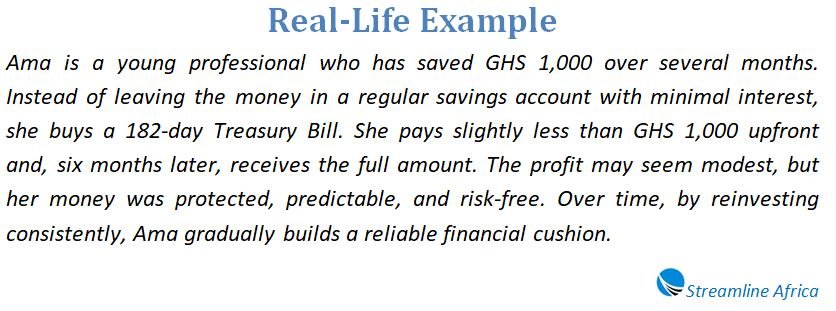
- Payment: Instead of paying the full face value of the bill, you pay a discounted price. For example, if you want a GHS 2,000 T-Bill, you might pay GHS 1900 upfront. At maturity, the government pays you the full GHS 2,000, meaning you earn GHS 100 as profit.
- Maturity: At the end of the holding period, you receive the full value of the bill plus your interest.
This structure makes it clear, predictable, and easy to plan your finances.
Benefits of Investing in T-Bills
The advantages of Treasury Bills go beyond just safety. Here are some of the benefits that make them attractive for ordinary people:
- Capital preservation: Unlike riskier assets, your initial money is safe.
- Steady income: The fixed interest provides predictable returns, making it easier to plan expenses.
- Liquidity: Since T-Bills have short durations, you don’t have to wait for years to access your funds.
- Simplicity: There are no complicated formulas or volatile markets to track.
- Accessibility: With mobile banking apps, more people than ever can participate.
Things to Keep in Mind
While T-Bills are among the safest investments, they are not without limitations. The returns, though steady, are usually lower than what you might earn from riskier investments like stocks or property. Inflation can also eat into your earnings if the interest rate is lower than the rate at which prices are rising.
Another point to remember is that in some countries, you may be taxed on the interest you earn from T-Bills. Always check the tax regulations in your country before investing.
Why More Africans Should Explore T-Bills
Across Africa, many people still prefer to save money under their mattresses, in savings accounts with low interest, or in informal schemes. While these methods may feel safe, they often do little to protect wealth from inflation.
T-Bills, on the other hand, offer a middle ground. They are safer than stocks but yield more than leaving money in a standard savings account. They also provide a structured way for people to grow their money while directly supporting their government’s financial stability.
By embracing T-Bills, Africans can build stronger personal finances while also contributing to national development.
Practical Tips for First-Time Investors
If you’re considering your first T-Bill purchase, here are some tips to make the experience smoother:
- Start small to understand the process before committing larger sums.
- Compare rates offered by different banks or platforms since they may vary slightly.
- Reinvest your matured T-Bills to build long-term savings.
- Track inflation rates in your country so you know whether your returns are keeping up with the cost of living.
- Use digital apps for convenience, but ensure they are government-approved to avoid scams.
Final Thoughts
Treasury Bills may not be the most glamorous form of investment, but their simplicity and safety make them an excellent option for both beginners and cautious investors. They provide peace of mind, guaranteed returns, and an opportunity to participate in national economic development.
Whether you are in Ghana, Nigeria, Kenya, South Africa, Zambia, or any other part of Africa, Treasury Bills are within reach. By starting small, staying consistent, and reinvesting over time, you can build a financial cushion that not only protects your money but also helps it grow.
For too long, many Africans have underestimated this opportunity. The truth is, safe money can be made by simply lending to your government—and Treasury Bills are proof of that.
FAQs about Treasury Bills
Why are T-Bills considered safe?
They are backed by the government, meaning repayment is guaranteed unless the country defaults. They also have fixed returns and short maturity periods.
How much money do I need to start?
In Ghana, you can start with around GHS 250, while in Nigeria, it begins at about ₦80,000. Minimums differ across banks and apps in other African countries.
Where can I buy Treasury Bills?
You can purchase T-Bills at commercial banks or through government-approved mobile and digital platforms such as Stanbic Bank, CalBank, Trove, Chaka, ABSA, and others.
What happens when my T-Bill matures?
At maturity, you receive the full face value of your investment plus interest. For example, if you pay a discounted GHS 950 for a GHS 1,000 T-Bill, you receive the full GHS 1,000 at the end of the term.