

When a business grows beyond a single operation and begins acquiring other companies, its financial story becomes more complex. A single income statement no longer captures the full scope of its activities. Instead, the parent company and its subsidiaries must be viewed as parts of one broader economic unit. That is where consolidated financial statements come in.
Imagine a technology entrepreneur in Nairobi who owns a software firm, a cybersecurity startup, and a cloud storage company. Each business has its own management team, accounting staff, and legal structure. Yet from an investor’s perspective, the entrepreneur controls all three. To understand the real financial strength of the group, their results need to be presented together. Consolidated financial statements make this possible.
What Consolidated Financial Statements Represent
Consolidated financial statements combine the financial results of a parent company and the entities it controls. Instead of presenting three or four separate reports, the group’s assets, liabilities, revenues, expenses, and cash flows are displayed as though the businesses operate as a single organization.
These statements typically include a consolidated balance sheet, consolidated income statement, and consolidated cash flow statement. Together, they show the financial position, profitability, and liquidity of the entire group.
The goal is clarity. Investors, regulators, lenders, and even employees want to understand the full economic footprint of the business, not just one slice of it.

The Core Idea Behind Consolidation
The concept rests on control. When one company has the power to direct the policies and financial decisions of another, accounting standards generally require that their financial information be combined.
Suppose Horizon Manufacturing Ltd. in Accra owns 80% of a packaging company in Kumasi. Even though the packaging company operates separately, Horizon controls its strategic direction. From a financial reporting standpoint, the two are treated as one economic entity.
This approach ensures that users of financial statements see the group’s total obligations, total earnings, and total resources.
The Mechanics of Bringing Numbers Together
Each company within a corporate group prepares its own financial statements first. These are created using standard accounting processes. Once completed, the parent company consolidates them.
Consolidation involves adding together similar items—such as cash balances, inventory, property, revenue, and expenses—while removing internal transactions. For example, if the parent company sold goods to its subsidiary, that sale must be eliminated during consolidation because, from the group’s perspective, it is not an external transaction.
This elimination process is essential. Without it, revenue and profits could be overstated.
The final consolidated reports reflect only transactions between the group and outside parties.
Ownership and the Threshold for Consolidation
Ownership percentage plays a central role in determining whether consolidation is required.
In most cases, if a company owns more than half of another company’s voting shares, the investee is considered a subsidiary and must be consolidated. Control is presumed at 50% or more ownership.
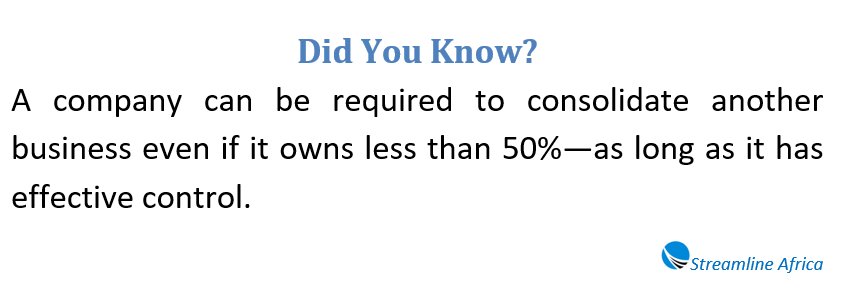
However, control can sometimes exist even below that threshold. For instance, if Riverstone Holdings owns 45% of a renewable energy company but has the contractual authority to appoint the majority of its board members, consolidation may still be necessary. In such cases, influence over key decisions matters more than the ownership percentage alone.
Conversely, if a company holds a small minority interest—say 10%—and has no meaningful influence, consolidation would not apply.
When the Cost and Equity Methods Apply
Not every ownership interest results in consolidation. Accounting standards recognize different levels of influence.
When ownership is minimal, typically below 20%, and there is no significant influence, the cost method is often used. Under this method, the investment is recorded at its purchase price and adjusted only for dividends received or impairment.
When ownership ranges roughly between 20% and 50%, and the investor has significant influence but not full control, the equity method usually applies. Here, the investor recognizes its share of the subsidiary’s profits or losses in its own income statement.
These distinctions prevent overstating control where it does not truly exist.
Deciding Between Consolidated and Separate Reporting
For private companies, the decision to consolidate may be influenced by tax planning, financing needs, or strategic considerations. Some may prepare separate financial statements for internal management purposes but consolidated statements for lenders.
Public companies, on the other hand, face stricter requirements. Once a reporting framework is established, switching from consolidated to separate statements is rarely simple. Changes can raise concerns among investors and auditors, and regulatory approvals may be necessary.
Structural events such as mergers, acquisitions, or spin-offs can also trigger changes in reporting approach.
Regulatory Frameworks and Reporting Standards
Public companies in the United States must follow Generally Accepted Accounting Principles (GAAP), established by the Financial Accounting Standards Board. Internationally, companies often apply International Financial Reporting Standards (IFRS), issued by the International Accounting Standards Board.
Both GAAP and IFRS contain detailed guidance on consolidation. They address control assessments, non-controlling interests, elimination of intercompany transactions, and disclosure requirements.
Consistency is critical. A parent and its subsidiaries must use the same accounting policies to ensure that consolidation produces meaningful results.
Infrastructure and Operational Demands
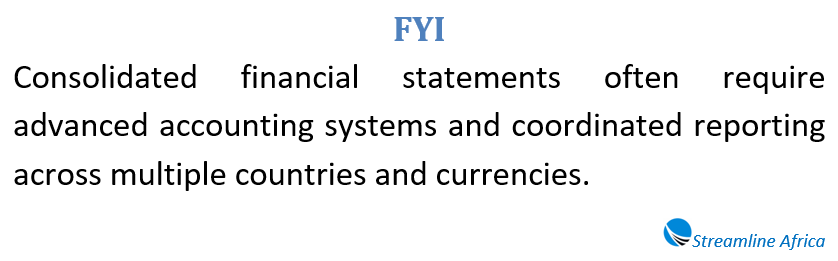
Preparing consolidated statements requires more than simply adding numbers together. It demands robust accounting systems and coordination across entities.
Subsidiaries must report financial data in a consistent format and timeline. Currency translation may be necessary if entities operate in different countries. Internal transactions must be tracked carefully so they can be eliminated accurately.
Large multinational groups often invest heavily in integrated financial reporting systems to manage this complexity. Smaller organizations may rely on specialized accounting teams or external advisors.
Safeguards Against Manipulation
Accounting standards include safeguards to prevent companies from shifting profits or assets between subsidiaries to distort financial results.
For example, a parent company cannot inflate revenue by selling products at artificially high prices to a subsidiary and counting the transaction as external income. Such transactions are eliminated during consolidation.
Similarly, transfers of assets, liabilities, or cash between group entities cannot be used to manipulate tax outcomes unfairly.
These provisions protect the integrity of financial reporting.
Real-World Corporate Illustrations
Large global enterprises provide clear examples of consolidation in action.
Consider Berkshire Hathaway. As a holding company, it owns businesses across insurance, railroads, energy, manufacturing, and retail. Its consolidated financial statements combine results from these diverse operations, presenting them as one economic entity. At the same time, certain investments—such as minority stakes in other publicly traded firms—are accounted for under the equity method rather than full consolidation.
Similarly, The Coca-Cola Company operates through a network of subsidiaries and bottling partners worldwide. Its consolidated reports capture revenues and expenses across continents, reflecting its global scale while eliminating internal transactions within the corporate group.
These examples demonstrate how consolidation provides transparency across complex structures.
Consolidated vs. Separate Financial Statements
A separate financial statement presents only the financial information of a single legal entity. It is useful for understanding the standalone performance of that entity.
A consolidated financial statement, by contrast, merges the parent and its subsidiaries into one unified presentation. It reflects the total assets controlled, total obligations owed, and total income earned by the group.
Investors evaluating the strength of a diversified corporation often rely on consolidated statements to assess overall stability.
Benefits for Stakeholders
Consolidated financial statements offer several advantages.
For investors, they provide a comprehensive view of risk exposure and earning potential. Creditors gain insight into total liabilities and cash flows available to service debt. Regulators can assess compliance more effectively when viewing the entire group structure.
Internally, management benefits from understanding how each subsidiary contributes to overall performance.
In some cases, tax efficiencies may also arise from consolidation, depending on jurisdictional rules.
Situations That May Trigger Reporting Changes
Corporate restructuring can alter consolidation requirements. If a company spins off a subsidiary, that entity may no longer appear in consolidated reports. Conversely, acquiring a controlling stake in a new business requires adding its financials to the group.
These changes must be disclosed clearly so that stakeholders understand shifts in financial presentation.
Transparency during such transitions builds trust.
Non-Controlling Interests
When a parent company owns less than 100% of a subsidiary, the remaining portion belongs to other shareholders. This portion is referred to as a non-controlling interest.
In consolidated statements, the full financial results of the subsidiary are included, but a portion of net income and equity is allocated to the non-controlling shareholders. This ensures fairness and accuracy in reporting.
The Bottom Line
Consolidated financial statements tell the complete financial story of a corporate group. They combine the results of a parent company and its subsidiaries into a unified set of reports that reflect the reality of control and economic integration.
Ownership levels, influence, regulatory standards, and strategic decisions all shape whether consolidation is required. Public companies must adhere to strict accounting frameworks such as GAAP or IFRS, while private companies often weigh tax and operational considerations.
From diversified conglomerates like Berkshire Hathaway to global consumer brands like The Coca-Cola Company, consolidation ensures that investors and regulators see the full scope of operations.
In an increasingly interconnected business world, understanding consolidated financial statements is essential. They move beyond the numbers of individual entities and present the broader economic reality of corporate groups—offering clarity, accountability, and a comprehensive view of financial health.
Consolidated Financial Statements – Frequently Asked Questions
Why Do Companies Prepare Consolidated Financial Statements?
They provide a complete picture of the group’s financial health. Investors, lenders, and regulators can better understand total assets, liabilities, income, and risks across all controlled entities.
When Is a Company Required to Consolidate Another Business?
Generally, consolidation is required when a parent company owns more than 50% of another company’s voting shares or otherwise has control over its financial and operating decisions.
Can Consolidation Happen with Less Than 50% Ownership?
Yes. If the parent company has effective control—such as appointing key management or directing strategic decisions—it may still need to consolidate, even with a lower ownership percentage.
What Is the Difference Between the Cost Method and the Equity Method?
The cost method applies when ownership is small and there is little influence, typically below 20%. The equity method is used when there is significant influence, usually between 20% and 50%, but not full control.
What Financial Statements Are Included in Consolidated Reporting?
A consolidated balance sheet, income statement, and cash flow statement are the core components. Together, they reflect the financial standing and performance of the entire corporate group.
How Are Internal Transactions Treated During Consolidation?
Transactions between the parent and subsidiaries are eliminated. This prevents double counting of revenue, expenses, assets, or liabilities within the group.
What Role Do GAAP and IFRS Play in Consolidation?
Public companies must follow established standards such as GAAP or IFRS. These frameworks provide detailed guidance on determining control, eliminating intercompany transactions, and reporting non-controlling interests.
What Is a Non-Controlling Interest?
If a parent company does not own 100% of a subsidiary, the portion owned by outside shareholders is called a non-controlling interest. It is reported separately within consolidated financial statements.
Why Are Consolidated Statements Important for Investors?
They show the total financial exposure and earning power of the group. Instead of analyzing separate entities individually, investors can evaluate the company as one economic unit.