
In the financial world, the word “default” carries significant weight. It refers to a situation where a borrower fails to meet the obligations tied to a loan or debt instrument. This could happen when a homeowner misses mortgage payments, when a company cannot meet bond obligations, or when a government refuses or is unable to repay its national debt. Defaults are not just numbers on a balance sheet—they affect lenders, investors, and in larger cases, entire economies.
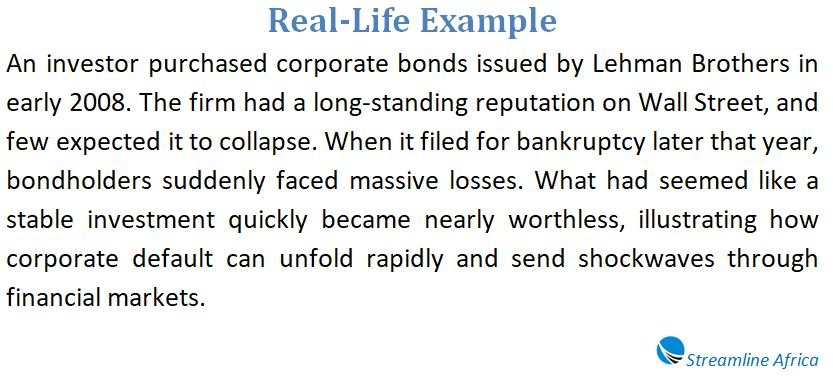
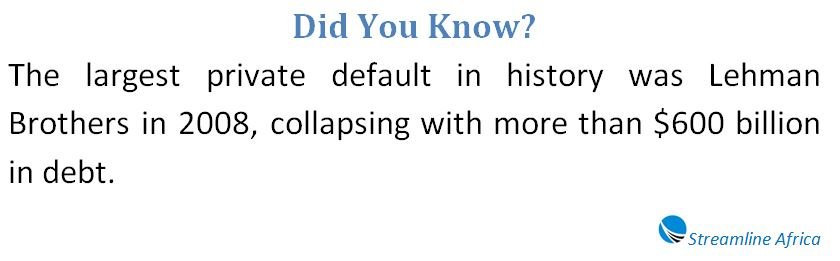
Some defaults are relatively small, involving an individual borrower or a single loan. Others, however, can shake global markets. The collapse of Lehman Brothers in 2008 remains the largest private-sector default in history, totaling more than $600 billion at the time. On the sovereign side, Greece’s failure to honor debt commitments in 2012 became one of the most significant national defaults, with losses estimated at $138 billion. These examples highlight how widespread and damaging a default can be.

Distinguishing Default from Related Concepts
The term “default” is sometimes confused with other financial terms like bankruptcy, insolvency, or illiquidity. While they are related, each has a distinct meaning.
A default occurs the moment a borrower misses a scheduled payment or violates the conditions of a loan contract. Insolvency, on the other hand, is a legal recognition that a borrower cannot meet their financial obligations. Illiquidity is more specific—it means a borrower lacks the immediate cash or liquid assets to pay debts, even if they hold other assets that could eventually cover the balance. Bankruptcy is a formal legal process where a court steps in to manage the affairs of someone who is insolvent or in default.
Understanding these differences is crucial, because default can sometimes be temporary, while insolvency and bankruptcy often represent deeper and more permanent financial problems.
Types of Default
Defaults are not all the same; they are generally divided into two main categories: debt service defaults and technical defaults.
A debt service default is the most straightforward form—when the borrower does not make scheduled principal or interest payments. For example, if a corporation misses a bond payment or a household misses a mortgage deadline, it constitutes a debt service default.
Technical default is less visible but equally important. This occurs when the borrower violates non-payment terms of a loan agreement, known as covenants. These covenants are rules written into contracts to protect lenders. Affirmative covenants require the borrower to maintain specific financial conditions, such as certain liquidity levels or debt coverage ratios. Negative covenants restrict certain activities, like selling core assets or issuing excessive dividends that could compromise repayment ability.
When covenants are broken, even without missed payments, lenders may consider the loan in default. Many contracts also include a “cross-default clause,” which means that if a borrower defaults on one obligation, other debts are automatically considered in default as well. This mechanism is designed to protect creditors but often accelerates financial distress for borrowers.
What Happens After a Default
When a borrower fails to cure a default, lenders usually respond quickly. In the corporate world, creditors may initiate bankruptcy proceedings to reclaim as much as possible. If the loan was secured with collateral, lenders may seize assets to cover their losses. For unsecured loans, creditors often rely on courts to restructure repayment or liquidate the debtor’s assets.
Investors and analysts also rely on financial models to predict and understand default risk. Tools like the Merton Model, Altman’s Z-score, and the Jarrow-Turnbull model are widely used to estimate the probability that a borrower will default, based on balance sheet data, market volatility, and other risk indicators. These models help banks and investors make informed decisions about lending and investing.
Sovereign Defaults
When countries default, the dynamics are very different from corporate or individual cases. Sovereign states cannot simply be dragged into bankruptcy court. Instead, negotiations between the defaulting country and its creditors often determine the outcome. In some cases, loans are restructured—interest rates are reduced, repayment periods are extended, or the overall debt burden is partially forgiven.
History offers many examples. Greece’s financial crisis in the 2010s forced international institutions to step in and restructure its debts. Russia in 1998 defaulted on its domestic bonds but managed to avoid defaulting on external Eurobonds. Argentina in 2002 failed to pay $1 billion owed to the World Bank, isolating itself from global capital markets. These events illustrate how sovereign defaults can shape both domestic economies and international relations.
Orderly Defaults
In some instances, economists argue that it is better to plan and manage a country’s default rather than allow it to spiral out of control. This approach is known as an “orderly default.” The goal is to restructure debt in a controlled way, minimizing damage to lenders, investors, and the broader economy.
Supporters of orderly defaults believe that delaying action only makes crises worse, both for the defaulting nation and for other economies tied to it. Carefully managed restructuring can help nations stabilize faster and reduce contagion risks in global markets. However, orchestrating such processes requires strong cooperation between governments, lenders, and international institutions—something that is not always easy to achieve.
Strategic Default
Not all defaults happen because borrowers lack money. Sometimes, debtors choose not to pay, even though they could. This is called strategic default. It typically occurs in non-recourse loans, where lenders cannot pursue additional claims beyond the collateral tied to the loan.
For example, during the housing crisis in the United States, some homeowners found themselves owing far more on their mortgages than their properties were worth. In these cases, some stopped paying and simply handed the keys back to the bank—a practice sometimes referred to as “jingle mail.”
Governments can also strategically default. In 2008, Ecuador’s president Rafael Correa declared part of the country’s debt “illegitimate” and chose not to repay it, even though the country had the resources to do so. Such actions are controversial, as they damage a nation’s credibility with international lenders, but they also reflect the political dimensions of sovereign debt.
Consumer Defaults
Defaults are not limited to corporations and countries. Individuals also default, often on mortgages, rent, credit cards, or utility bills. Consumer defaults are widespread and can be influenced by a range of social and economic factors.
Research across the European Union has shown that certain groups are more vulnerable. Single households, the unemployed, younger people, and those without strong social networks face higher risks. In some countries, even digital illiteracy increases default rates, as households unable to navigate online systems often miss out on benefits or support programs they are entitled to.
When consumer defaults occur, debt counseling is often the first line of response. Non-legal solutions are generally less disruptive and cheaper than formal bankruptcy. However, if debts remain unmanageable, individuals may enter legal processes for debt settlement or bankruptcy. These procedures vary by country, lasting as little as one year in the UK and up to six years in Germany.
In the United States, research has shown that pre-purchase financial counseling can significantly lower default rates. By helping borrowers understand loan terms and manage household budgets, counseling programs can prevent financial distress before it escalates.
Why Defaults Matter
Defaults matter because they create ripple effects. For individuals, a default can mean loss of a home, damage to credit scores, and limited access to future loans. For corporations, defaults often lead to bankruptcy, layoffs, and reduced investor confidence. For countries, the consequences can be catastrophic—ranging from economic isolation to political instability.
Moreover, defaults undermine trust, which is the foundation of finance. Credit markets rely on the belief that borrowers will repay what they owe. When defaults occur, that trust erodes, making lenders more cautious and increasing borrowing costs for everyone.
Managing Default Risk
Preventing defaults requires proactive management. For lenders, this means carefully evaluating borrowers, monitoring creditworthiness, and using financial models to anticipate problems early. Diversification also helps—spreading exposure across multiple borrowers reduces the risk of catastrophic loss.
For borrowers, avoiding default means maintaining healthy financial practices. Governments must manage budgets responsibly, corporations must keep debt at sustainable levels, and individuals must borrow within their means. Financial education, transparency, and responsible lending are all critical in reducing default rates across the board.
Conclusion
Default is a complex and multifaceted issue in finance. It can be as small as a missed credit card payment or as large as a national debt crisis. While the causes vary—from economic mismanagement to strategic decisions—the effects are always far-reaching. Defaults erode trust, disrupt markets, and create long-lasting economic scars.
At the same time, not all defaults signal the end of the road. With effective counseling, restructuring, and sometimes orderly management, borrowers can recover, and lenders can salvage value. Ultimately, managing default risk is about balance—between borrowing and repayment, risk and reward, short-term pressures and long-term stability. In a globalized world, understanding default is essential for anyone involved in finance, from individual borrowers to international investors.
Default in Finance – FAQs
How is default different from bankruptcy or insolvency?
Default is simply missing a payment or breaking loan terms. Insolvency means being unable to pay debts, while bankruptcy is a legal process that manages insolvency under court supervision.
What are the main types of default?
The two primary types are debt service default, when scheduled payments are missed, and technical default, when loan covenants are broken even if payments are current.
What role do loan covenants play in default?
Covenants are rules in debt agreements. Affirmative covenants require borrowers to maintain certain financial ratios, while negative covenants restrict risky actions like selling key assets. Breaking these can trigger default.
What happens when a corporation defaults?
Creditors may push the company into bankruptcy, seize collateral if loans are secured, or seek legal action to recover value from corporate assets.

Can countries default on their debts?
Yes, sovereign states can default, but unlike companies, they cannot be forced into bankruptcy. Instead, debts are usually restructured through negotiation with creditors.
What is a strategic default?
A strategic default occurs when a borrower chooses not to pay despite having the ability to do so, often because paying is no longer financially beneficial.
Why do consumer defaults happen?
Households may default on rent, mortgages, credit cards, or utilities due to unemployment, low income, or lack of support networks. In many cases, financial counseling can help prevent this.
Why are defaults significant to the economy?
Defaults damage trust between borrowers and lenders, raise borrowing costs, and can trigger broader economic instability—especially when large corporations or governments are involved.