
Receiving a bonus at the end of the year can feel like the ultimate reward for months of dedication and hard work. Whether it’s for hitting performance targets, staying loyal to your company for many years, or simply as a token of appreciation, bonuses are a welcomed financial boost. However, like regular income, bonuses in Ghana are subject to tax. The way these payments are taxed depends on how they relate to your basic annual salary. Understanding the rules ensures that both employers and employees handle bonus payments correctly and avoid any tax surprises.
What Exactly Is a Bonus?
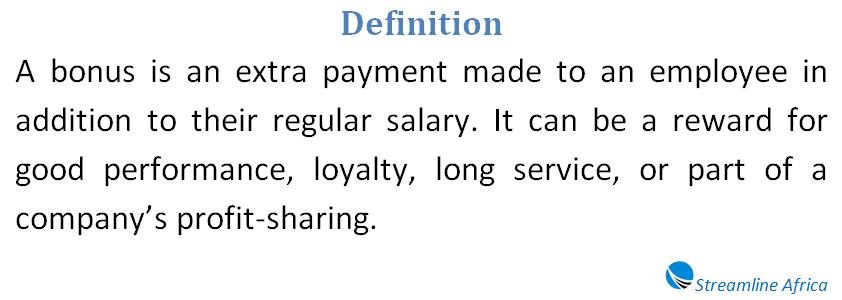
A bonus is an additional payment made to an employee on top of their usual salary. It serves as a financial incentive or a reward for specific achievements. Employers have the freedom to decide the type of bonus they offer and the criteria for awarding it. Some businesses grant bonuses for outstanding individual or team performance, while others give them to recognize long service, loyalty, or to share in the company’s profits.
In Ghana, regardless of the name or reason for the payment, the tax authorities treat all such extra payments as “bonuses” for tax purposes. This uniform treatment simplifies how taxes are calculated and ensures fairness across different types of organizations.

Common Types of Bonuses
Companies in Ghana use various bonus structures depending on their policies and goals. Some of the most common include:
- Performance bonuses, which reward employees who exceed specific targets or deliver exceptional results.
- Long service bonuses, offered to staff who have served the organization for a considerable number of years.
- Monthly or quarterly bonuses, typically tied to regular performance evaluations or sales figures.
- Annual bonuses, often given at the end of the financial year as part of profit-sharing or general rewards.
Each of these bonuses may vary in amount and frequency, but they all follow the same tax rules under Ghanaian law.
How Employers Decide Bonus Amounts
The amount of bonus an employee receives is entirely at the discretion of the employer. There are no legal restrictions on how much a company can pay as a bonus. Some organizations may give modest amounts, while others offer significant sums as part of their compensation strategy. What matters for tax purposes is not the reason behind the payment, but how the amount compares to a specific threshold set by tax regulations.
The 15% Threshold: The Basis for Bonus Tax
The Ghana Revenue Authority (GRA) uses a simple formula to determine how bonuses are taxed. It begins with calculating 15% of the employee’s annual basic salary, referred to as the “15% threshold.” Once this figure is known, the actual bonus payment is compared to it.
- If the bonus is less than or equal to 15% of the annual basic salary, it is taxed at a flat rate of 5%, and this tax is considered final. The bonus amount does not get added to your regular salary for further tax calculations.
- If the bonus is greater than 15% of the annual basic salary, the portion up to the 15% threshold is taxed at 5% (final tax). The excess above that threshold is treated differently: it is added to the employee’s total chargeable income and taxed using the normal graduated personal income tax rates, which range from 0% to 35%.
This two-step system ensures that smaller or moderate bonuses are taxed simply and at a lower rate, while larger bonuses are subjected to the same progressive tax system as regular income.
Why Bonuses Are Not Always Added to Gross Earnings
One common question employees ask is whether their bonuses are added to their gross income for tax purposes. The answer depends on the size of the bonus. If the total bonus falls within the 15% threshold, it is not added to the employee’s gross earnings. Instead, it is taxed separately at the 5% final tax rate. This simplifies payroll calculations and ensures that employees do not face higher taxes because of modest bonuses.
However, if the bonus exceeds the threshold, the excess portion is added to gross income. This amount is then taxed at the standard graduated personal income tax rates applicable to the individual. The initial 15% portion still enjoys the 5% final tax.
How Bonus Tax Is Computed in Practice
Let’s break down how this taxation works step by step:
- Determine the employee’s annual basic salary.
- Calculate 15% of that annual salary to find the threshold.
- Compare the bonus amount to the threshold.
- If the bonus is less than or equal to the threshold:
- Apply a 5% tax to the full bonus amount. This is a final tax, and no further calculations are required.
- If the bonus exceeds the threshold:
- Apply the 5% tax to the threshold portion.
- Add the excess to the employee’s chargeable income and apply the normal tax bands to that portion.
This method ensures transparency and consistency in how bonuses are treated for tax purposes.
Illustrative Example 1: Bonus Within the Threshold
Consider Selorm, who earns an annual basic salary of GHS 24,000. During the year, his employer gives him a bonus of GHS 1,500.
- First, calculate 15% of his annual salary:
15% × GHS 24,000 = GHS 3,600. - Since the GHS 1,500 bonus is below the threshold of GHS 3,600, the entire amount is taxed at 5%:
5% × GHS 1,500 = GHS 75.
This GHS 75 is the final tax on Selorm’s bonus. The GHS 1,500 is not added to his regular earnings when computing his overall tax liability for the year.
Illustrative Example 2: Bonus Above the Threshold
Now take Afia, who earns an annual basic salary of GHS 15,000 and receives a bonus of GHS 7,000.
- First, calculate 15% of her annual salary:
15% × GHS 15,000 = GHS 2,250. - The first GHS 2,250 of her bonus is taxed at 5%:
5% × GHS 2,250 = GHS 112.50. - The remaining GHS 4,750 (GHS 7,000 − GHS 2,250) is added to her chargeable income. This amount is then taxed using the personal income tax bands, which range from 0% to 35% depending on the individual’s total income level.
This example shows how larger bonuses can push employees into higher tax brackets for the excess portion, leading to more tax than the simple 5% applied to smaller bonuses.
Payroll Treatment of Bonuses
From a payroll management perspective, bonuses require careful handling. Employers must accurately separate the portion of the bonus that falls within the 15% threshold and apply the 5% final tax. For any amount above the threshold, payroll teams must add it to the employee’s chargeable income and apply the appropriate graduated tax rates.
Accurate computation ensures compliance with Ghana Revenue Authority regulations and prevents underpayment or overpayment of taxes. Many companies rely on payroll software or outsourced payroll service providers to handle these calculations correctly and issue payslips that clearly show how bonus taxes were applied.
The Importance of Final Tax on Bonuses
The 5% tax applied to bonuses within the threshold is described as a final tax. This means once it has been deducted, the tax obligation on that portion is complete. It does not need to be revisited during annual tax assessments, and it is not subject to additional deductions or refunds. This system simplifies recordkeeping for both employers and employees and ensures clarity in how bonus income is treated.
Implications for Employees
Understanding how bonuses are taxed allows employees to better anticipate their take-home pay. If you know your basic annual salary and the bonus you are likely to receive, you can estimate how much tax will be deducted. For bonuses within the threshold, the calculation is straightforward. For larger bonuses, you may want to consider the impact of the excess being added to your income, especially if it could push you into a higher tax band.
Being informed helps avoid misunderstandings when you receive your payslip and ensures you can plan financially, whether the bonus is intended for savings, investment, or personal spending.
Implications for Employers
For employers, proper handling of bonus taxation is crucial to maintain compliance with tax laws and foster employee trust. Incorrect calculations can lead to penalties from tax authorities or dissatisfaction among staff. Employers should keep clear records, apply the correct tax rates, and communicate openly with employees about how their bonuses are taxed. This transparency builds confidence and ensures smoother payroll operations.
Conclusion
Bonuses are a significant part of employee compensation in many organizations in Ghana. While they provide financial rewards and motivation, they also come with specific tax obligations. The key factor is the 15% threshold of the annual basic salary. Bonuses within this limit are taxed at a simple 5% final rate, while any excess is taxed at the normal personal income tax rates.
Both employees and employers benefit from understanding these rules. Employees can accurately predict their net bonus amounts, and employers can ensure compliance and avoid errors in payroll processing. In short, knowing how bonus taxation works allows everyone to focus on the reward itself, rather than being caught off guard by the tax implications.
Employee Bonus Tax – Frequently Asked Questions
How does the Ghana Revenue Authority determine how bonuses are taxed?
The GRA uses a 15% threshold of the employee’s annual basic salary. Bonus payments are compared to this figure to decide how much is taxed at the special 5% final rate and how much is taxed at regular income tax rates.
What is the 15% threshold?
The 15% threshold is simply 15% of an employee’s annual basic salary. This number determines how much of the bonus is taxed at 5% and whether any part of it should be added to chargeable income for normal tax calculations.
How are bonuses within the 15% threshold taxed?
If the total bonus amount is less than or equal to 15% of your annual basic salary, it is taxed at a flat 5%. This tax is considered final, meaning it won’t be added to your regular income for further taxation.
What happens if the bonus exceeds the 15% threshold?
When a bonus goes beyond the 15% threshold, the portion up to the threshold is taxed at 5% (final tax). The remaining amount is added to your chargeable income and taxed at the normal personal income tax bands, which range from 0% to 35%.
Do all types of bonuses follow the same tax rules?
Yes. Whether it’s a performance bonus, long service bonus, monthly incentive, or an annual reward, they all follow the same tax rules under Ghanaian law.

Are there legal limits on how much bonus an employer can pay?
No. Employers have full discretion to decide how much bonus to give. The law focuses on how these bonuses are taxed, not on setting a limit to the amount.
Is the 5% bonus tax deducted in addition to income tax?
No. The 5% tax on bonuses within the threshold is a final tax. Once it’s deducted, that portion of your income is not taxed again.
Why do employers need to separate threshold and excess amounts on payroll?
Accurate separation ensures the right tax is applied. The threshold portion gets the 5% final tax, while any excess must be added to chargeable income and taxed at normal rates. Mistakes can lead to compliance issues or underpayment of taxes.
How can employees estimate their bonus tax?
By knowing their annual basic salary, they can calculate 15% to find their threshold. Then they apply 5% on any bonus within that figure. Any amount above it will follow normal income tax rates.
What are the implications for employees?
Understanding bonus taxation helps employees anticipate their take-home pay. It also prevents surprises when they receive their payslips and helps with better financial planning.
Why is understanding bonus taxation important for employers?
Employers must ensure they comply with GRA rules to avoid penalties and payroll errors. Properly communicating bonus tax calculations also builds trust and transparency with employees.