
From my perspective, Ghana demonstrates how real estate can become a powerful catalyst for national development when policy ambition, private capital and demographic momentum converge. The country’s property market is not yet as mature as those of long-established global hubs, but its trajectory reveals important lessons about growth, discipline and system design—lessons that resonate far beyond West Africa.
For global real estate leaders, Ghana’s experience is not about copying building styles or marketing narratives. It is about understanding how emerging markets create opportunity when demand is real, timelines are compressed and execution determines success. The United States and other mature markets still command vast capital and institutional depth. However, as regulatory complexity and project timelines expand, investors are increasingly paying attention to markets like Ghana, where the fundamentals are strong and the growth curve remains steep.
Understanding The Differences Between Mature Markets And Ghana
Ghana’s real estate sector has expanded rapidly over the past decade, driven by urbanization, population growth and a rising middle class. Accra, Kumasi and Takoradi have seen consistent demand for residential, commercial and mixed-use developments. According to industry estimates and land registry data, property transactions and development activity in Greater Accra alone have grown steadily year over year, with strong participation from local investors and the Ghanaian diaspora.
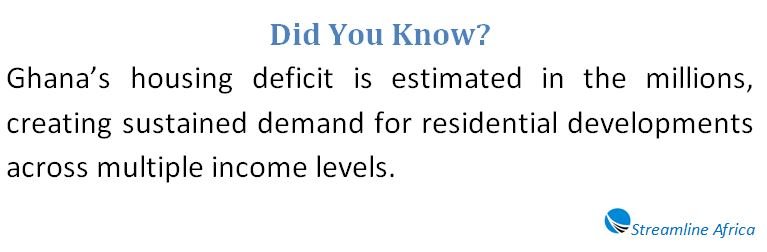
Unlike mature markets where supply often outpaces demand in certain segments, Ghana faces a structural housing deficit. This imbalance creates natural absorption for well-planned projects, particularly in middle-income and upper-middle-income categories. However, it also places pressure on developers to deliver efficiently and responsibly.
Behind the growth figures is a system still in transition. While opportunities are abundant, the market rewards developers who understand local land tenure systems, regulatory processes and financing realities.

Regulation And Land Ownership
One of the defining characteristics of Ghana’s real estate market is its land ownership structure. Land is held under a mix of customary (stool, skin and family land) and state ownership. This framework requires developers to conduct extensive due diligence before acquisition. Clear title verification, proper documentation and engagement with traditional authorities are not optional—they are fundamental to project viability.
In recent years, government agencies such as the Lands Commission have made strides toward digitization and title registration reform. The introduction of digital land records and cadastral mapping aims to reduce disputes and improve transparency. While progress is ongoing, these reforms signal a commitment to improving investor confidence.
In contrast, mature markets benefit from long-established title systems but often face heavy zoning restrictions and layered approvals. Ghana’s challenge is clarity; its advantage is flexibility. When land rights are properly secured, projects can move forward with fewer procedural bottlenecks.
For developers, the lesson is straightforward: accountability starts with land integrity. Projects that fail to resolve land issues early almost always face delays, cost overruns or litigation.
Speed Of Development And Execution
Construction timelines in Ghana can be significantly shorter than in heavily regulated markets—provided developers are prepared. Once land acquisition and permitting are resolved, projects often move quickly due to strong labor availability and less fragmented approval processes.
Private developers who employ standardized designs, phased construction and reliable local contractors frequently complete mid-rise residential projects within 18 to 30 months. Speed is not driven by deregulation, but by necessity. Financing costs, currency exposure and market competition all incentivize timely delivery.
In mature markets, extended permitting, community objections and environmental reviews often push projects well beyond initial schedules. Ghana’s environment, while not without challenges, rewards decisiveness and operational discipline.
For international investors, this highlights an important principle: faster execution reduces exposure to macroeconomic volatility, particularly in emerging markets where currency and inflation risks must be actively managed.
The Luxury And Diaspora Market
Ghana’s luxury real estate segment has grown alongside increased interest from the diaspora and foreign professionals. High-end developments in areas such as Airport, Cantonments and East Legon cater to buyers seeking modern amenities, security and long-term value.
Unlike purely speculative luxury markets, Ghana’s high-end demand is closely tied to lifestyle and return migration. Many buyers view property ownership as both an emotional and financial investment—a connection to home and a hedge against future uncertainty.
Maintenance and service charges tend to be lower than in many Western markets, though quality varies widely by developer. Well-managed developments that prioritize durability, power reliability and water infrastructure command a premium and retain value over time.
For global real estate leaders, Ghana illustrates that luxury is not defined solely by price point. It is defined by reliability, functionality and long-term usability in the local context.
Digitalization And Market Transparency
Digital transformation in Ghana’s real estate sector is accelerating, though unevenly. Online property listings, virtual tours and digital payment systems have become standard for reputable developers. Government-led digitization of land records and permitting processes continues to expand, reducing manual paperwork and improving traceability.
Private platforms are also experimenting with fractional ownership models aimed at diaspora investors who wish to participate without full capital commitment. While these models remain nascent, they reflect a broader trend toward accessibility and innovation.
In mature markets, technology adoption often runs ahead of regulation. In Ghana, regulation and technology are evolving together. This creates an opportunity to build systems that prioritize transparency from the outset rather than retrofitting controls after problems emerge.
Residency, Citizenship And Long-Term Commitment
Ghana offers a unique advantage through its openness to the diaspora and foreign investors. While property ownership alone does not grant residency or citizenship, programs such as the Right of Abode and long-term residence permits create pathways for individuals with Ghanaian heritage or sustained economic engagement.
This approach aligns real estate investment with broader national goals—skills transfer, entrepreneurship and capital inflows. Investors who build, employ and contribute locally are encouraged to establish long-term roots.
In contrast, many mature markets strictly separate immigration policy from real estate ownership. Ghana’s model emphasizes relationship-building over transactional investment, fostering more durable capital commitments.
What Global Real Estate Leaders Can Learn From Ghana
The central lesson from Ghana is not about scale—it is about alignment. When real demand, cultural context and economic necessity intersect, real estate becomes a driver of inclusive growth rather than speculative excess.
Developers operating in Ghana quickly learn the value of thorough due diligence, disciplined execution and community engagement. Investors learn that returns are tied not just to market cycles, but to trust, transparency and local partnership.
At the same time, Ghana can learn from mature markets, particularly in the areas of institutional financing, standardized private credit and large-scale housing delivery. A deeper private capital ecosystem could help bridge the gap between banks and equity, supporting mid-sized developers and expanding access to affordable housing.
For global real estate leaders, Ghana offers a reminder that the future of property development will not be defined solely by established capitals. It will be shaped by markets that combine growth potential with reform momentum. The question is not whether emerging markets like Ghana will attract more attention—but whether investors and developers are prepared to engage with them thoughtfully, responsibly and for the long term.
Most-commonly Asked Questions about the Real Estate Industry in Ghana
What Makes Ghana’s Real Estate Market Attractive To Global Investors?
Ghana’s property market is driven by genuine housing demand, rapid urbanization and strong interest from the diaspora. Unlike saturated markets, well-located developments often experience faster absorption, making execution quality more important than speculative pricing.
How Does Land Ownership Affect Real Estate Development In Ghana?
Land ownership in Ghana combines customary and state systems, which means thorough due diligence is essential. Developers who verify title, engage traditional authorities and secure proper documentation early significantly reduce legal and financial risk.
Why Is Execution Speed So Critical In The Ghanaian Market?
Shorter development timelines help limit exposure to inflation, currency volatility and rising construction costs. Developers who plan efficiently and build in phases are better positioned to protect margins and deliver on schedule.
What Defines Luxury Real Estate In Ghana Compared To Mature Markets?
Luxury in Ghana is less about excess and more about reliability. Buyers prioritize power stability, water access, security and professional property management over purely aesthetic features.
How Is Digitalization Changing Ghana’s Real Estate Sector?
Digital land registration, online property platforms and virtual tours are improving transparency and access. While still evolving, these tools are helping investors—especially those abroad—make more informed decisions.
What Role Does The Ghanaian Diaspora Play In Property Demand?
Diaspora investors drive a large share of mid-to-high-end residential demand. For many, property ownership represents both a financial investment and a long-term connection to home.
What Can Mature Markets Learn From Ghana’s Real Estate Experience?
Ghana highlights the importance of aligning real demand with disciplined execution. In markets where housing shortages exist, speed, trust and local partnerships often matter more than complex financial engineering.