
For decades, Africa has been known for its resource wealth, yet the continent has often struggled to turn its natural reserves into sustainable industrial growth. What is changing now is the arrival of artificial intelligence—an innovation that is reshaping how exploration, production, and operations unfold across the oil and gas value chain. The continent is witnessing a technological leap that is accelerating discoveries, unlocking long-buried reserves, and driving smarter, more efficient energy systems than ever before.
Industry leaders and analysts agree that Africa’s next wave of energy development will not come solely from new wells or expanded offshore fields, but from intelligent tools capable of interpreting geological data with unprecedented speed and accuracy. AI is injecting new life into an industry traditionally constrained by slow exploration cycles, aging infrastructure, and high operating costs. As a result, Africa’s oil and gas landscape is slowly shifting from a frontier of uncertainty to one of calculated opportunity.
Investment Momentum Builds as Africa Becomes the New Exploration Hotspot
The continent’s reputation as a promising but underexplored region has sparked a surge of interest from global energy giants. Forecasts from the Africa Energy Chamber project that industry spending will climb to around $54 billion by 2030—an increase of $11 billion from 2025 predictions. This investment surge reflects growing confidence in Africa’s energy future, particularly as AI-powered tools improve the speed and accuracy of exploration outcomes.
Long-term projections are equally optimistic. According to a Verified Market Research analysis, the continent’s oil and gas sector could climb toward $85.7 billion by 2032, supported by an annual growth rate of 6.8 percent from 2026 onward. As new discoveries reshape the energy map—from Namibia’s promising Orange Basin to Mozambique’s enormous Rovuma gas reserves—international players are positioning themselves early.
Recent deals underscore this momentum. In late 2025, ExxonMobil signed an agreement with Gabon to conduct offshore exploration, reinforcing Central Africa’s strategic importance. Earlier that year, Gazprom expanded its footprint by entering Tanzania’s natural-gas market. Meanwhile, new basins across West Africa’s MSGBC region (Mauritania, Senegal, The Gambia, Guinea-Bissau, and Guinea) have captured attention for their potential to become the next frontier of high-value discoveries.
These moves illustrate a simple truth: companies that once considered Africa a risky gamble are now treating it as a critical pillar of their future portfolios—largely because AI reduces exploration uncertainty.
How AI Is Accelerating Discovery and Improving Geological Accuracy
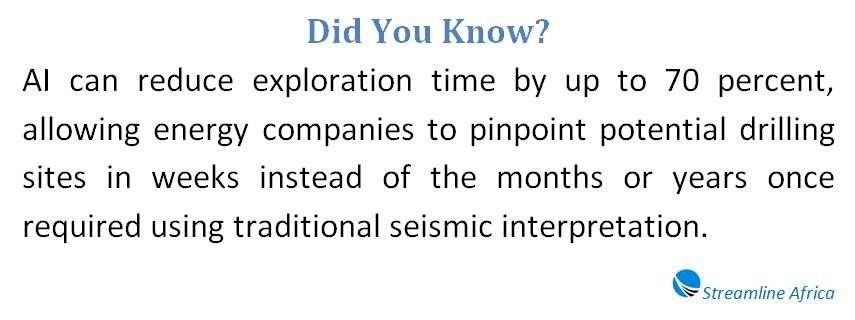
Traditionally, identifying commercially viable oil and gas deposits required years of seismic interpretation, geological modeling, and manual data processing. AI is overturning this model entirely. With its ability to analyze seismic surveys, magnetotelluric readings, drilling logs, and satellite imagery at scale, AI can detect subsurface anomalies faster and with greater precision.
Machine-learning algorithms sift through enormous datasets, identify patterns that humans may miss, and generate probability maps that help companies decide where to drill next. The result is fewer dry wells, lower exploration costs, and faster development timelines.
Industry veteran Bolaji Ogundare emphasizes that AI enhances both upstream and downstream operations. In upstream segments, AI improves reservoir analysis, forecasts potential well performance, and helps operators determine the best extraction techniques. On the downstream side, AI supports real-time demand forecasting, supply-chain optimization, and efficient fuel distribution—areas that have long suffered from logistical inefficiencies in Africa.
Likewise, AI-assisted predictive systems help manage pipelines, refineries, and transport networks more efficiently by identifying potential mechanical failures before they occur. This shift toward predictive maintenance is essential in regions where infrastructure degradation has historically caused costly disruptions.
Reviving Existing Fields Through Intelligent Enhanced Recovery Techniques
AI is not only valuable for new exploration—it is also revitalizing aging fields once deemed uneconomic. Enhanced oil recovery (EOR) techniques have been around for decades, but AI is elevating their effectiveness by optimizing injection schedules, monitoring reservoir pressure, and adjusting fluid mixes in real time.
On Angola’s coastline, AI-driven EOR systems are currently helping maximize output from mature wells. By coordinating smart water, gas, and chemical injections, operators are achieving higher recovery rates while reducing overall waste. What was once considered costly, trial-and-error experimentation is now a precise, data-driven process.
This renewed attention to older infrastructure is drawing fresh waves of capital back into fields that companies had nearly abandoned. Investors are recognizing that with AI support, mature fields still hold considerable value—especially in a market where global demand for transitional fuels such as natural gas remains strong.
AI Transforms Daily Operations Through Data-Driven Decision-Making
One of the least glamorous but most transformative outcomes of AI adoption is the overhaul of back-office and operational processes. Oil and gas firms produce massive amounts of data—from drilling measurements to financial transactions—and human teams have long struggled to process this information efficiently.
Dylan Lamb from AICA Data notes that the industry’s data volume is expanding far more rapidly than human capacity to evaluate it. AI systems, however, not only process enormous datasets but also extract insights that improve planning, reduce downtime, and extend equipment lifespan. This operational intelligence can significantly reduce overhead costs, making African projects more attractive to investors.
From automated risk assessments to AI-driven inventory management, data intelligence is creating leaner, more responsive oil and gas enterprises. Digital twins—virtual replicas of physical assets—are becoming more common as well, enabling operators to test scenarios and anticipate failures without halting operations.
AI’s Expanding Role Across the Broader Energy Landscape
Although AI’s impact on oil and gas has been dramatic, its influence spans the full energy ecosystem. Smart-grid technologies are improving electricity distribution in urban centers, machine-learning algorithms are helping expand renewable energy storage, and AI-powered Internet of Things (IoT) solutions are improving energy efficiency in industrial and commercial environments.
AI is also supporting the rise of electric mobility across African cities. Predictive models help optimize charging networks, forecast energy demand, and reduce grid congestion. These advancements signal a broader transformation: Africa is no longer simply a supplier of raw fossil fuels but is evolving into a more technologically sophisticated energy producer.
However, these advancements are not without challenges. Ogundare points out that sustained funding for energy development remains a major bottleneck. Many African governments face budget constraints, while private investors frequently seek short-term returns. Addressing these financing gaps will be essential for AI-driven modernization to reach its full potential.
Understanding the Continent’s Vast Undiscovered Resources
A major reason Africa remains such a focal point in global energy discussions is its staggering volume of undiscovered resources. A 2024 geological analysis by Dou and colleagues estimates that nearly 39 percent of the continent’s oil resources and almost 49 percent of its gas resources have yet to be found. These numbers highlight how much potential remains untapped—particularly when compared to Africa’s modest 9.3 percent share of known global reserves.
Improved technology is making it easier than ever to locate and extract these resources. Regions once considered technically challenging or economically unviable are now within reach thanks to precise subsurface mapping and intelligent drilling techniques. Emerging markets such as Namibia and Senegal are already demonstrating how quickly new discoveries can scale when paired with the right digital tools.
A Future Where Africa Helps Power the World’s Digital Infrastructure
As AI technologies expand globally, the energy demand from data centers is skyrocketing. These facilities require vast amounts of electricity—often measured in gigawatts—to power servers, cooling systems, and high-performance computing operations. Africa, with its abundant potential in both conventional and renewable energy, is well-positioned to supply this future demand.
Hydropower corridors across Central Africa, solar hubs in the Sahel, geothermal potential in East Africa, and natural gas reserves throughout the continent collectively create an energy ecosystem that could support a global digital economy. If managed strategically, Africa could not only fuel its internal growth but also become a significant player in powering the next generation of AI-driven industries worldwide.
The Road Ahead: A More Intelligent, More Competitive African Energy Sector
The integration of AI into Africa’s oil and gas sector is still unfolding, but the impact is already unmistakable. Faster discoveries, lower production costs, improved operational efficiency, and extended field lifespans are setting the stage for a more competitive industry. For African nations seeking economic diversification and sustainable development, this technological shift offers a rare chance to leapfrog traditional barriers.
As long as funding continues and policy frameworks evolve to support innovation, Africa could transition from being a follower in global energy markets to a leader in smart exploration and resource development. The continent’s vast untapped reserves, combined with modern digital tools, mark the beginning of a transformative era—one where intelligent systems drive progress, and Africa’s energy potential finally meets its promise.
FAQs About Africa’s AI-Driven Oil and Gas Revolution
How is AI improving oil and gas exploration in Africa?
AI helps geologists and operators interpret seismic data, satellite imagery, and drilling logs with far greater speed and accuracy compared to manual methods. This reduces the number of unsuccessful wells, cuts exploration costs, and accelerates the timeline from discovery to production.
Why is Africa attracting more investment from global energy companies?
Africa still holds vast untapped oil and gas reserves, and new basins continue to show strong potential. With AI reducing exploration risks and improving productivity, international companies now view African markets as more competitive and less volatile than before.

Which countries are leading AI adoption in oil and gas on the continent?
Countries like Angola, Nigeria, Namibia, Mozambique, and Senegal are at the forefront. They are leveraging AI for exploration, enhanced recovery, and infrastructure optimization. Emerging exploration hotspots such as Gabon and Tanzania are also seeing increased technological investments.
What role does AI play in optimizing existing oil fields?
AI-driven enhanced recovery systems monitor reservoir behavior, adjust injection techniques, and predict equipment failures. This revitalizes aging fields, extends their productive lifespan, and increases output without requiring new drilling campaigns.
How is AI impacting downstream operations?
AI forecasts fuel demand, manages distribution logistics, improves inventory accuracy, and identifies supply-chain inefficiencies. This is particularly important in Africa, where downstream bottlenecks have historically limited profitability.
Are there challenges slowing the adoption of AI in Africa’s energy industry?
Yes. Major barriers include inconsistent funding, limited digital infrastructure in certain regions, a shortage of specialized technical skills, and regulatory frameworks that have not fully adapted to emerging technologies.
What is the significance of Africa’s undiscovered oil and gas resources?
Research indicates that nearly half of the continent’s natural gas and more than a third of its oil deposits remain undiscovered. This means AI-driven exploration could dramatically increase Africa’s share of global energy reserves over the next decade.
How is AI influencing renewable energy development in Africa?
AI improves renewable storage, streamlines electricity distribution, enhances solar and wind forecasting, and supports the growth of smart grids. This strengthens Africa’s broader energy transition and reduces over-reliance on fossil fuels.
Can Africa’s energy sector support global AI data-center demand?
Yes. With the rise of renewable investments and abundant natural gas reserves, Africa is well positioned to supply the high energy demand of global data centers and AI-driven industries in the coming years.
Why is the integration of AI considered a game-changer for Africa’s oil and gas future?
AI increases accuracy, reduces risk, enhances operational efficiency, and lowers overall extraction and processing costs. Combined with Africa’s vast yet underexploited reserves, this positions the continent for unprecedented energy-driven growth.