

As the world becomes increasingly interconnected, the flow of money, labor, and business activity across borders has grown dramatically. This shift has made it more important than ever to understand how income earned abroad and income earned domestically by foreign entities affect a nation’s economic story. Net foreign factor income (NFFI) is a key concept that helps explain this dynamic. It highlights the difference between what a country’s citizens and firms earn outside its borders and what foreign individuals and companies earn within the country. This measure is central to distinguishing gross domestic product (GDP) from gross national product (GNP), two widely used economic indicators that offer different perspectives on national output.
What Net Foreign Factor Income Means
NFFI is essentially a balancing figure that adjusts GDP to reflect the income earned by a nation’s own people and organizations globally. While GDP captures the value of everything produced within a country’s borders, GNP focuses on who actually earns the income, regardless of where production occurs. The difference between these two measures—GNP minus GDP—is what economists refer to as net foreign factor income.
In simple terms, NFFI reflects the net flow of income across a nation’s borders. If a country’s citizens and businesses receive more income from abroad than foreign entities earn domestically, NFFI will be positive. But if more income flows out to foreign owners than comes in from overseas assets and labor, NFFI becomes negative.
Understanding the Relationship Between GDP and GNP
GDP is the most commonly referenced measure of economic output. It includes all goods and services produced within a country, whether the producer is a local business or an international corporation. It tells us how active the economy is from a territorial standpoint. GNP, however, tells a different story by focusing on ownership rather than geographic location. It captures the income generated by a nation’s residents and firms even if they earn that money abroad.
To illustrate, consider a multinational corporation headquartered in France with manufacturing plants in Kenya. The production in Kenya contributes to Kenya’s GDP, but the income that flows back to the French company and its shareholders contributes to France’s GNP. This difference—between where money is generated and who ultimately earns it—is at the core of NFFI.
In many countries, the difference between GDP and GNP is relatively small because the income flowing in and out tends to balance. But in certain economies, particularly smaller nations that attract large foreign investments or host significant foreign operations, NFFI can dramatically shift the interpretation of economic performance.
Why NFFI Matters for Smaller or Investment-Heavy Economies
For major economies with large global footprints, citizens and businesses often earn significant income abroad, balancing out the earnings of foreign companies operating domestically. But smaller nations or countries with heavy foreign investment may experience sizable gaps between GDP and GNP.
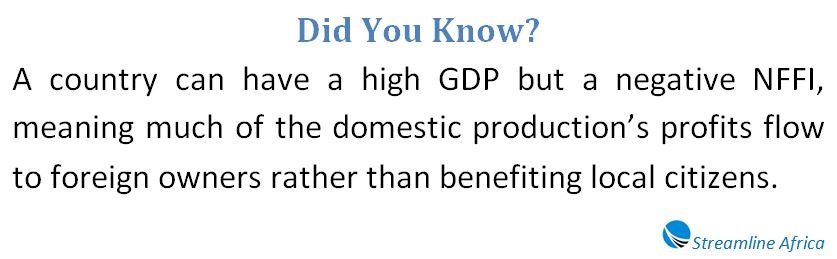
If much of the domestic economic activity is controlled by foreign firms, a country may show strong GDP numbers, giving the impression of a thriving economy. However, if foreign owners are sending most of their profits back to their home countries, GNP—which reflects the earnings retained by local citizens—can be much lower. In these cases, NFFI becomes a crucial factor because it reveals how much income actually remains within the national economy.
This distinction helps policymakers avoid misleading conclusions when comparing GDP and GNP. A booming GDP doesn’t always mean citizens are benefiting proportionally, especially when foreign ownership plays a major role.
Shifting Measures of Economic Output
Historically, many nations used GNP as the primary gauge of economic performance. But in the late 20th century, GDP became the dominant measure, particularly after the United States officially shifted to GDP as its main indicator. The transition happened because GDP aligns more closely with other major economic statistics and allows easier comparisons between countries, most of which had already adopted GDP.
Despite the widespread use of GDP, economists have long debated its limitations. Critics note that GDP includes economic activity that may not enhance quality of life and ignores unpaid labor, such as caregiving and volunteer work. Another limitation is that GDP counts income earned within a country even if that income eventually leaves due to foreign ownership. This is where NFFI helps provide a clearer picture.
Economic Well-Being Beyond GDP and GNP
Some economists argue that neither GDP nor GNP fully captures a population’s well-being. GDP focuses solely on production within borders, while GNP shifts the lens to citizens’ earnings but still misses crucial social, environmental, and household factors. In countries where foreign companies repatriate large portions of their profits, GDP can overstate how much income actually benefits local people.
A sizable negative NFFI indicates that a country’s GDP is inflated by foreign operations and that much of the value created domestically is ultimately earned by outsiders. In such cases, GNP provides a more realistic sense of residents’ economic conditions.
This issue has become more prominent as globalization accelerates. People relocate for work, companies expand across continents, and investments flow freely through international markets. These shifts mean that income is no longer tied tightly to geographic borders, making NFFI more important in interpreting economic indicators accurately.
The Growing Relevance of Cross-Border Income
Modern economies are interlinked through trade, mobility, and investment. As a result, the income earned abroad by a nation’s residents and the income generated domestically by foreign entities play an increasingly large role in national accounts. The ease with which companies expand into foreign markets and workers migrate to seek opportunities makes NFFI a valuable indicator.
For instance, countries with large diasporas often receive significant remittances, boosting income flowing in from abroad. Meanwhile, nations hosting multinational corporations may see large profits flowing outward. In both cases, NFFI shapes how we interpret economic well-being, allowing deeper insights beyond standard GDP figures.
NFFI and the Challenge of Measuring Prosperity
As debates continue over the best ways to measure a nation’s progress, NFFI serves as an important reminder that economic indicators must account for cross-border income flows. A country with a high GDP but heavily negative NFFI may appear wealthier on paper than it truly is for its residents. Conversely, a nation with substantial outward investment may enjoy higher income levels even if its GDP is modest.
Ultimately, NFFI enriches the conversation about national output, providing context that allows economists and policymakers to interpret GDP and GNP more responsibly. It highlights the complexity of global economic relationships and reinforces the need for multiple measures when evaluating a country’s economic health.
Conclusion
Net foreign factor income sits at the intersection of national production and global income flows. By examining the difference between GDP and GNP, NFFI helps reveal how much income truly belongs to a country’s residents. Its relevance continues to grow in a world where economic borders are increasingly porous. Understanding NFFI enables a clearer picture of who benefits from economic activity, especially in nations with substantial foreign investment or widespread international operations.
Frequently Asked Questions
How Does NFFI Relate to GDP and GNP?
NFFI is the balancing figure that converts GDP into GNP. When you add NFFI to GDP, you get GNP, which reflects income earned by a nation’s residents regardless of location.
Why Can NFFI Be Positive or Negative?
NFFI becomes positive when residents earn more abroad than foreign firms earn locally, and negative when more income flows out to foreign owners than comes in.
Why Is NFFI Important for Interpreting Economic Health?
It reveals whether the income generated in a country stays with its people or flows out, helping policymakers avoid misleading conclusions based solely on GDP.
How Does Foreign Investment Affect NFFI?
High foreign investment can raise GDP but lower GNP if foreign companies send large profits back home, creating a negative NFFI.
Why Do Smaller Economies Pay Close Attention to NFFI?
Smaller or investment-heavy countries often rely heavily on foreign firms, so NFFI helps show how much income actually benefits local citizens.
Why Did GDP Become More Popular Than GNP?
GDP became the global standard because it aligns with other economic statistics and allows easier comparison across countries.
What Does NFFI Reveal That GDP Alone Cannot?
GDP shows production within borders, but NFFI helps reveal whether residents are genuinely benefiting from that production.
How Does Globalization Affect NFFI?
As companies expand internationally and workers migrate, income increasingly crosses borders, making NFFI essential for accurate economic interpretation.
How Do Remittances Influence NFFI?
Countries with large diasporas often receive significant income from abroad, which can boost NFFI and improve residents’ overall income levels.
What Does a Negative NFFI Mean for a Country?
A negative NFFI means foreign entities earn more domestically than locals earn abroad, suggesting that part of the economy’s output is leaving the country.
Why Is NFFI Important for Measuring Prosperity?
It helps identify how much national income truly belongs to residents, offering a clearer picture of economic well-being beyond GDP and GNP figures.