
Taxes on imported goods have been around for centuries, shaping how nations trade and protect their economies. Today, these taxes are known as import duties, sometimes referred to as customs duties, tariffs, or import taxes. They play a crucial role in international trade, affecting businesses, governments, and everyday consumers. Understanding how import duties function provides insight into global commerce and how countries balance free trade with economic protection.
What Exactly Is an Import Duty?
An import duty is a tax that a government imposes on goods brought into its borders. The rate depends on the type and value of the product. Depending on the laws of a country, the tax may also account for shipping and insurance costs. These duties serve as a barrier to imports, ensuring that foreign products do not overwhelm local markets without contributing to government revenue.
Different nations may use varying terminology. While some refer to it as a tariff, others use “import tax” or “customs duty.” Regardless of the name, the purpose remains consistent: raise revenue, regulate trade, and protect domestic industries.
Why Governments Impose Import Duties
Import duties aren’t just about collecting taxes; they often reflect broader economic and political goals. Governments typically levy these charges for three primary reasons.
First, they generate revenue. For many developing nations, customs duties make up a significant share of government income, funding infrastructure, education, and healthcare.
Second, they protect domestic industries. By taxing imports, governments make foreign goods more expensive compared to local alternatives. This protection gives local producers a better chance to grow and compete.
Finally, import duties can be used as a political tool. A country may impose high tariffs on products from another nation to signal disapproval or to retaliate against unfair trade practices. This form of economic pressure can influence diplomatic relations.
Import Duties in the United States
In the U.S., Congress determines import duties through laws, and the U.S. International Trade Commission maintains the Harmonized Tariff Schedule (HTS). This detailed list specifies duty rates for thousands of products. The amount owed depends on how the product is classified and the origin country.
The U.S. applies different rates based on trade relationships. Goods from countries with normal trade relations generally face standard rates, while products from nations without such agreements may face significantly higher duties. In addition, special trade programs may grant preferential rates to developing countries, encouraging global trade cooperation.
The Role of International Organizations
Trade is rarely just about two countries. International organizations and agreements often shape how import duties are applied worldwide. The World Trade Organization (WTO), for instance, exists to facilitate smoother trade and reduce excessive tariffs. Its members agree to negotiate tariff reductions, and once these commitments are made, they become binding.
Regional agreements also reshape tariff structures. One well-known example was the North American Free Trade Agreement (NAFTA), which created a duty-free zone for most goods traded among the United States, Canada, and Mexico. In 2020, it was replaced by the United States–Mexico–Canada Agreement (USMCA), which updated trade rules while preserving most tariff-free benefits.
By lowering duties through such agreements, countries encourage free trade and economic integration, making goods cheaper and supply chains more efficient.

Essential Paperwork for Paying Import Duties
When goods arrive at a border, customs authorities require documentation before duties can be calculated. The most important paperwork includes:
- Commercial invoice – A detailed record of the transaction, including the price, terms of sale, and product descriptions.
- Bill of lading or airway bill – A shipping receipt that confirms who sent the goods, who is receiving them, and how they are being transported.
- Packing list – A breakdown of quantities, sizes, and weights, which customs officers compare with physical shipments.
- Certificate of origin – Proof of where the goods were manufactured, which may influence the duty rate depending on trade agreements.
- Permits or licenses – For regulated products such as food, pharmaceuticals, or weapons, additional permissions may be required.
These documents ensure transparency and help customs authorities apply the correct duty while preventing fraud.
How Import Duties Are Calculated
The calculation of an import duty is not as simple as applying a flat tax. It usually depends on several factors:
- The declared value of the goods (including cost, insurance, and freight).
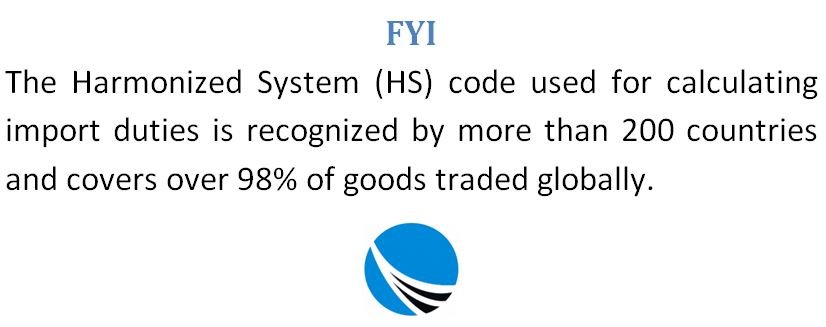
- The product’s classification under the Harmonized System (HS) code.
- The country of origin and whether trade agreements apply.
For example, imagine a U.S. company importing electronics worth $50,000 from China. If the tariff rate for that category is 5%, the duty would be $2,500. However, if the same electronics came from a country with a free trade agreement, the duty might be much lower—or even zero.
This system ensures fairness but also allows governments to adjust duty rates based on strategic priorities.
Exemptions and Reductions
While import duties are widespread, not all goods are taxed equally. Many countries grant exemptions or reduced rates under specific conditions.
Free trade agreements are the most common way to lower duties. For example, under the USMCA, numerous products move freely across North American borders without extra charges.
Duty-free quotas are another approach. Governments may allow a fixed quantity of certain products to enter without duties, after which normal rates apply. This method balances the benefits of cheaper imports with protection for domestic industries.
Temporary imports also enjoy exemptions. Goods brought in for exhibitions, repairs, or demonstrations can often enter duty-free, provided they are re-exported within a set period.
Import Duty vs. Export Duty
While import duties apply to incoming goods, export duties target goods leaving a country. Each has unique economic implications.
Import duties raise the cost of foreign goods, protecting domestic producers and generating government revenue. However, they can also increase prices for consumers and businesses that rely on imported inputs.
Export duties, on the other hand, discourage the outflow of critical resources. A government might impose them to keep essential raw materials available for local industries, such as minerals or agricultural products. By doing so, the country ensures that domestic manufacturers have a steady supply for production.
In short, import duties aim to control what enters a country, while export duties focus on what leaves it.
Real-World Applications
Different territories within the United States illustrate how import duty rules can vary.
- Guam charges no duties but imposes fees and local taxes, such as a 4% use tax.
- Puerto Rico treats U.S. shipments as domestic, meaning no duties apply, but state sales tax is enforced.
- U.S. Virgin Islands exempt goods from U.S. origins but apply excise taxes, particularly on items like alcohol and tobacco.
These examples show that duty policies can differ even within the same country, depending on local law.
Example: Alcohol Import Rules
Alcohol provides a clear example of how duty-free allowances work. Returning U.S. residents who are at least 21 can bring back one liter of alcohol without paying duties, provided it’s for personal use. Bringing in larger amounts is possible, but anything beyond the exemption is taxed.
In some cases, state laws impose additional limits, and customs officers may require permits if the quantities suggest resale rather than personal consumption. This demonstrates how import duty enforcement often goes hand-in-hand with local regulations.
Who Pays Import Duties?
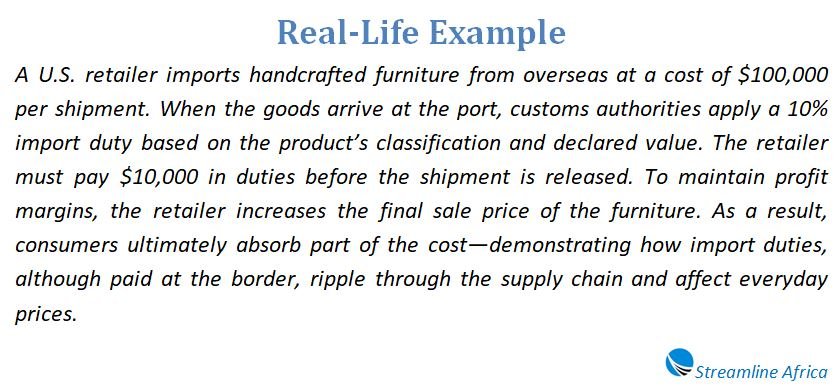
The responsibility for paying duties usually falls on the importer of record—the person or business receiving the goods. The sales agreement determines whether the seller or buyer bears the cost, with terms like Delivered Duty Paid (DDP) or Delivered Duty Unpaid (DDU) clarifying the arrangement.
Ultimately, while importers pay the duty upfront, the cost often gets passed down the supply chain, eventually reaching consumers through higher retail prices.
Import Duties and Broader Taxes
Import duties differ from other taxes, though they sometimes overlap. For instance, after paying duties at customs, imported goods may also face value-added tax (VAT), sales tax, or excise duties within the domestic market. This layered system ensures that both imported and locally produced items contribute to government revenue.
The Bigger Picture
Import duties are more than just financial obligations at the border. They reflect a nation’s approach to trade, balancing the need for government revenue with protection of domestic industries and diplomatic considerations. While free trade advocates argue for reduced tariffs to encourage global commerce, governments often rely on duties as tools of economic policy.
In practice, import duties shape the price of everything from groceries to electronics. They determine the competitiveness of domestic industries, influence global supply chains, and even play a role in international relations.
Final Thoughts
Import duties may seem like technical details buried in trade law, but they affect daily life in significant ways. Every time a consumer buys an imported product—whether it’s a bottle of wine, a pair of sneakers, or a new smartphone—the price includes a hidden layer shaped by tariffs and taxes.
For businesses, understanding import duties is critical to managing costs and staying competitive. For governments, these taxes represent both a source of revenue and a tool for guiding economic policy. And for consumers, they are a reminder that global trade always carries a price, often in the form of customs duty.
FAQs about Import Duties
Why do governments impose import duties?
Governments use them to generate income, safeguard local businesses from foreign competition, and occasionally as a political tool in trade disputes.
Who is responsible for paying import duties?
Usually, the importer of record—whether a business or individual—pays the duty. Depending on the sales agreement, this cost may be passed on to the consumer.
How are import duties calculated?
They are typically based on the product’s value, which includes the cost of goods, shipping, and insurance. Classification under the Harmonized System (HS) code also determines the rate.
Can import duties be reduced or waived?
Yes, through free trade agreements, duty-free quotas, or exemptions for temporary imports, governments can lower or eliminate duties on certain goods.
How do import duties differ from export duties?
Import duties apply to goods entering a country, while export duties are charged on goods leaving it. Each affects trade differently, either by protecting local markets or controlling resource outflows.
What documents are required for paying import duties?
Key documents include a commercial invoice, bill of lading or airway bill, packing list, certificate of origin, and any permits for restricted goods.
How do international organizations influence import duties?
Groups like the World Trade Organization (WTO) and regional agreements such as the USMCA encourage countries to lower tariffs and create fairer trade systems.
Do import duties affect everyday consumers?
Yes. Even though businesses pay the duties upfront, the added costs are often included in the final retail price of imported goods.
What is an example of duty-free allowances?
In the U.S., travelers over 21 can bring back one liter of alcohol for personal use without paying duties. Anything beyond that is subject to customs charges.